
Breeze Acquisition Corp. II: SPAC Economics, Execution Risk, and the Search for a Value-Accretive Deal
With over $130 million in cash and no operating revenues, Breeze Acquisition Corp. II sits at a critical juncture: the success or failure of its future business combination will define its long-term value. The company’s capital structure and early-stage status shape both its upside potential and its exposure to the challenges endemic to the SPAC model.
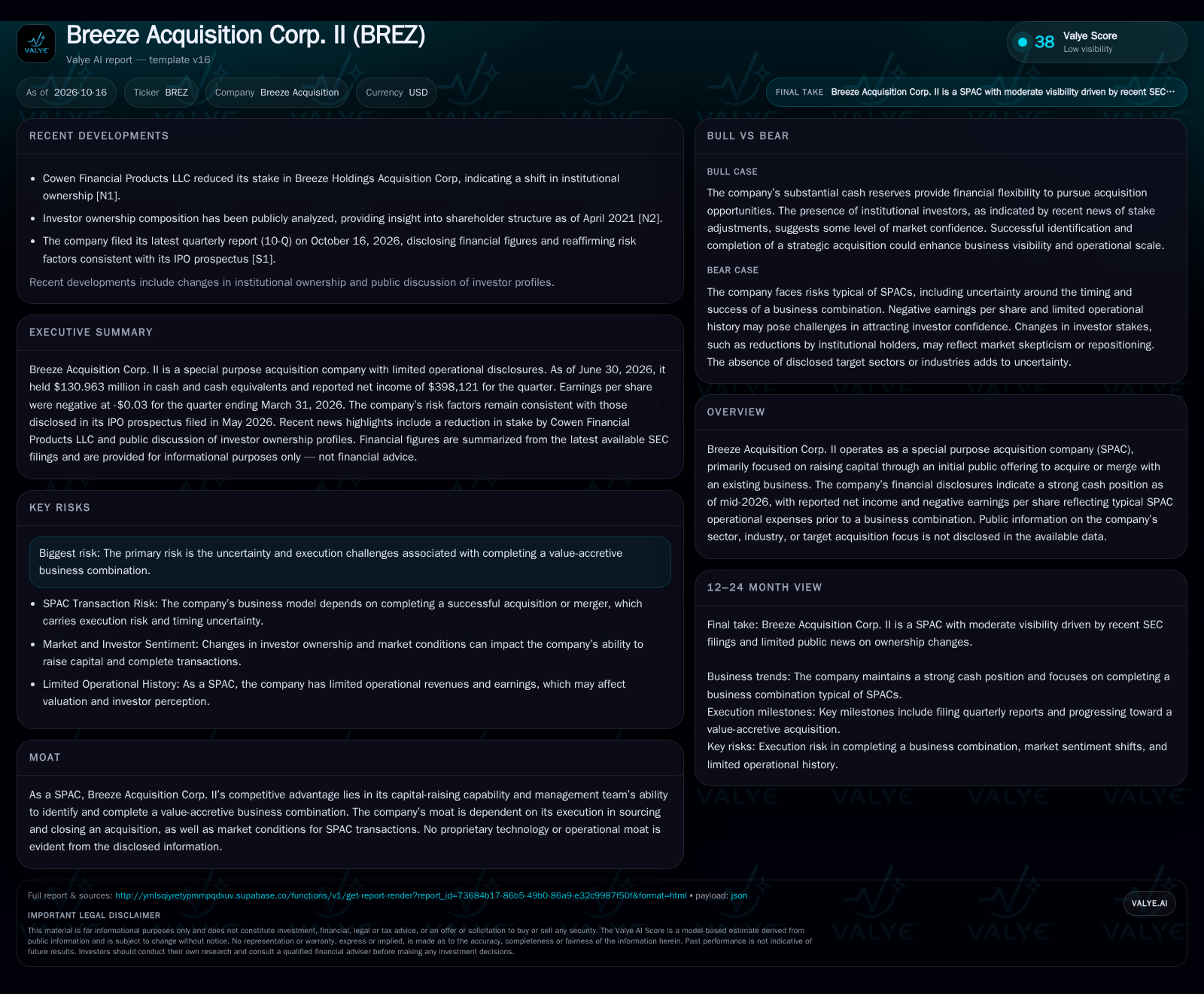
Breeze Acquisition Corp. II is a newly public SPAC with $130.963 million in cash and no operating revenues as of June 30, 2026. Its financial performance to date reflects typical pre-acquisition SPAC economics—interest income offsetting organizational and compliance costs. The company's future now hinges entirely on sourcing and executing a value-creating merger or acquisition, with material risks related to timing, deal quality, and changes in investor sentiment. Institutional ownership shifts, such as Cowen Financial Products LLC reducing its stake, underscore the market's sensitivity to SPAC execution and uncertainty. [S1] [N1]
Breeze Acquisition Corp. II exemplifies the classic blank-check company: flush with cash and awaiting its defining business combination, yet generating no operating revenue and incurring organizational expenses. The company’s recent IPO and subsequent financial disclosures reveal a reported cash position and a clean cap table, but also underline the binary nature of the SPAC model—where future value creation depends entirely on sourcing, negotiating, and consummating a compelling acquisition. With institutional investors already adjusting their positions and no target yet identified, Breeze’s next moves will be decisive in shaping its long-term trajectory. [S1] [N1]
Breeze’s Cash Position and Pre-Acquisition Status Define Its Present Reality
As of June 30, 2026, Breeze Acquisition Corp. II reported $130.963 million in cash and cash equivalents and total current assets of $523.311 million, according to its latest 10-Q filing. These figures are the direct result of its IPO and associated private placement, which together placed over $140 million in a trust account dedicated to funding a future acquisition or merger. The company’s net income of $398,121 for the quarter ending June 30, 2026, was driven by interest income and fluctuations in the fair value of over-allotment liabilities, not by any operating business activity. Breeze remains in the pre-acquisition phase: it has not selected a target nor initiated substantive discussions with any business, and it expects no operating revenues until after a business combination is completed. [S1]
Recent changes in institutional ownership, notably Cowen Financial Products LLC reducing its stake, further highlight the market’s focus on execution and SPAC-specific uncertainties. These ownership shifts signal that investor sentiment is closely tied to the company’s ability to identify and close a value-accretive transaction. [N1]
How SPAC Economics Shape Breeze’s Operating Model and Value Creation
Breeze Acquisition Corp. II operates as a special purpose acquisition company, meaning its current economics are dominated by cash management and the costs of maintaining a public shell. Until a business combination is completed, the company’s revenues are limited to interest income generated by its trust account, while expenses consist of organizational, legal, financial reporting, and due diligence costs. This structure results in modest net income or losses, with earnings per share reflecting non-operating activities rather than business performance.
The SPAC model is capital-efficient in its early stages—most funds are preserved for acquisition rather than ongoing operations. However, significant value dilution can occur at the combination stage, especially if redemptions are high or if the sponsor’s promote absorbs a material share of post-merger equity. The economics of the eventual deal will depend on the terms negotiated, the industry and growth profile of the target, and market conditions at the time of merger. If Breeze can secure a target with strong growth potential and negotiate favorable terms, operating leverage could be substantial post-combination. Conversely, weak deal structure or overpayment may erode shareholder value.
SPAC Competition, Market Sentiment, and the Challenge of Differentiation
Breeze operates in a crowded SPAC landscape, where a glut of blank-check companies compete for a finite pool of attractive targets. Its primary competitive advantage lies in its cash reserves and the potential credibility of its sponsor team. However, with no disclosed sector focus or target pipeline, Breeze has limited differentiation relative to peers at this stage.
The broader SPAC market has faced headwinds since 2021, including increased regulatory scrutiny, investor wariness about deal quality, and a shift from speculative enthusiasm to more cautious capital allocation. Competing SPACs with established sponsor reputations, sector expertise, or proprietary deal flow may be better positioned to secure high-quality targets. Traditional IPOs, direct listings, and private equity exits also compete for the same acquisition candidates, making the deal environment more challenging.
What a Successful Acquisition Could Unlock for Breeze Shareholders
The most favorable scenario for Breeze is the identification and completion of a business combination with a fast-growing, scalable target at a compelling valuation. Should the management team leverage its capital pool to secure a differentiated business in an attractive sector—such as technology, healthcare, or sustainability—shareholder value could be unlocked through post-merger growth, public market access, and multiple expansion.
Confirmation of this scenario would come from public announcements of a definitive agreement with a high-quality target, positive market reaction to deal terms, and limited shareholder redemptions at the time of the merger vote. Further evidence would include the target’s strong historical growth, credible management, and robust forward projections. Conversely, a lack of progress toward a deal, high redemption rates, or tepid market response would challenge the upside thesis.
The Most Plausible Outcome: Protracted Search, Execution Risk, and Market Sensitivity
Given the crowded SPAC market and the absence of a disclosed acquisition pipeline, the most likely scenario is a prolonged search for a suitable target, punctuated by incremental news or rumors but no immediate transaction. Breeze will continue to incur operating and compliance costs, with interest income partially offsetting these expenses. Market sentiment and share price will remain volatile, driven by speculation about potential targets and broader trends in SPAC deal-making.
Confirmation of this outcome would involve multiple quarters with no deal announcement, continued adjustments to the shareholder base, and financials that reflect ongoing administrative costs without any material revenue generation. The thesis would be challenged by a sudden definitive agreement or by the company failing to secure a deal within the typical SPAC deadline, potentially triggering liquidation.
Deal Failure, Liquidation, and the Erosion of SPAC Value
The principal risk facing Breeze is the failure to consummate a business combination within the required timeframe, leading to the return of trust capital to shareholders and the loss of any upside optionality. High redemption rates, poor deal quality, or an inability to secure a target could force the company toward liquidation, resulting in minimal returns for sponsors and limited upside for common shareholders.
Evidence supporting this scenario would include repeated extensions of the SPAC’s life, lack of substantive deal announcements, rising investor redemptions, and declining market sentiment. A definitive liquidation announcement or regulatory barriers to closing a deal would confirm the downside thesis.
Milestones and Metrics to Scrutinize as Breeze Pursues Its First Transaction
Disclosure of a definitive agreement with a business combination target, including sector, valuation, and deal structure.
Quarterly updates on trust account balance and any material changes to available cash or current assets. [S1]
Levels of shareholder redemptions if a merger is proposed, as high redemptions can erode deal economics.
Changes in sponsor or institutional ownership, especially further reductions or new strategic investors. [N1]
SEC filings or press releases outlining extensions to the SPAC’s deadline or amendments to trust protections, if disclosed.
Progress toward regulatory approvals or any announced regulatory scrutiny of a proposed deal, if disclosed.
Updates on the management team’s communications regarding target industry focus or acquisition strategy, if disclosed.
Market reaction and trading volume following any major announcement, which could signal investor confidence or concern.
Disclaimer: This is research-only, informational analysis and not investment advice. It may include AI-generated interpretation and general industry context. Always verify important details using primary sources.

Comments