
Leopard Energy: Royalty Acquisition Ambitions Confront Structural Constraints in U.S. Oil
Leopard Energy, now controlled by Zenith Energy, has exited mobile apps to focus on U.S.
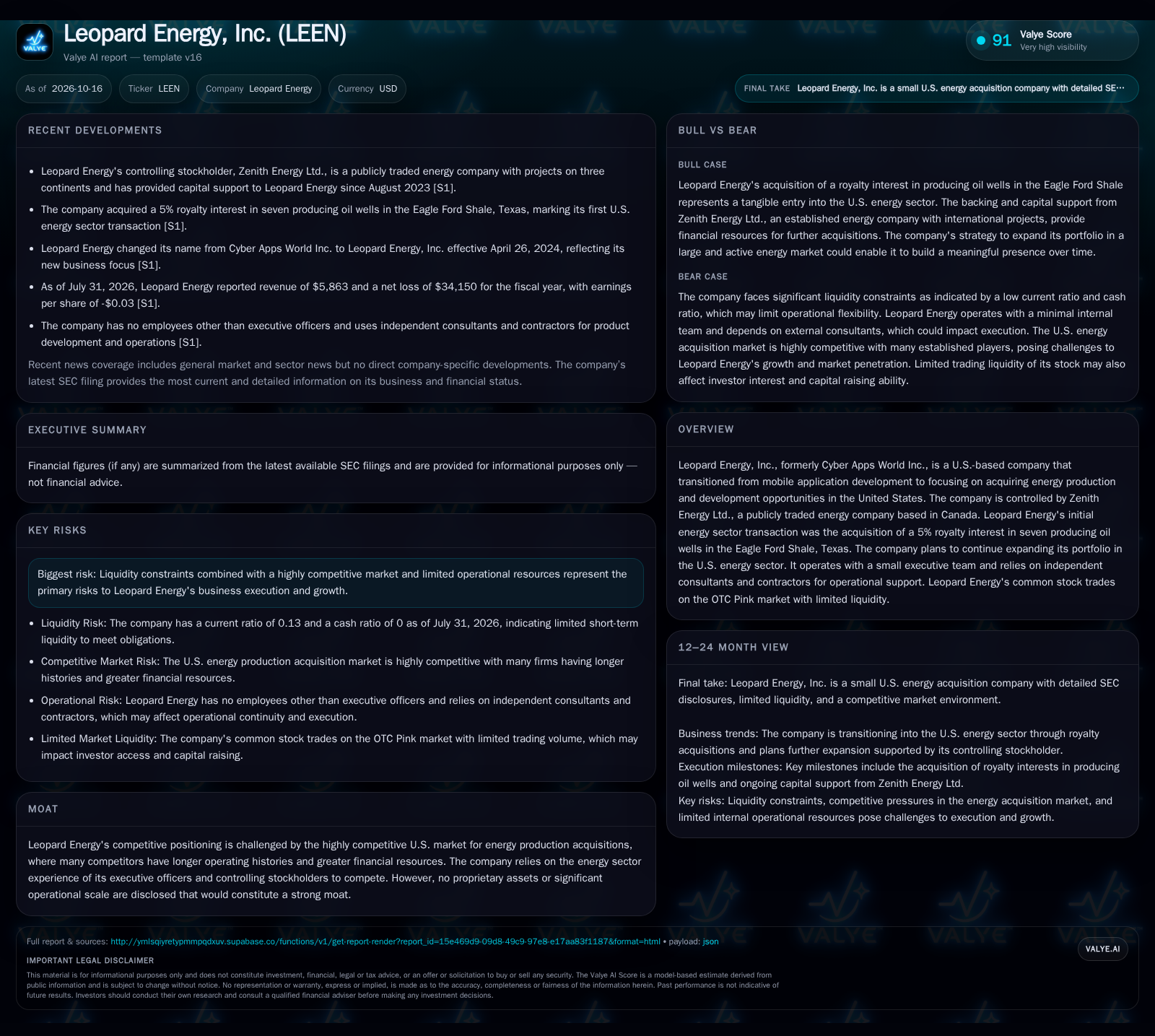
Leopard Energy, now controlled by Zenith Energy, has exited mobile apps to focus on U.S. oil and gas royalties, acquiring a 5% stake in seven Eagle Ford Shale wells. Despite access to a supportive parent, the company’s minimal cash, outsized current liabilities, and reliance on contractors highlight execution risks. Success depends on sourcing further attractive royalty deals, improving operational scale, and navigating a crowded field dominated by larger, better-capitalized rivals. [S1]
Leopard Energy, Inc. has engineered a dramatic transformation, shifting from a dormant mobile app developer to an aspiring acquirer of U.S. oil and gas royalties. With Zenith Energy now in control and providing essential capital, Leopard’s initial step—a modest royalty stake in producing Eagle Ford wells—signals intent but also exposes structural weaknesses. The company’s next moves will test both its access to deals and its ability to convert parent backing into sustainable U.S. energy sector presence.
Leopard Energy’s Royalty Debut and Capital Structure: What Has Actually Changed?
Leopard Energy’s most consequential recent development is its January 2024 acquisition of a 5% royalty interest in seven producing oil wells in the Eagle Ford Shale, Texas. This marks the company’s first tangible step into the U.S. energy sector, transitioning from its prior identity as Cyber Apps World Inc. [S1]. The change was catalyzed by Zenith Energy’s August 2023 purchase of 99.87% voting control, alongside direct capital support totaling approximately $466,000 in cash and capital payments since the takeover [S1].
Despite this backing, operational metrics underscore severe constraints: as of July 31, 2026, Leopard reported only $5,863 in annual revenue and a net loss of $34,150. The balance sheet is particularly thin, with just $17,620 in current assets against $136,598 in current liabilities, resulting in a current ratio of 0.13 and no available cash [S1]. These facts frame a company at the earliest stage of its new strategy, reliant on external sponsorship and facing an urgent need to scale revenue and liquidity.
Royalty Model Economics: High-Margin Potential Meets Capital Access Friction
Leopard Energy’s current business model centers on acquiring royalty interests in producing oil assets—a structure that, if executed at scale, can generate predictable, high-margin cash flows with minimal operating overhead. Royalties provide a percentage of gross production revenue, typically insulated from direct operating costs and capital expenditures incurred by the operator. This model offers attractive economics if the company can assemble a diversified portfolio of producing assets at reasonable valuations.
However, the company’s execution is capital-intensive: acquiring royalty interests requires upfront cash outlays, and the earnings power of small royalty stakes is inherently limited absent substantial deal flow. The company is thus structurally dependent on ongoing capital infusions from Zenith Energy or external investors. The reliance on independent consultants and contractors instead of an internal acquisition team may keep fixed costs low, but it also limits internal deal sourcing capabilities and could raise per-transaction costs if deal volume increases.
Operating leverage is theoretically high: incremental royalty acquisitions should add revenue with minimal incremental corporate overhead. But the company’s current scale is far below the threshold where such leverage would meaningfully improve margins or net income.
Can a Microcap Entrant Compete in U.S. Oil and Gas Royalties?
The U.S. market for oil and gas royalty acquisitions is crowded, with established royalty trusts, private equity-backed aggregators, and institutional investors all competing for producing interests—particularly in prolific basins like the Eagle Ford. Competitors often have deeper relationships with operators, superior access to deal flow, and lower costs of capital. Leopard Energy faces the dual challenge of sourcing attractive opportunities and avoiding overpaying in a seller’s market.
Zenith Energy’s controlling stake provides some credibility and potential sourcing advantages, given its international energy experience. However, Leopard lacks proprietary technology, operational scale, or unique access to off-market deals. The company’s reliance on external consultants may accelerate initial deal execution but does not confer a lasting moat. Switching costs for operators selling royalty interests are low, and the market is highly transactional. Furthermore, the company’s OTC Pink listing and limited trading liquidity could deter institutional partners or sellers seeking counterparties with robust balance sheets and public market presence.
Without a differentiated sourcing engine, cost advantage, or exclusive relationships, Leopard’s competitive position is fragile and highly sensitive to capital availability and the willingness of Zenith Energy to continue funding growth.
How Aggressive Capital Deployment and Parent Leverage Could Build a Scalable Royalty Platform
A constructive scenario for Leopard Energy would involve sustained capital support from Zenith Energy, enabling the company to acquire a series of small but cash-flowing royalty interests in producing wells across multiple U.S. basins. If Zenith leverages its broader network to source off-market or distressed deals, Leopard could assemble a portfolio that achieves meaningful scale and diversification, boosting both revenue and margin profile.
Evidence that would confirm this path includes a visible acceleration in royalty acquisitions, rising revenues from additional producing assets, and disclosures of larger or more diversified portfolio holdings. A move to secure debt or equity funding beyond Zenith’s support would also indicate growing market confidence. The scenario would be falsified if Zenith withdraws capital support, if deal flow remains limited to one-off transactions, or if disclosed revenues fail to keep pace with acquisition announcements.
Incremental Royalty Growth Under Capital and Execution Constraints
The most plausible near-term outcome is incremental growth—Leopard Energy may add one or two small royalty interests per year, contingent on Zenith’s willingness to continue modest capital infusions. Revenue growth would track new acquisitions but remain modest absent a step-change in deal sourcing or funding.
Confirmation would come from periodic acquisition disclosures, gradual revenue increases, and continued small-scale capital contributions from Zenith. The scenario would be challenged if liquidity metrics deteriorate further, if no new royalty deals are completed, or if operational costs rise due to increased reliance on consultants without corresponding revenue expansion.
Liquidity Squeeze and Deal Drought Could Stall the U.S. Energy Ambition
On the downside, Leopard Energy’s acute liquidity constraints, minimal recurring revenue, and lack of cash could force it to pause or halt new acquisitions. If Zenith Energy reduces or ceases capital support, the company would be unable to compete for royalty interests, leading to stagnation or even forced asset sales. Operational risks could compound if key consultants disengage or if administrative costs outpace limited royalty receipts.
Confirmation of this scenario would include further deterioration of current ratio metrics, absence of new acquisition announcements, declining revenue, or disclosures of payment delays or creditor actions. A protracted period of inactivity or a strategic review citing funding challenges would further support the downside thesis.
Milestones That Will Determine If Leopard Energy’s Royalty Strategy Gains Traction
Frequency and scale of new royalty interest acquisitions—disclosures of additional deals or expansion into new basins would indicate progress.
Quarterly revenue growth attributable to royalty payments—if disclosed, this would show whether the portfolio is building sufficient cash flow.
Ongoing capital contributions or credit facilities from Zenith Energy or third parties—watch for filings or announcements confirming continued funding.
Shifts in operational structure—such as hiring internal staff or acquiring proprietary sourcing capabilities, which would signal an evolution beyond pure contractor reliance.
Announcements of partnerships with operators or other royalty aggregators—evidence of improved access to deal flow.
Trading volume and share price behavior on the OTC Pink market—while not directly tied to operations, increased liquidity could ease future capital raises.
Disclosure of any legal or regulatory proceedings related to acquisitions or royalty entitlements, which could create unexpected friction.
Disclaimer: This is research-only, informational analysis and not investment advice. It may include AI-generated interpretation and general industry context. Always verify important details using primary sources.

Comments