
Noble Romans Inc: Franchise Model Dynamics in Regional Pizza Growth
Noble Romans Inc operates a hybrid model of company-owned and franchised pizza restaurants, reporting modest profitability and reported liquidity position as of mid-2026. The company’s ability to drive sustainable growth will depend on managing commodity exposure, leveraging its franchise system, and navigating the capital constraints that often define smaller restaurant operators.
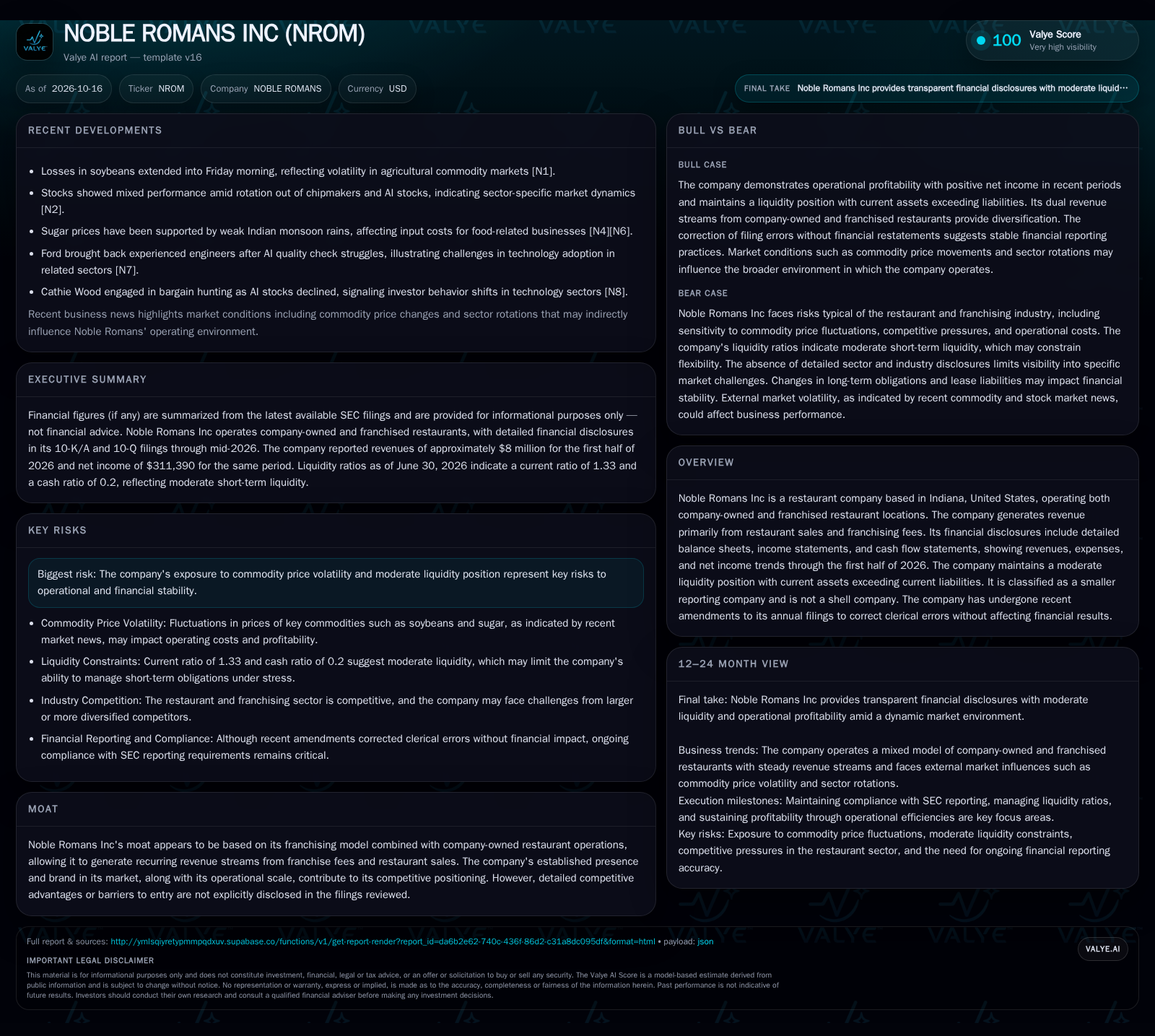
Noble Romans Inc reported $8.03 million in revenue and $311,390 in net income for the first half of 2026, with a current ratio of 1.33 and a cash ratio of 0.2 as of June 30, 2026. The company’s business model blends company-owned and franchised restaurants, creating both recurring franchise fees and direct restaurant sales. The success of its franchise-driven strategy will hinge on its ability to scale without overextending capital or compromising brand standards. [S2]
With $8.03 million in revenue and just over $311,000 in net income for the first half of 2026, the company’s hybrid model of franchised and company-owned locations provides operational diversification but also exposes it to the sector’s perennial risks—commodity cost swings, tight capital, and limited public-market visibility. The question is whether Noble Romans can leverage its franchise system to achieve durable growth without stretching its financial resources too thin or losing brand cohesion along the way. [S2]
Recent Results Reflect Moderate Profitability and a Prudent Liquidity Stance
For the six months ended June 30, 2026, Noble Romans Inc reported total revenue of $8.03 million and net income of $311,390, with $4.12 million of revenue and $190,620 in net income attributable to the most recent quarter. These results reflect operational profitability, but margins remain thin—a reality underscored by the company’s current ratio of 1.33 and cash ratio of 0.2 as of June 30, 2026. Current assets of $3.63 million and current liabilities of $2.73 million leave a modest buffer for working capital needs. Total assets of $15.59 million, offset by $11.78 million in total liabilities, reinforce the company’s levered but not overstretched balance sheet. [S2]
Noble Romans’ revenue mix includes sales from both company-owned restaurants and franchising activities. The company reported cash and liquidity metrics for the period; these figures do not by themselves establish operating runway, investment capacity, financial flexibility, or financing capacity. [S2]
Revenue Patterns and Margin Limits in the Hybrid Franchise Structure
Noble Romans’ business model blends direct restaurant operations with a franchising system, creating two primary revenue streams: restaurant sales and franchise fees (including royalties and administrative charges). Company-owned restaurants typically generate higher revenue per unit but entail significant operating costs—labor, occupancy, and fluctuating commodity inputs. Franchising changes the revenue and cost mix; actual segment margins depend on the company's disclosed economics.
The company’s ability to scale, however, is inherently capital-constrained. Expanding company-owned locations requires substantial upfront investment and working capital, while the franchise model allows for asset-light growth but depends on a robust pipeline of qualified franchisees and effective brand stewardship. Operating leverage in the franchise model can be attractive if system-wide sales grow, but fixed costs in G&A and support functions mean that underperformance by franchisees or company stores can quickly erode profitability.
Commodity price volatility (flour, cheese, meats, vegetable oils) remains a structural risk for both company-owned and franchised units, as input cost spikes can compress margins unless offset by menu pricing power—a lever that is notoriously difficult to pull in value-conscious pizza markets. The absence of disclosed per-unit economics, royalty rates, or franchisee churn data limits visibility into underlying business resilience.
Competitive Landscape: Balancing National Giants and Local Pizza Chains
Noble Romans competes in an intensely fragmented and competitive pizza sector, facing pressure from large national chains (e.g., Domino’s, Pizza Hut, Papa John’s), regional players, and a wide array of independent operators. Larger competitors benefit from scale-driven procurement, sophisticated marketing, and national delivery infrastructure, while local independents often have deep community ties and operational agility.
The company’s primary competitive lever is its hybrid model: company-owned stores can serve as brand showrooms and training hubs, while franchising offers the prospect of faster geographic expansion with lower capital risk. However, without evidence of differentiated product offerings, unique technology, or clear switching costs for franchisees, Noble Romans’ moat appears limited. The risk is that franchisees may defect or underperform if the brand fails to drive sufficient local demand or if input costs erode unit-level economics.
Furthermore, as a thinly-traded OTCQB stock with limited governance protections compared to exchange-listed companies, Noble Romans may find it harder to attract institutional capital or high-quality franchisees seeking the credibility and resources of a more visible partner. [S1] [S2]
Potential for Operating Leverage Through Franchise Growth and Sales Momentum
The bull case for Noble Romans rests on its ability to accelerate systemwide sales—both through same-store sales growth and an expanding franchise footprint. If the company can attract and retain capable franchisees, maintain quality standards, and adapt menu pricing to offset commodity inflation, the franchise fee stream could become more predictable and margin-accretive.
Evidence that would confirm this scenario includes accelerating franchise unit openings, rising recurring royalty revenue, and stable or improving net income margins. Additional proof points would be disclosed franchisee retention rates, positive same-store sales trends, and effective commodity cost pass-through. Announcements of new multi-unit franchise development agreements or successful entry into new geographic markets would further support the upside case.
Forecasting Growth Amid Cost Challenges and Capital Limitations
The most plausible scenario is that Noble Romans continues to operate a modestly profitable, regionally focused restaurant and franchising business. Revenue may grow at a measured pace, primarily through incremental franchise additions and careful management of company-owned locations. Cost inflation—especially in food and labor—may continue to pressure margins, but operational discipline and selective menu adjustments could mitigate the impact.
In this scenario, the company avoids major financial distress but also struggles to achieve breakout growth. Confirming evidence would include stable revenue, small but positive net income, and maintenance of current liquidity ratios. Falsifying evidence would be a sharp deterioration in cash balances, rising franchisee closures, or negative same-store sales trends.
Profitability Risks from Commodity Volatility and Franchise Performance
The bear case centers on external shocks or internal execution failures: a surge in commodity prices (e.g., cheese, flour) could rapidly compress margins at company-owned stores and strain franchisee profitability. If franchisees struggle or exit the system, recurring royalty streams would decline, potentially triggering a negative spiral of declining brand presence and reduced scale benefits.
Evidence confirming the downside scenario would include sequential declines in cash, negative net income, increased long-term debt or lease liabilities, or disclosures of franchisee defaults and store closures. Inability to pass through cost increases or to secure additional capital would further amplify downside risk.
Indicators of Sustainability in Noble Romans’ Hybrid Franchise Approach
Quarterly net income trends and operating margin progression: sustained profitability would signal resilience, while margin compression could indicate structural cost or demand issues. [S2]
Franchise unit openings, closures, and net system growth: a useful metric would be the number of active franchised locations and their year-over-year change, if disclosed.
Recurring royalty and franchise fee revenue as a proportion of total revenue: rising mix would suggest successful franchise expansion and margin improvement, if disclosed.
Same-store sales growth (company-owned and franchised restaurants): positive comps would indicate healthy demand and pricing power, if disclosed.
Cash flow from operations and changes in cash balances: sequential declines may flag emerging liquidity pressure. [S2]
Commodity cost trends and menu pricing adjustments: evidence of effective cost pass-through or hedging would help test margin stability.
Franchisee retention rates and support costs: high churn or increased support expenses may signal franchisee stress or weak value proposition, if disclosed.
Announcements of new franchise agreements or entry into new markets: positive momentum would support the upside scenario.
Disclaimer: This is research-only, informational analysis and not investment advice. It may include AI-generated interpretation and general industry context. Always verify important details using primary sources.

Comments