
Commercial Metals Co.: Integrated Steel Expansion, Precast Growth, and the Tug-of-War Between Cost Pressures and Market Reach
Recent acquisitions and micro mill investments position CMC to deepen its construction solutions footprint and expand steel capacity, but energy volatility, trade policy uncertainty, and integration execution remain pivotal forces shaping future returns.
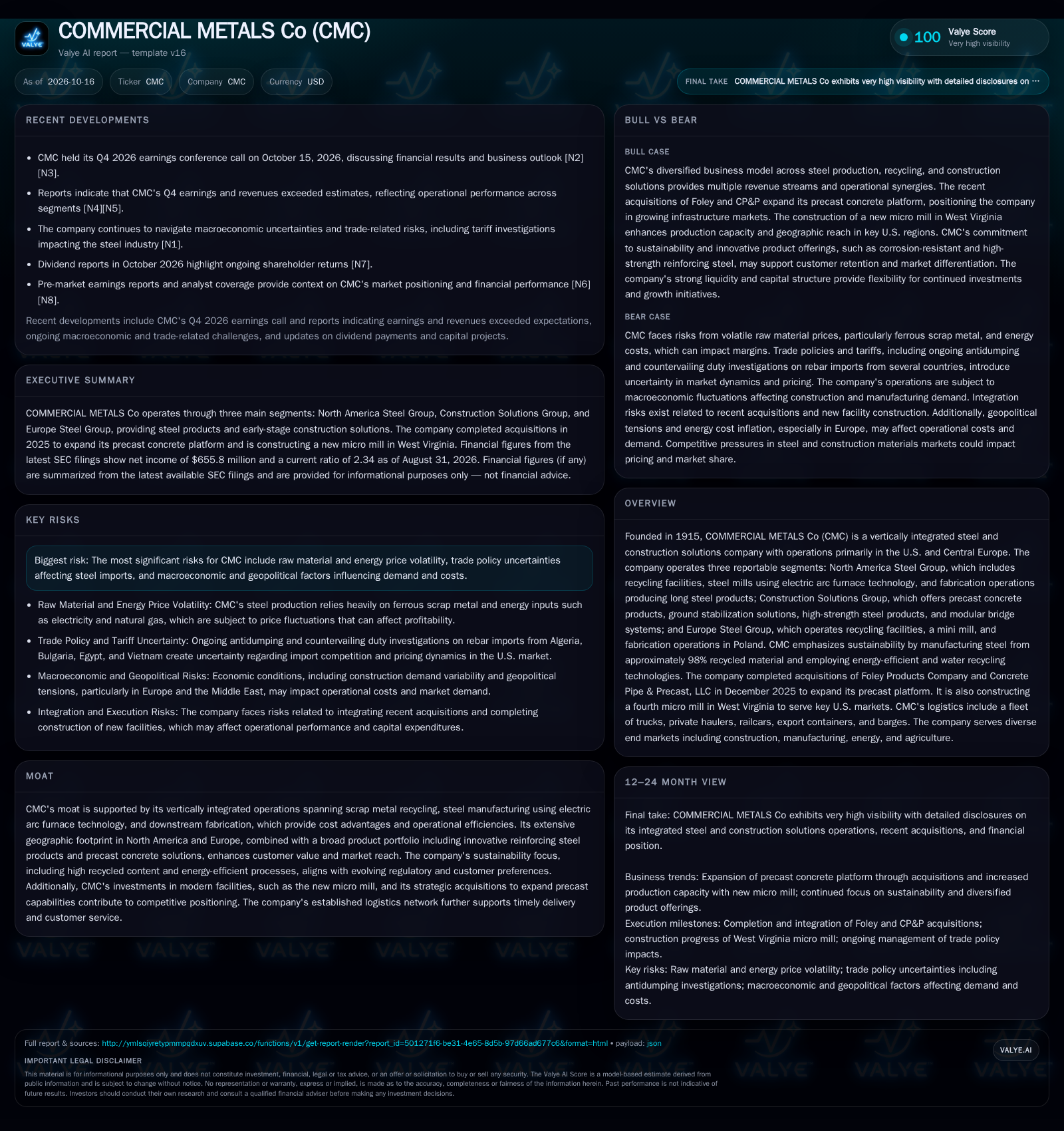
CMC is increasing its U.S. steel output with a new micro mill, expanding its precast concrete business through recent acquisitions, and reported net income of $656 million for FY2026, with a $1.7 billion downstream backlog. The company’s vertically integrated model and sustainability focus support operational resilience, but macro volatility, energy costs, and trade policy are key uncertainties. Watch integration progress, mill ramp-up, and market demand as drivers of the next phase.
Commercial Metals Co. (CMC) is navigating a pivotal period: the company’s expansion into precast concrete solutions via recent acquisitions and the construction of a new U.S. micro mill are set against a backdrop of persistent energy cost volatility, trade policy headwinds, and integration execution risk. With a robust FY2026 net income and substantial downstream backlog, CMC’s vertically integrated approach and sustainability emphasis offer potential resilience. However, the path forward will be shaped by how effectively the company manages macroeconomic, regulatory, and operational crosscurrents.
Strategic Expansion Meets Execution Crossroads
Recent developments highlight CMC’s drive to consolidate its position in steel and construction solutions: the company completed the acquisitions of Foley Products Company and Concrete Pipe & Precast, LLC in December 2025, significantly broadening its precast concrete offerings. At the same time, CMC is building a fourth electric arc furnace (EAF) micro mill in West Virginia, targeting increased rebar output for key U.S. regions. As of August 31, 2026, CMC reported net income of $656 million, a current ratio of 2.34, and a downstream products backlog of $1.7 billion, indicating both financial performance and future revenue visibility [S1]. These moves come as the company faces heightened energy costs in Europe and ongoing trade policy risks, notably antidumping investigations on rebar imports. The interplay of these factors places CMC at a strategic crossroads: success now depends on effective integration of acquisitions, timely execution of new capacity, and agile response to macro and regulatory disruptions.
How Vertical Integration and Product Mix Shape Profitability
CMC’s business model is built around vertical integration: its operations span scrap metal recycling, EAF-based steelmaking, downstream fabrication, and—more recently—precast concrete solutions. This structure allows the company to internalize supply chains, buffer raw material volatility, and capture value across multiple points in the construction value chain. The EAF model in particular enables flexible, lower-capital-intensity steel production—especially when using high-recycled-content feedstock—though it exposes the company to scrap price fluctuations and electricity/gas costs. The addition of precast concrete broadens CMC’s margin profile, as these products typically command higher value-added pricing but require effective execution and integration to realize synergies.
Operating leverage is a key dynamic: as new capacity (such as the West Virginia micro mill) ramps and as acquired precast operations are integrated, fixed costs can be spread over greater volume—potentially boosting margins if demand holds. However, capital needs remain significant, both for mill construction and for working capital tied to volatile input and finished goods prices. The company’s ability to flex production and adjust product mix in response to market signals will be critical for sustaining profitability through cycles.
Sustainability, Scale, and Geographic Reach as Differentiators
CMC operates in a fiercely competitive landscape, facing both domestic and international steelmakers, regional construction materials players, and substitutes such as concrete, composites, and alternative construction methods. Its vertically integrated model provides potential cost and service advantages, particularly in regions where logistics and scrap sourcing efficiencies can be leveraged. The company’s 98% recycled steel content and energy-efficient EAF operations align with rising regulatory and customer sustainability preferences, which may enhance stickiness with certain institutional and infrastructure buyers.
The expansion into precast concrete and modular construction solutions may further differentiate CMC, allowing it to participate in earlier stages of construction projects and offer bundled or value-engineered solutions. However, these markets are also fragmented and execution-intensive, with local competitors and varying customer requirements. On the steel side, CMC’s new micro mill capacity could pressure regional competitors, but may also invite price-based responses if market growth lags. Internationally, the Polish operations provide access to the European market but face higher energy cost risks and exposure to currency and policy volatility.
When Integration, Demand, and Policy Align: Path to Outperformance
CMC could deliver outsized returns if several levers move in its favor. Seamless integration of the Foley and CP&P acquisitions would enable the company to capture cross-selling, procurement, and operational synergies, positioning its Construction Solutions Group as a go-to provider for infrastructure and large-scale construction projects. Timely completion and ramp-up of the West Virginia micro mill, coupled with strong demand from public and private construction initiatives, would allow CMC to leverage its expanded capacity and realize associated operating leverage.
Supportive trade policy—such as the upholding of tariffs or successful outcomes in antidumping investigations—could limit import competition and firm up domestic steel prices. A benign energy cost environment, or effective hedging and energy management, would further support margins. Evidence for this scenario would include above-trend revenue and margin expansion in both steel and construction solutions segments, declining integration costs, and continued growth in backlog. Confirmation would also come from increased contract wins for bundled steel and precast offerings, and positive updates on mill commissioning and utilization rates.
Balancing Growth Initiatives with Cost and Policy Volatility
The most plausible trajectory is one where CMC executes on its expansion and integration plans, but faces ongoing headwinds from raw material and energy price volatility, as well as intermittent trade policy disruptions. Demand for steel and construction solutions likely remains healthy but cyclical, tied to U.S. infrastructure spending, non-residential construction, and broader macro trends. The new micro mill gradually ramps to planned capacity, contributing to revenue but also adding incremental fixed costs in the near term.
Integration of acquired precast operations delivers moderate synergies, but some friction or one-time costs persist. Backlog provides some visibility, but order intake may fluctuate with project cycles and customer sentiment. The company manages to preserve margins through a mix of cost control, product mix optimization, and selective pricing actions, but does not see a step-change in profitability. Evidence for this scenario would be steady, if uneven, revenue growth, stable to slightly improving margins, and regular updates on integration and mill progress. Watch for commentary on input cost management, order trends, and the evolution of trade and tariff landscapes.
If Input Volatility, Policy Shocks, or Execution Missteps Dominate
CMC’s earnings power could be meaningfully impaired if multiple risk factors materialize simultaneously. A sharp increase in scrap or energy prices—particularly in Europe—would compress margins, especially if these costs cannot be fully passed through to customers. Adverse outcomes in antidumping or countervailing duty cases could allow low-priced imports to erode domestic market pricing, forcing CMC to defend share with lower margins.
On the operational front, delays or cost overruns in the West Virginia micro mill construction, or significant integration challenges with the Foley and CP&P acquisitions, could result in unanticipated expenses, lost synergies, and management distraction. Demand shocks—such as a construction downturn or project delays—would exacerbate these effects by lowering utilization and amplifying fixed-cost absorption issues. Evidence supporting this scenario would include downward revisions to backlog, negative margin surprises, persistent integration charges, and negative commentary on market or regulatory conditions.
Milestones and Metrics That Will Shape CMC’s Next Chapter
Progress and cost-to-complete updates for the West Virginia micro mill, including any changes to schedule or budget.
Backlog evolution for both downstream products and the Construction Solutions Group, as an indicator of demand and revenue visibility.
Reported synergies, margin trends, and integration costs tied to the Foley and CP&P acquisitions—if disclosed.
Quarterly updates on input cost management, especially scrap and energy prices, and the extent of cost pass-through to customers.
Segment-level revenue and margin performance, with particular attention to the contribution from precast concrete and modular solutions.
Outcomes and commentary on ongoing antidumping and countervailing duty investigations impacting rebar imports.
Order intake and utilization rates for new and existing mills, especially as the West Virginia facility ramps up.
Any material updates on energy costs, particularly in the European operations, and management’s mitigation strategies.
Disclaimer: This is research-only, informational analysis and not investment advice. It may include AI-generated interpretation and general industry context. Always verify important details using primary sources.

Comments