
CTW: Platform Leverage in Animation IP Gaming Meets the Realities of Monetization and Execution Risk
CTW’s niche focus on animation IP-driven games and its developer-advance model create alignment but also exposure to execution risk and the limits of its addressable market. Recent financials highlight both the revenue potential of its G123.jp platform and the persistent challenge of achieving profitability in a highly competitive, hit-driven arena.
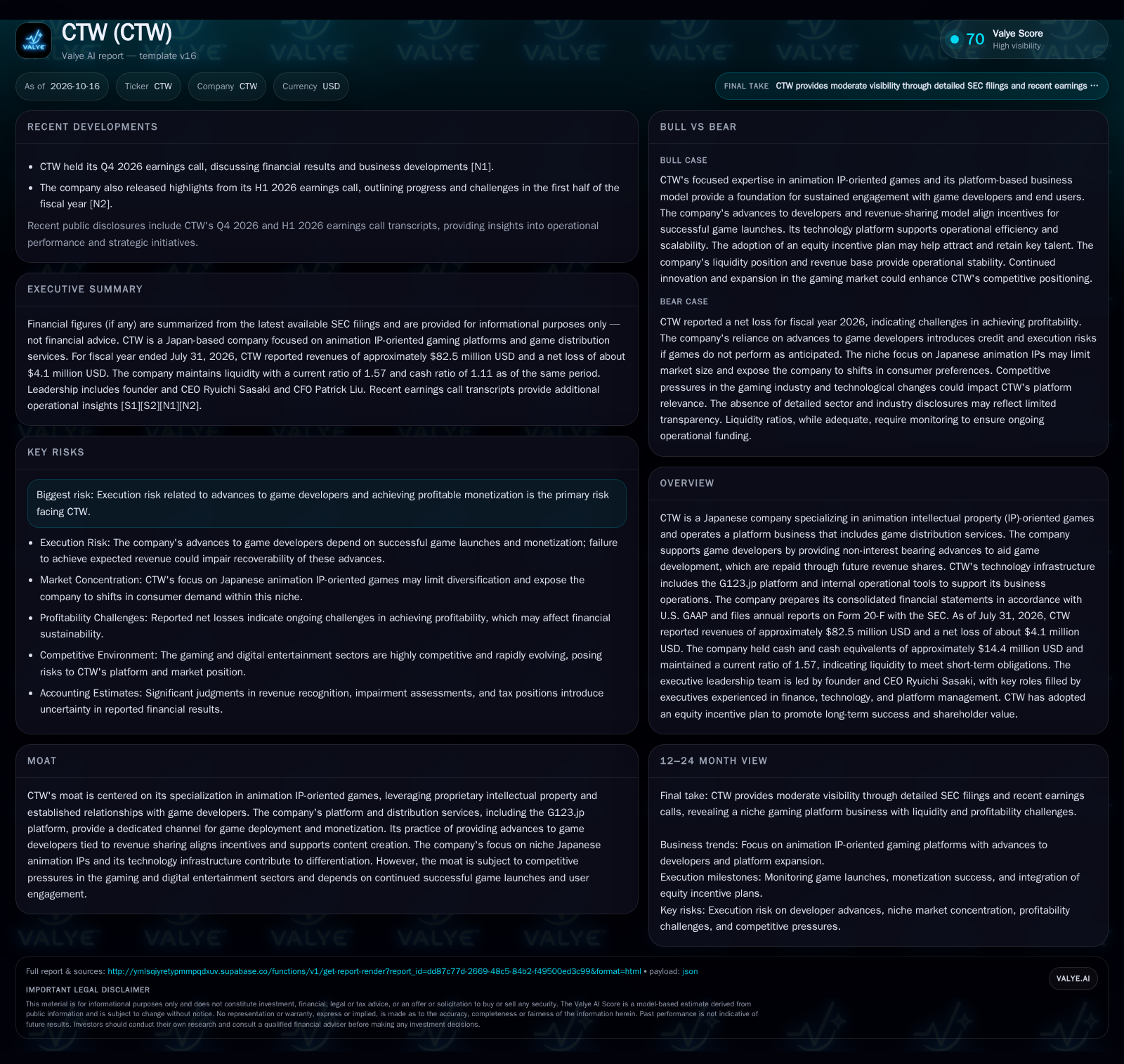
CTW, a Japanese gaming platform company centered on animation IPs and developer partnerships, reported $82.5M in revenue and a $4.1M net loss for fiscal 2026. The business model—providing advances to developers repaid through revenue share—supports content creation but introduces execution and credit risk. Key watchpoints include game launch performance, revenue retention, and the ability to leverage its platform and IP focus for sustainable growth. [S1] [S2] [N1] [N2]
CTW stands at a pivotal juncture: its strategy of combining a proprietary gaming platform with deep ties to animation IPs and developer partnerships has yielded meaningful revenue, but not yet profitability. The company’s willingness to fund game development through non-interest-bearing advances is a double-edged sword—fueling content creation and platform exclusivity, yet exposing CTW to the financial consequences of underperforming titles. With $14.4 million in cash and reported liquidity position, CTW is not immediately constrained, but the path to sustainable profit remains uncertain amid hit-driven market dynamics, evolving player preferences, and growing competition. The next phase will test whether its platform leverage and IP focus can deliver durable returns or whether execution risk and market concentration will limit upside. [S1] [S2] [N1] [N2]
Recent Financials Highlight Both Platform Scale and Profitability Hurdles
For the fiscal year ended July 31, 2026, CTW reported revenue of approximately $82.5 million USD and a net loss of about $4.1 million USD. The company reported cash and liquidity metrics for the period; these figures do not by themselves establish operating runway, investment capacity, financial flexibility, or financing capacity. These financials underscore that CTW’s G123.jp platform and developer-advance model are generating material revenue, but the company is not yet achieving profitability. The result is a business with operational traction but an unresolved challenge around cost structure, monetization, or both. [S1] [S2] [N1] [N2]
Developer-Advance Model: Amplifying Content at the Cost of Execution Risk
CTW’s economics are shaped by its role as a gaming platform operator and financial backer of content: it provides non-interest-bearing advances to developers, which are then repaid via a share of future game revenue. This structure can accelerate the onboarding of high-potential games, foster exclusivity, and align incentives between CTW and its developer partners. However, it also shifts a portion of development risk onto CTW’s balance sheet. If a game fails to achieve commercial traction, the advance may not be fully repaid, resulting in write-downs or impairment charges.
The company’s revenue is thus a blend of platform fees, its share of game monetization, and potentially other distribution or service revenues. Variable costs are likely tied to platform operations, marketing, and ongoing developer support, while fixed costs include technology infrastructure and overhead. The potential for operating leverage exists if hit games drive user and revenue growth without a commensurate increase in fixed costs—but this depends on the success rate of funded games and the effectiveness of user acquisition and retention strategies.
Capital needs are moderate in the near term, as evidenced by the current liquidity position, but could become acute if a string of advances fails to generate expected returns or if the company seeks to scale aggressively into new markets or IP categories.
Niche IP Focus vs. Broader Platform Competition
CTW’s competitive differentiation is rooted in its specialization: it targets animation IP-oriented games, leveraging relationships with developers and IP holders to supply exclusive or differentiated content for the G123.jp platform. In theory, this focus can cultivate a dedicated user base and create switching frictions for fans of particular IPs.
However, the competitive landscape for gaming platforms—especially in Japan and adjacent Asian markets—is intense. CTW must contend with large-scale global platforms, regional competitors, and the broader ecosystem of mobile, PC, and browser-based game distribution channels. Many rivals possess larger user bases, greater marketing budgets, and more diversified content portfolios.
Substitution risk is real: consumers can shift attention to alternative platforms or new entertainment formats, and game developers may seek more lucrative or less restrictive distribution arrangements. The company’s moat is thus dependent on its ability to consistently secure attractive IPs, execute successful launches, and maintain an engaged user base.
If Hit Games and Platform Engagement Accelerate, Operating Leverage Could Emerge
The most favorable scenario is one in which CTW’s developer-advance model consistently yields commercially successful games that resonate with its animation IP-focused audience. If several titles achieve breakout success, user engagement and monetization on G123.jp could rise, both increasing CTW’s revenue share and improving operating leverage as fixed platform costs are spread over a larger revenue base.
Expansion into new animation IPs, successful integration of the equity incentive plan (attracting key talent), and enhanced developer partnerships could further reinforce the flywheel effect—drawing more creators and content to the platform. Confirmation of this scenario would come from sequential revenue growth, margin expansion, reduced impairment charges on advances, and evidence of higher retention or average revenue per user. Falsification would be a lack of revenue growth despite new game launches, persistent or rising net losses, or an increase in advances written off as unrecoverable.
Platform Grows, but Profitability Remains Elusive Without Higher Hit Rate or Cost Discipline
The most plausible path is that CTW continues to grow its revenue base through a steady cadence of game launches and moderate platform expansion, but net losses persist due to the hit-driven nature of the business and the costs associated with developer advances, marketing, and platform operations. The company’s liquidity remains sufficient for ongoing operations, but the balance between investing in new content and managing credit risk on advances becomes increasingly critical.
Confirmation of this middle path would be stable or modestly growing revenues, a gradual reduction in the net loss margin, and limited impairment or write-downs on advances. Falsification would be either a rapid swing to profitability (indicating a more favorable scenario) or a sharp deterioration in cash balances and a spike in unrecoverable advances (moving toward downside risk).
Execution Risk Materializes: Advances Not Recovered, Cash Burn Accelerates
The adverse scenario is one where a significant portion of developer advances fail to yield successful games, leading to increased impairments and a widening net loss.
Competitive pressures could exacerbate this dynamic if key developers or IP holders defect to rival platforms, or if user attention shifts to alternative formats. Confirmation of this scenario would be a marked increase in impairment charges, rapid cash burn, a decline in new game launches, or management signaling the need for external funding. Falsification would be demonstrated by stable or improving advance recovery rates and maintenance of a healthy reported cash balance.
Milestones That Will Determine Whether CTW’s Platform Model Delivers Sustainable Value
The success rate of recent and upcoming game launches, measured by their ability to generate revenue sufficient to repay advances and contribute to platform profitability.
Impairment or write-down rates on advances to game developers—if disclosed—which would indicate the effectiveness of CTW’s game selection and risk assessment processes.
Sequential revenue growth and margin trends, especially evidence of operating leverage or improvement in net loss margin.
Adoption and impact of the 2025 Equity Incentive Plan, particularly whether it supports retention and attraction of key technology and creative talent.
User engagement and retention metrics for the G123.jp platform—if disclosed—as a proxy for the stickiness and appeal of CTW’s content portfolio.
Shifts in the competitive landscape, including new platform entrants, major licensing deals, or developer defections that could alter CTW’s market positioning.
Management commentary on pipeline health, advance recovery expectations, and any changes in revenue recognition or impairment policies.
Disclaimer: This is research-only, informational analysis and not investment advice. It may include AI-generated interpretation and general industry context. Always verify important details using primary sources.

Comments