
High Roller Technologies: Multi-Brand iCasino Ambitions Meet Regulatory Complexity and Execution Risk
High Roller Technologies pivots to a scalable, multi-brand iCasino strategy and U.S. prediction markets entry. Its recent market exits, material internal control weaknesses, and regulatory hurdles in new segments frame a business with growth potential but heightened operational uncertainty.
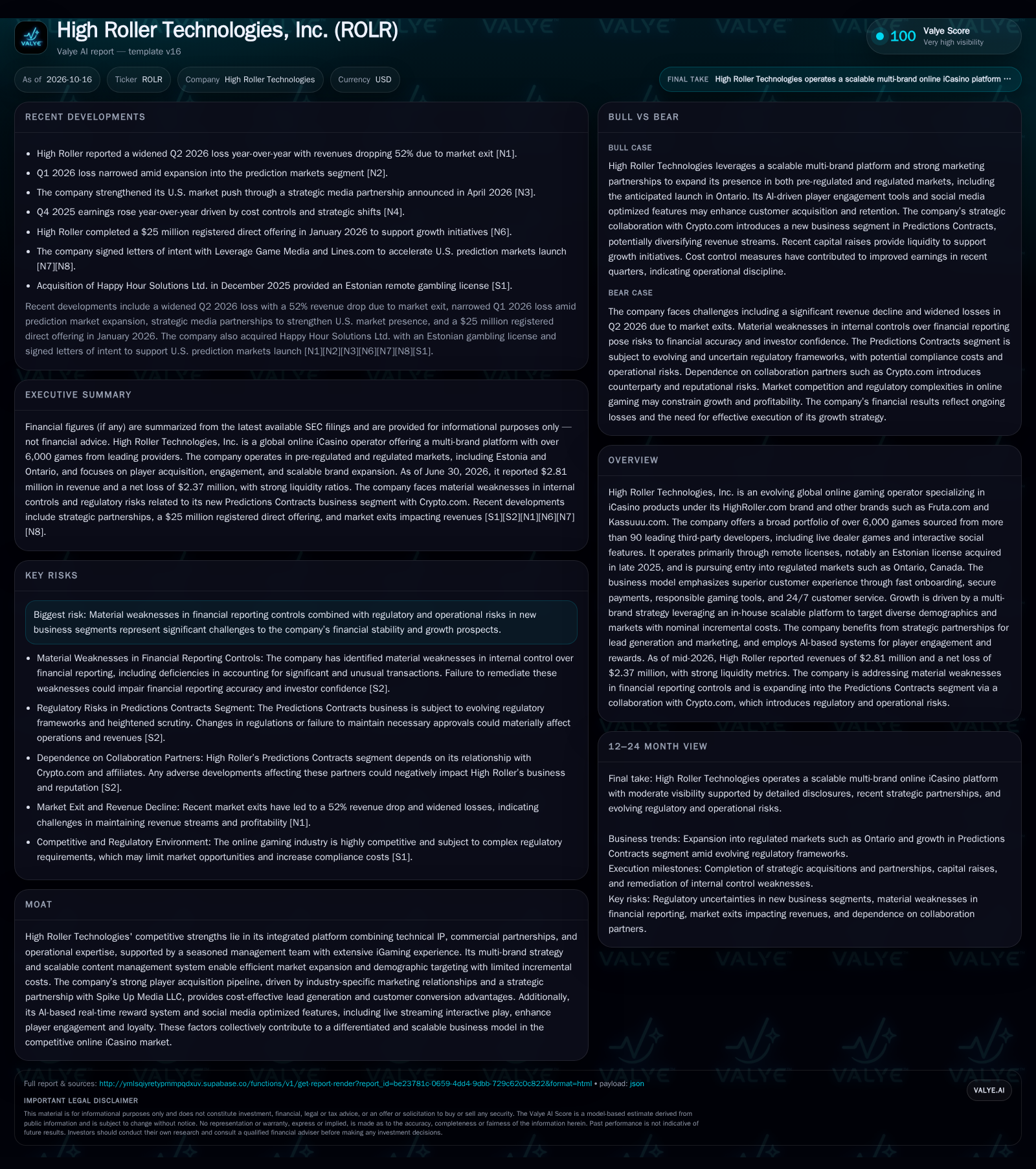
High Roller Technologies is a global online gaming operator offering over 6,000 iCasino games across multiple brands. After exiting certain markets, it saw Q2 2026 revenues drop 52% year-over-year, despite possessing $18 million in cash and recently raising $25 million for growth. The company is entering the regulated U.S. prediction markets via a Crypto.com partnership but faces material weaknesses in financial reporting and complex regulatory risks as it seeks to expand in markets like Ontario and the U.S. [S1] [S2] [N1] [N6]
High Roller Technologies, Inc. is at a strategic crossroads: its multi-brand iCasino model aims for global reach and demographic breadth, but recent revenue declines from market exits, unresolved internal control weaknesses, and entry into the heavily regulated U.S. prediction markets introduce new layers of execution risk.
Recent Revenue Declines, Capital Raise, and Regulatory Expansion Define the 2026 Backdrop
High Roller Technologies reported a 52% year-over-year revenue drop for Q2 2026, attributed to a significant market exit, with quarterly revenue at $2.81 million and a net loss of $2.37 million [N1] [S2]. This contraction highlights the company’s sensitivity to market access and regulatory shifts. In response, High Roller raised $25 million in a registered direct offering in January 2026 to fund its U.S. prediction markets entry and broader growth initiatives [N6]. The company’s push into the U.S. is anchored by a partnership with Crypto.com, launching a Predictions Contracts segment under a newly acquired Guaranteed Introducing Broker license [S2]. However, material weaknesses in internal control over financial reporting remain unresolved, potentially affecting both operational integrity and investor confidence [S2].
Scalable Multi-Brand Model: Operating Leverage and Margin Levers in iCasino and Prediction Markets
High Roller’s core iCasino business generates revenue through gross gaming hold—essentially, the difference between player wagers and payouts—across over 6,000 games from more than 90 providers. The company’s in-house platform supports a multi-brand strategy, enabling new brands to launch with minimal incremental cost, theoretically enhancing operating leverage as incremental marketing and overhead per brand declines with scale [S1]. Revenue mix is driven by game popularity, bonus structures, player engagement, and the effectiveness of its AI-based reward and retention systems. Supplier agreements are primarily revenue-share models, so gross margins depend on both game mix and negotiated terms with content providers.
The new Predictions Contracts segment, facilitated by Crypto.com, adds a brokerage-style revenue stream tied to event-based derivatives in the U.S. This model is likely to be lower margin in early phases—given regulatory, compliance, and partnership costs—but could scale if customer uptake accelerates and fixed regulatory infrastructure is leveraged across a growing user base. However, incremental regulatory, compliance, and technology costs could offset operating leverage if market entry is slower or more fragmented than planned.
The company reported cash and liquidity metrics for the period; these figures do not by themselves establish operating runway, investment capacity, financial flexibility, or financing capacity. [S2] [N6]
Strategic Partnerships, Brand Breadth, and Platform Features: Competitive Advantages and Threats
High Roller’s competitive position is rooted in several factors: a scalable in-house technology platform, a deep catalog of games from leading providers, and a multi-brand deployment strategy targeting diverse market segments [S1]. Strategic marketing partnerships, particularly with Spike Up Media LLC, are designed to lower customer acquisition costs and accelerate market penetration. Social features—such as live streaming and interactive play—enhance engagement and may improve retention, differentiating the offering in a crowded iCasino landscape.
However, the company faces intense competition from both global iGaming incumbents and local/regional operators in each regulated market. These competitors often have greater scale, deeper compliance infrastructure, and established player bases. In the emerging U.S. prediction markets, High Roller will compete not only with traditional sportsbooks but also with new entrants and established financial exchanges expanding into event-based derivatives. Regulatory barriers, high compliance costs, and dependency on partners like Crypto.com could also limit the pace and profitability of expansion.
Switching frictions in online gaming are typically low, with customer loyalty driven by bonuses, user experience, and brand trust. High Roller’s AI-driven reward system and social features may help reduce churn, but sustained differentiation will depend on continuous product innovation and marketing execution.
If Multi-Brand Scaling and U.S. Prediction Markets Gain Traction
A favorable scenario for High Roller hinges on successful scaling of its multi-brand iCasino platform in new regulated markets (notably Ontario and U.S. states), combined with strong early adoption of its Predictions Contracts offering. If the company leverages its AI-powered engagement tools and partnership-driven acquisition pipeline, it could achieve high player lifetime value and low acquisition costs, driving operating leverage and margin expansion. The U.S. partnership with Crypto.com could provide rapid access to a large addressable market if regulatory acceptance accelerates and customer onboarding is frictionless.
Evidence supporting this scenario would include: rapid revenue growth in newly entered regulated markets; sustained or improving gross margins as incremental costs remain contained; increased player retention and engagement metrics (if disclosed); and early profitability or narrowing losses in the Predictions Contracts segment. Successful remediation of internal controls would boost investor confidence and facilitate further capital access.
Incremental Growth Amid Persistent Volatility and Execution Risk
The most plausible path is one of moderate revenue growth from new brand launches and selective market entries, offset by ongoing volatility from regulatory changes, market exits, and competition. The iCasino core may stabilize as market access in Ontario and other regulated geographies comes online, but the company could face continued net losses as investments in technology, compliance, and marketing outpace near-term revenue gains.
Execution risk remains high in the Predictions Contracts segment, where regulatory clarity and consumer adoption are still developing. If customer acquisition costs remain manageable and internal controls are remediated, gradual improvement in financial performance is possible. However, persistent material weaknesses in financial reporting and episodic market exits could constrain valuation and access to additional capital.
Confirmation of this scenario would come from modest sequential revenue growth, contained losses, gradual traction in new segments, and incremental progress in resolving material control deficiencies.
Cascading Regulatory, Execution, and Control Failures Could Trigger Further Contraction
A negative outcome could materialize if High Roller encounters further regulatory setbacks—such as delayed or denied market licenses, adverse changes in U.S. event contract regulations, or compliance failures in existing markets. Additional market exits could trigger further revenue declines and impair the company’s ability to leverage its scalable model. Unresolved internal control weaknesses could lead to financial restatements, loss of investor confidence, or even regulatory penalties.
Dependence on external partners, especially for the Predictions Contracts segment, introduces counterparty and reputational risk: breakdowns in these relationships or operational failures by Crypto.com could disrupt customer experience and erode trust. If customer acquisition costs rise or bonus expenses escalate in a competitive environment, gross margins could compress further, leading to deeper losses and potential liquidity stress despite the recent capital raise.
Evidence of this scenario would include further revenue contraction, expanding losses, delays in new market launches, regulatory actions or fines, and persistent or worsening control deficiencies.
Milestones and Metrics That Will Define High Roller’s Strategic Trajectory
Revenue growth and margin trends by brand and geography, particularly in Ontario and U.S. prediction markets, if disclosed.
Progress and timeline for remediation of material weaknesses in internal control over financial reporting.
Customer acquisition cost, player retention rates, and bonus expense ratios—whether these metrics improve as the multi-brand model scales, if disclosed.
Adoption and transaction volumes in the Predictions Contracts segment after U.S. launch, if disclosed.
Regulatory outcomes: timing of Ontario license approval and any new licenses or regulatory setbacks in the U.S. or other markets.
Evolving terms and operational performance of the Crypto.com partnership, including customer onboarding and revenue-sharing mechanics, if disclosed.
Net cash burn rate and liquidity position as expansion investments continue and losses persist.
Any further market exits, new strategic partnerships, or changes in supplier/content agreements that impact revenue visibility.
Disclaimer: This is research-only, informational analysis and not investment advice. It may include AI-generated interpretation and general industry context. Always verify important details using primary sources.

Comments