
Apogee Acquisition Corp: SPAC Timeline, Internal Controls, and the Challenge of Value Creation
With a business combination deadline set for July 2027 and recent IPO proceeds in trust, Apogee Acquisition Corp faces a binary outcome: secure an accretive deal or face mandatory liquidation. Material weaknesses in controls and a lack of extension plan complicate the search for a technology-driven target.
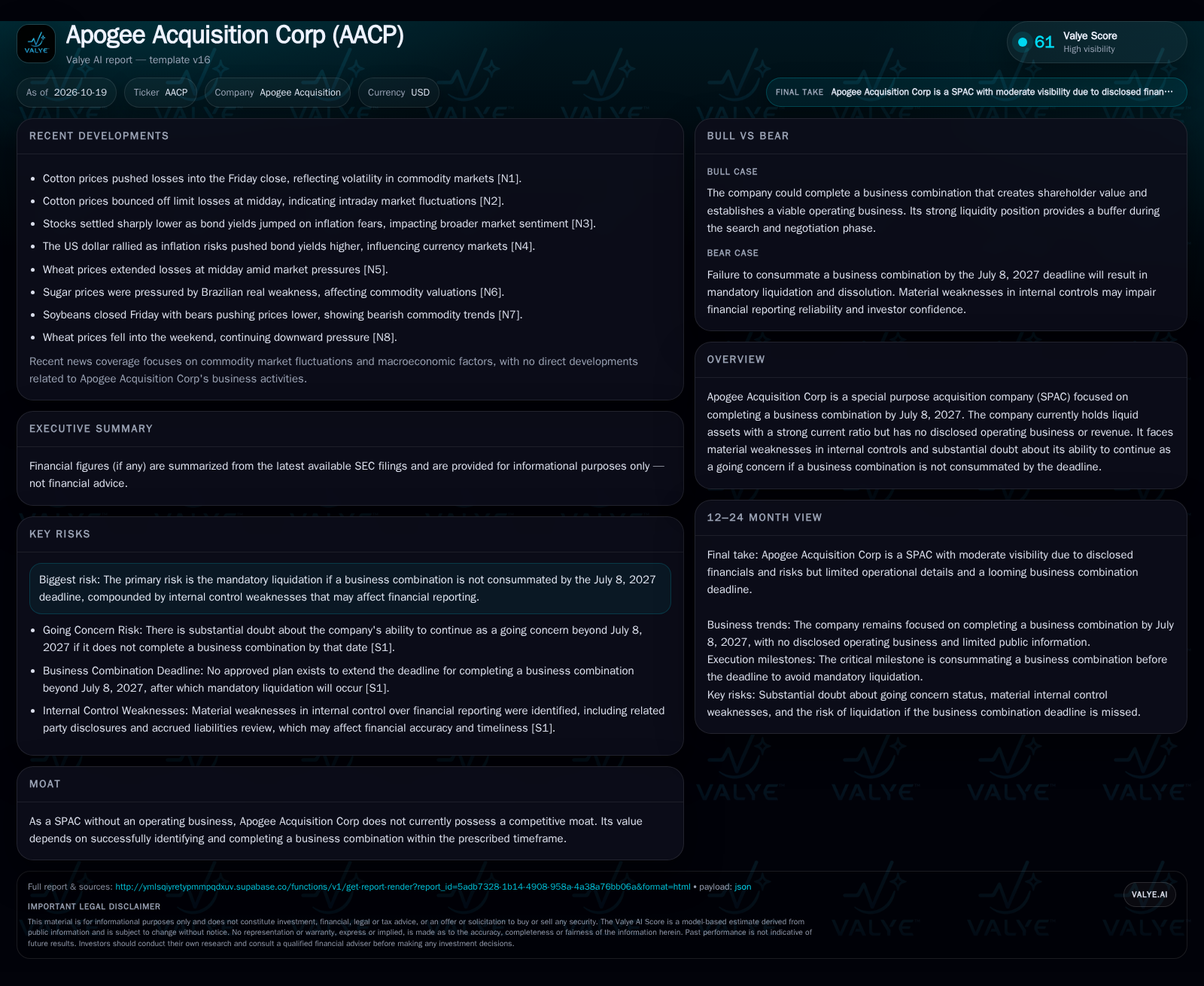
Apogee Acquisition Corp is a newly public SPAC focused on advanced technology targets, holding $172.5M in trust and facing a July 2027 deadline to complete a business combination. Material weaknesses in internal controls and the absence of a deadline extension plan increase execution risk. The company's value now hinges entirely on its ability to source and close an accretive transaction before mandatory liquidation [S1].
Apogee Acquisition Corp (AACP), a Cayman Islands-incorporated SPAC, embodies the current market's all-or-nothing dynamic for blank check companies. With $172.5 million in trust from its April 2026 IPO and a mandate to acquire a business in advanced technology domains, Apogee's future depends on closing a suitable deal by July 8, 2027. The lack of operational business, material internal control weaknesses, and no plan to extend its combination deadline leave investors with a classic binary: value creation via a timely merger, or forced liquidation and return of funds.
Deadline and Control Weaknesses Define Apogee’s Current State
Apogee Acquisition Corp’s most material facts are its $172.5 million in IPO proceeds held in trust, its mandate to complete a business combination by July 8, 2027, and the recent identification of material weaknesses in internal controls, particularly in related party transactions and accrued liabilities reporting [S1]. No revenue-generating business exists pre-combination; all current income is from interest on trust assets. Critically, there is no approved plan to extend the deadline, and substantial doubt exists about the company’s ability to continue as a going concern if it fails to close a deal in time [S1]. These factors set the stage for a classic SPAC binary: a successful acquisition could create value, but failure triggers mandatory liquidation.
SPAC Economics: Trust, Redemptions, and the Merger Value Equation
Apogee’s business model is typical of a post-IPO SPAC: it holds investor funds in trust, generates non-operating income from those funds, and incurs administrative and diligence costs as it searches for a target [S1]. The economics hinge on successfully identifying and closing a merger with a private company, typically at a premium to trust value. If a combination is completed, value may accrue to public shareholders through access to a high-growth or undervalued operating business, sponsor incentives, and potential PIPE (private investment in public equity) participation.
If no deal is completed, the trust is returned to shareholders minus minimal expenses. The SPAC structure incentivizes sponsors to close a deal—any deal—while public shareholders face the risk of dilution or suboptimal target selection. The material control weaknesses increase the risk of financial misstatements or delayed disclosures, potentially undermining shareholder confidence and complicating regulatory compliance [S1].
The interplay between sponsor incentives and shareholder interests is a critical dynamic in SPAC economics. Sponsors typically receive a significant equity stake contingent on deal completion, which motivates them to pursue transactions even under suboptimal conditions. However, this misalignment can lead to pressure to consummate deals that may not maximize long-term shareholder value. The presence of material weaknesses in internal controls exacerbates this risk, as financial misstatements or delayed disclosures could impair investor trust and hinder the SPAC’s ability to attract quality PIPE investors or negotiate favorable terms with targets. Thus, governance robustness is not merely a compliance issue but a strategic factor influencing deal quality and post-merger success.
Deal Sourcing in a Crowded SPAC Landscape
Apogee is one of many SPACs competing for a limited pool of attractive targets, especially in advanced technology sectors. The search focuses on companies in software, hardware, compute infrastructure, engineered materials, intelligent systems, automation, and energy tech [S1]. The competitive set includes other technology-focused SPACs, direct listings, and late-stage private equity, all vying for similar targets—often driving up valuations or leading to challenging negotiations.
Sponsor reputation, speed, and flexibility in deal structuring are potential differentiators, but Apogee’s lack of a public track record and its recent internal control deficiencies may hamper its ability to win high-quality deals. Target companies may prefer acquirers with a clean compliance record and proven execution capability. The SPAC’s time constraint adds further pressure: as the deadline approaches, negotiating leverage may shift toward targets.
The competitive environment for technology-focused SPACs is further complicated by the evolving preferences of private companies considering public market entry. Increasingly, targets weigh the benefits of SPAC mergers against alternatives such as traditional IPOs, direct listings, or private funding rounds. Factors such as valuation certainty, speed of execution, and post-merger strategic support influence these decisions. Apogee’s ability to differentiate itself may depend on demonstrating operational expertise, offering flexible deal structures, and maintaining transparent governance practices. Additionally, the time-limited nature of SPACs imposes a compressed negotiation timeline, which can disadvantage sponsors lacking established relationships or operational track records, potentially resulting in less favorable deal terms or missed opportunities.
Value Creation if Apogee Secures a High-Quality Tech Merger
The favorable scenario unfolds if Apogee identifies and closes a merger with a fast-growing, scalable technology company that public markets have not yet fully valued. The economics could work if the target brings material revenue growth, strong margins, and a credible path to profitability, justifying a valuation above trust value. Additional PIPE financing or strategic partnerships could enhance the deal, providing further capital and validation.
Evidence supporting this scenario would include the announcement of a definitive agreement with a well-regarded technology target, clear disclosure of pro forma financials, and market reaction showing a premium to trust value. Improved internal controls and timely, transparent communication would further boost investor confidence. Redemptions would remain low, preserving capital for the new operating company.
Most Likely Outcome: Execution Risk Persists, Marginal Deal Possible
The most probable path is that Apogee will continue its search, incurring administrative and diligence costs while evaluating technology targets. Given the competitive environment and the upcoming deadline, it may close a deal with a company that is viable but not best-in-class—perhaps a business with some growth prospects but limited scale or profitability. In this scenario, redemptions could be substantial, eroding the cash available for the merged entity and potentially diluting any upside for remaining shareholders.
Confirmation of this scenario would come from extended deal negotiations, a late-stage target announcement, high redemption rates, and tepid market response. If material control weaknesses persist or are not remediated, this could further constrain deal quality and post-combination performance.
In this scenario, the interplay between redemption levels and deal structure becomes pivotal. Elevated redemptions reduce the cash available to the post-merger entity, potentially necessitating higher sponsor dilution or reliance on PIPE financing to maintain operational runway. This dynamic can strain investor returns and complicate post-merger governance. Furthermore, if internal control deficiencies remain unaddressed, they may delay regulatory approvals or erode market confidence, increasing the risk of deal renegotiation or failure. The cumulative effect may be a transaction that delivers limited incremental value over the trust liquidation value, underscoring the importance of timely remediation and proactive investor communication to mitigate execution risks.
Mandatory Liquidation: The Cost of No Deal or Failed Execution
If Apogee fails to secure a business combination by July 8, 2027, or if a proposed deal is rejected by shareholders or regulators, the SPAC will be forced to liquidate, returning trust proceeds to public shareholders minus limited expenses [S1]. In this scenario, sponsor capital is lost, and public shareholders receive only their pro rata share of the trust, with no upside from a merger.
Evidence of this scenario could include prolonged silence or vague updates from management, missed regulatory filings, unresolved internal control issues, or the absence of a target announcement as the deadline nears. A failed shareholder vote on a proposed merger or regulatory intervention could also precipitate liquidation.
Milestones That Will Decide Apogee’s Fate Before July 2027
Announcement of a definitive agreement with a merger target, including detailed pro forma financials and sponsor alignment with public shareholders.
Remediation of material weaknesses in internal controls, particularly around related party disclosures and accrued liabilities—if disclosed, auditor confirmation would help test the thesis.
Redemption rate at the time of merger vote; high redemptions would erode the capital base and signal low investor confidence.
PIPE (private investment in public equity) participation or strategic co-investment, which would provide additional validation and funding.
SEC review outcomes and the timely filing of required disclosures, especially in the context of the identified control weaknesses.
Shareholder vote results on any proposed business combination, as rejection could trigger liquidation.
Updates on the pursuit (or absence) of a deadline extension plan as July 2027 approaches.
Disclaimer: This is research-only, informational analysis and not investment advice. It may include AI-generated interpretation and general industry context. Always verify important details using primary sources.

Comments