
Fastenal’s Managed Inventory and Digital Supply Chain: Margin Tensions and the Next Phase of Industrial Distribution
Fastenal’s growth in technology-driven managed inventory, combined with its deep branch network, reinforces customer stickiness but invites new margin and competitive pressures as industrial procurement evolves.
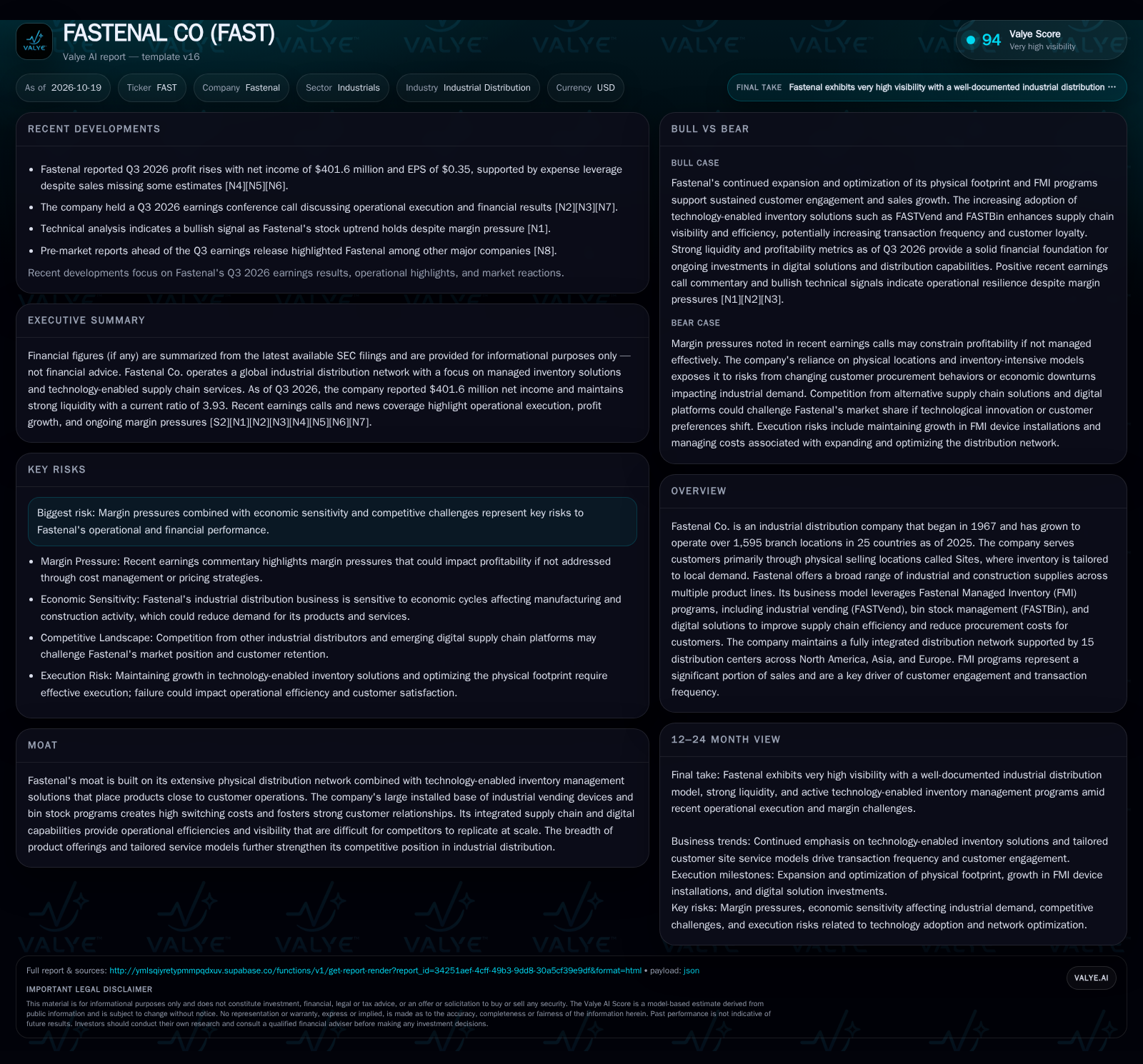
Fastenal is leveraging its expanding managed inventory programs and digital supply chain services to deepen customer integration and drive sales growth. With nearly 45% of sales now coming from technology-enabled inventory management, the company’s model is increasingly differentiated by on-site presence and automation. [S1] [S2] [N2] [N3] [N4]
Fastenal is at a pivotal juncture as it seeks to reinforce its leadership in industrial distribution through expanding managed inventory programs and digital supply chain services. The company’s ongoing investments in technology—combined with its vast branch network—are driving increased customer engagement and higher transaction frequency, with nearly half of its sales now stemming from inventory management solutions. However, persistent margin pressures and the threat of digital-native competitors mean execution and adaptability are more critical than ever. Fastenal’s financial strength provides a cushion, but its ability to sustain growth and defend margins will be tested as procurement behaviors shift and new technologies reshape the industrial supply chain landscape. [S1] [S2] [N2] [N3] [N4]
Managed Inventory Penetration Rises as Margin Pressures Persist
By the end of 2025, Fastenal’s Fastenal Managed Inventory (FMI) programs accounted for 44.7% of total sales, up from 42.5% the previous year, with daily sales from FMI channels increasing to $14.6 million. This shift underscores the company’s success in embedding itself deeper into customer operations through technology-enabled solutions like FASTVend and FASTBin. The installed base of vending and bin management machines reached 136,638 machine equivalents, a 7.6% year-over-year increase, demonstrating ongoing customer adoption and reinforcing Fastenal’s strategy of building recurring, high-frequency business. [S1]
Financially, Fastenal reported Q3 2026 net income of $401.6 million and a current ratio of 3.93, indicating a robust balance sheet. Still, recent earnings calls and analyst commentary highlight ongoing margin pressures—despite profit growth—which remain a central concern for the firm as it scales its physical and technological footprint. [S2] [N1] [N2] [N3] [N4]
How Fastenal’s Service Model Drives Revenue and Cost Dynamics
Fastenal’s revenue engine relies on a mix of product sales and value-added services delivered through its extensive network of 1,595 branch locations and on-site customer Sites. The economics of the business are increasingly shaped by technology-enabled managed inventory programs: industrial vending and bin management not only automate replenishment but also embed Fastenal’s supply chain solutions directly into customer workflows. This deep integration tends to increase transaction frequency and reduce customer churn, potentially providing a more stable revenue base than traditional spot sales.
The company’s cost structure is a blend of fixed expenses—branch operations, distribution centers, technology infrastructure—and variable costs tied to inventory and fulfillment. As FMI sales rise, Fastenal may see improved operating leverage if device deployments scale efficiently and drive incremental sales with minimal additional overhead. However, expanding and maintaining the physical and tech-enabled footprint is capital-intensive, and the economics depend on sustained utilization and customer retention.
Pricing power is nuanced. While Fastenal’s on-site presence and automation can justify a premium for convenience and reduced procurement costs, margin compression may occur if customers use the visibility and data from these solutions to negotiate harder or if competitive digital platforms undercut on price.
Physical Scale Meets Digital Disruption: Fastenal’s Defenses and Vulnerabilities
Fastenal’s competitive position is anchored in its physical proximity to customers, breadth of product offerings, and the stickiness created by on-site inventory management programs. The large installed base of vending and bin management devices, coupled with tailored service models, creates switching frictions for customers and raises barriers to entry for traditional distributors.
However, the industrial supply chain is increasingly contested by digital-native platforms and e-commerce entrants that promise broader selection, dynamic pricing, and streamlined procurement without the need for physical infrastructure. These competitors can leverage data analytics and scale without the overhead of branches, posing a threat to legacy distributors if procurement behaviors shift toward digital-first models.
Fastenal’s moat remains durable in sectors where proximity, rapid fulfillment, and tailored inventory are critical. Yet, the company’s ability to defend its position will depend on the pace of technology adoption, the value customers place on embedded service versus transactional convenience, and its capacity to continuously innovate its digital and physical offerings.
Customer Integration Deepens and Automation Drives Profitable Growth
A favorable scenario for Fastenal centers on accelerating adoption of FMI programs and digital solutions, leading to even greater customer integration. As more customers transition to automated inventory management, Fastenal could see rising transaction frequency, higher share of wallet, and improved retention—resulting in compounding revenue growth with less cyclicality than traditional distribution.
Profit margins could stabilize or even expand if the company achieves greater operating leverage from scaled device deployments and digital services, offsetting inflationary cost pressures. Evidence supporting this scenario would include continued double-digit growth in installed FMI devices, rising share of sales from managed inventory programs, stabilization or expansion of gross margins, and customer testimonials or case studies highlighting cost savings and operational improvements from Fastenal’s solutions.
Confirmation would also come from increased digital solution adoption (eProcurement, EDI), higher renewal rates for managed inventory contracts (if disclosed), and successful entry into new verticals or geographies leveraging the technology-enabled model.
Incremental Gains Amid Margin Tug-of-War and Execution Demands
The most plausible outcome is continued, incremental growth in managed inventory sales and device installations, with FMI programs gradually capturing a larger share of total revenue. Fastenal’s physical network and customer relationships provide a buffer against sudden disruption, but margin pressures persist due to rising input costs, competitive pricing dynamics, and ongoing investment needs.
The company likely maintains profitability and a reported balance sheet position, but gross margin may remain under pressure unless cost controls or pricing strategies offset inflation and competitive threats. FMI adoption could slow if customers become more price-sensitive or if alternative digital solutions gain traction.
This scenario would be confirmed by steady but not accelerating growth in FMI installation metrics, stable to modestly declining gross margins, and periodic references to competitive pricing or cost management in earnings calls. A plateau in customer adoption of digital or managed inventory solutions would also support the base case.
Margin Compression and Digital Disintermediation Erode Competitive Edge
In the adverse scenario, margin pressures intensify—either from rising costs, aggressive price competition, or customer pushback against embedded service premiums. If digital-native competitors or alternative procurement platforms gain share, Fastenal could experience both slowing growth in managed inventory installations and erosion of its physical network’s relevance.
A shift in customer procurement behavior away from on-site inventory management toward more transactional, price-driven digital channels would weaken switching frictions and expose Fastenal to churn. If operating expenses rise faster than sales, or if technology investments fail to deliver incremental sales or cost savings, profitability could deteriorate despite a healthy topline.
Evidence would include declining or stagnating FMI installations, a shrinking share of sales from managed inventory, consecutive quarters of falling gross margins, and management commentary about competitive or cost headwinds. Accelerated branch closures or restructuring charges would further indicate structural stress.
What Will Test Fastenal’s Model in the Next Chapter?
The pace of FMI device installations and signings—continued double-digit growth would support the upside, while stagnation or decline would signal risk.
Gross margin trends—stabilization or improvement would suggest successful cost management or pricing power; sustained declines would validate margin pressure concerns.
Share of total sales from managed inventory programs—the ability to push this figure beyond 45-50% would indicate deepening customer integration.
Adoption rates for digital solutions such as eProcurement and EDI—if disclosed, accelerating adoption would support the digital differentiation thesis.
Customer retention and renewal rates for FMI programs—a useful metric if disclosed, as high retention would reinforce the stickiness of Fastenal’s service model.
Competitive pricing commentary and customer feedback in earnings transcripts—signs of increased price sensitivity or competitive encroachment would be early warning signals.
Branch network optimization metrics—changes in the number or productivity of Sites could reflect either efficiency gains or network strain.
Capital expenditure trends and technology investment levels—rising investment without corresponding revenue growth could pressure returns and margins.
Disclaimer: This is research-only, informational analysis and not investment advice. It may include AI-generated interpretation and general industry context. Always verify important details using primary sources.

Comments