
GoPro’s Inflection: Subscription Strain, Hardware Economics, and the Limits of Brand Leverage
A sharp revenue contraction and declining subscriber base have put GoPro’s high-margin digital ambitions under pressure, raising the stakes for operational discipline, product innovation, and a credible return to profitability amid intensifying competition and supply chain stress.
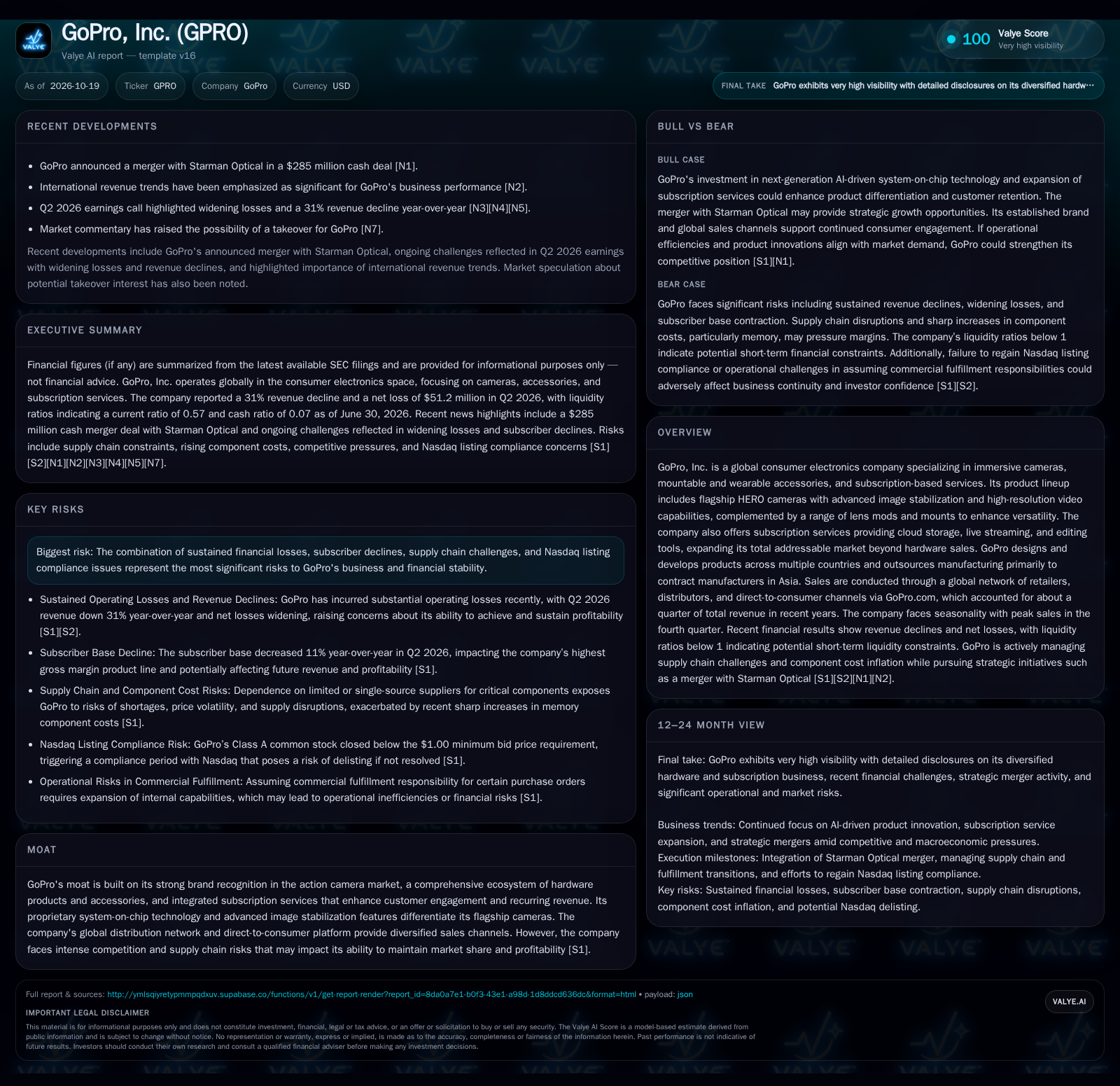
GoPro’s Q2 2026 results reveal a 31% year-over-year revenue drop to $104.9M and an 11% subscriber decline, straining its highest-margin business line. With component costs surging and operational complexity rising, the sustainability of GoPro’s hybrid hardware–subscription model faces a critical test. Potential takeover speculation and international revenue trends add strategic uncertainty to an already challenging outlook. [S1] [S2] [N2] [N3] [N7]
GoPro’s ambition to pivot from hardware cyclicality to a recurring-revenue digital platform is colliding with a tough reality: sharp revenue declines, a shrinking subscriber base, and intense cost inflation are converging to test the company’s resilience and strategic options. While its brand and product ecosystem remain strong, Q2 2026’s financial results and operational headwinds highlight a business model at a crossroads—where execution, innovation, and financial discipline will determine whether GoPro can reestablish growth and regain market confidence.
Recent Financial Strain and Subscriber Erosion Dominate GoPro’s Outlook
GoPro reported a 31% year-over-year revenue decline in Q2 2026, with sales falling to $104.9 million and a net loss of $51.2 million for the period. These figures mark a significant deterioration in operating performance, exacerbated by an 11% drop in the subscriber base to 2.18 million—directly impacting GoPro’s highest gross margin business line. Liquidity metrics are now acute: the current ratio stands at 0.57 and the cash ratio at 0.07 as of June 30, 2026, with just $27.3 million in cash and equivalents. Component cost inflation is severe, with memory prices up 80%–115% as of March 2026. Meanwhile, GoPro’s Class A stock fell below the $1.00 Nasdaq minimum bid, triggering a compliance window and raising the specter of delisting. These developments, coupled with market speculation of a potential takeover, have set a high-stakes context for GoPro’s next phase. [S1] [S2] [N2] [N3] [N7]
Subscription Margins, Hardware Volatility, and the Limits of Operating Leverage
GoPro’s business model blends cyclical, margin-constrained hardware sales with higher-margin digital subscriptions (Premium, Premium+, Quik). In theory, the recurring-revenue subscription layer could dampen hardware cyclicality and unlock operating leverage, as digital gross margins tend to be structurally higher. However, the sharp 11% subscriber decline in Q2 2026 undercuts this thesis, as subscription revenue is not only smaller in absolute terms but also critical for blended margin improvement. Hardware, by contrast, remains exposed to price competition, seasonality, and severe component cost swings—such as the 80%–115% spike in memory costs. Fixed costs in design, marketing, and R&D are substantial, and GoPro’s move to assume more commercial fulfillment responsibilities adds complexity and potential margin drag. The company reported cash and liquidity metrics for the period; these figures do not by themselves establish operating runway, investment capacity, financial flexibility, or financing capacity. [S1] [S2]
The interplay between hardware volatility and subscription margin dynamics also raises questions about GoPro’s capacity to leverage fixed costs effectively. While digital subscriptions theoretically offer scalable revenue with lower incremental costs, the upfront investments in R&D and marketing are largely fixed and must be amortized over a growing subscriber base to improve overall profitability. If subscriber attrition persists or growth stalls, these fixed costs become a heavier burden on operating margins, limiting the potential for operating leverage. Additionally, the assumption of commercial fulfillment responsibilities introduces new operational risks and cost structures that may not scale linearly with revenue, potentially diluting margin gains from subscription growth and complicating cash flow predictability.
Moreover, the hybrid model’s sensitivity to component cost fluctuations suggests that GoPro’s gross margin resilience depends heavily on its ability to innovate in product design and supply chain management. Without effective hedging strategies or alternative sourcing, memory and other component price volatility can rapidly erode hardware profitability, forcing either price reductions or margin sacrifices. The company’s capacity to negotiate favorable supplier contracts or redesign products to reduce component intensity will be critical in managing cost pressures. Failure to do so could exacerbate the margin squeeze, especially if subscription revenue does not ramp up sufficiently to offset hardware margin declines.
Brand Strength vs. Commodity Pressures: Where GoPro Stands in a Crowded Market
GoPro’s brand remains synonymous with action cameras and its ecosystem of mountable accessories and editing tools provides differentiation. Its proprietary system-on-chip and advanced stabilization features have historically set its flagship HERO line apart. However, barriers to entry in consumer imaging hardware are eroding: smartphone cameras now offer robust video capabilities, while lower-cost competitors and niche entrants (including drone and 360-degree camera makers) compete aggressively on price and features. GoPro’s subscription value proposition—editing, storage, content monetization—faces competitive pressure from broader cloud platforms (Google, Apple, Adobe) and from device-agnostic editing apps. GoPro’s global retail and direct-to-consumer footprint is an advantage, but international revenue trends have become more volatile, and the company’s ability to command premium pricing is increasingly challenged by hardware commoditization and rapid innovation cycles elsewhere. [S1] [N2]
GoPro’s competitive positioning also hinges on its ability to sustain differentiation in a market where technological convergence is accelerating. As smartphone cameras increasingly incorporate advanced features such as high-resolution video, image stabilization, and AI-powered editing, the unique value proposition of dedicated action cameras narrows. To maintain relevance, GoPro must continuously innovate not only in hardware but also in software and ecosystem integration, ensuring seamless user experiences that justify premium pricing. Failure to keep pace with consumer expectations or to build compelling network effects around its subscription services could invite further erosion from both established tech giants and nimble startups.
Furthermore, GoPro’s international exposure introduces additional complexity in navigating diverse competitive landscapes and regulatory environments. Currency fluctuations, import tariffs, and local consumer preferences can materially impact sales and profitability in key markets. The company’s ability to adapt marketing strategies, pricing, and product offerings to regional nuances while maintaining operational efficiency will be crucial. Strategic partnerships or localized content and service offerings might enhance competitive resilience abroad, but these initiatives require investment and carry execution risk amid tightening financial constraints.
What a Digital-First Turnaround Would Require: Subscription Recovery and Ecosystem Expansion
The most constructive scenario for GoPro is a stabilization and rebound in its subscription base, restoring higher-margin digital revenue and providing the cash flow needed to support R&D and marketing. This would likely require successful new product launches—such as AI-enabled hardware, feature-rich software updates, or innovative accessories—capable of reigniting consumer enthusiasm and driving both hardware upgrades and subscription attach rates. Operationally, GoPro would need to manage supply chain risk and component inflation, possibly through design simplification or alternative sourcing. Confirmation of this scenario would come from sustained subscriber growth (or stabilization) quarter-on-quarter, margin improvement despite input cost headwinds, and evidence that new products or partnerships (such as the pending Starman Optical merger) are resonating with core and adjacent user segments. A reversal in international sales declines and a return to Nasdaq compliance would further support the case.
Stabilization Hinges on Cost Control and Slower Subscriber Attrition
A realistic near-term outcome is that GoPro manages to slow its subscriber decline and contain operating losses, but does not return to meaningful growth. Hardware sales may remain volatile due to macroeconomic and competitive pressures, but aggressive cost-cutting and operational streamlining prevent cash burn from accelerating. Subscription revenue becomes less of a growth engine and more of a stabilizer, limiting further margin erosion but not offsetting hardware headwinds. Evidence for this scenario would include a plateauing of subscriber losses, modest improvement in gross margins despite cost inflation, and no further deterioration in liquidity ratios. The company might secure an extension or regain Nasdaq compliance, but remains in a holding pattern unless a strategic event or breakthrough product changes the trajectory.
Margin Compression, Liquidity Stress, and Strategic Options Narrowing
In a more adverse scenario, GoPro’s subscriber base continues to erode, exacerbating revenue declines and margin compression. Hardware sales fail to recover meaningfully, and further component cost increases or supply chain disruptions squeeze gross profits. Liquidity ratios deteriorate further, potentially triggering covenant breaches or forcing asset sales, layoffs, or emergency capital raises. Loss of Nasdaq listing could further impair access to capital and erode stakeholder confidence. In this environment, GoPro may be forced to pursue a sale under distress or accept highly dilutive financing. Confirmation would come from continued sharp subscriber and revenue declines, further deterioration in current and cash ratios, and public signals of strategic review or restructuring.
Testing GoPro’s Digital Transition: What Will Determine If the Model Is Sustainable
Quarterly subscriber growth or attrition rates, especially for Premium and Premium+ tiers, as this directly affects gross margin and digital revenue mix.
Gross margin trends by segment (hardware vs. subscription), if disclosed, to assess whether digital mix is offsetting hardware margin compression.
International revenue performance, particularly in markets with high competitive intensity or currency volatility.
Progress on regaining or maintaining Nasdaq listing compliance, as a delisting could have cascading effects on investor confidence and capital access.
Cost trends for key components, especially memory, and any evidence of alternative sourcing or design changes to mitigate inflation.
Operational execution on commercial fulfillment responsibilities, including any disclosures of increased costs, delays, or inventory write-downs.
Strategic developments, such as the outcome of the Starman Optical merger or substantiated takeover interest, which could materially alter GoPro’s risk/reward profile.
Disclaimer: This is research-only, informational analysis and not investment advice. It may include AI-generated interpretation and general industry context. Always verify important details using primary sources.

Comments