
Rocky Mountain Chocolate Factory: Margin Rebound, Franchise Expansion, and the Liquidity Squeeze
Despite a modest gross margin recovery and new franchise development agreements, Rocky Mountain Chocolate Factory faces acute liquidity pressure and ongoing net losses. The next phase hinges on execution, cost control, and the company’s ability to convert franchise expansion into sustainable cash flow.
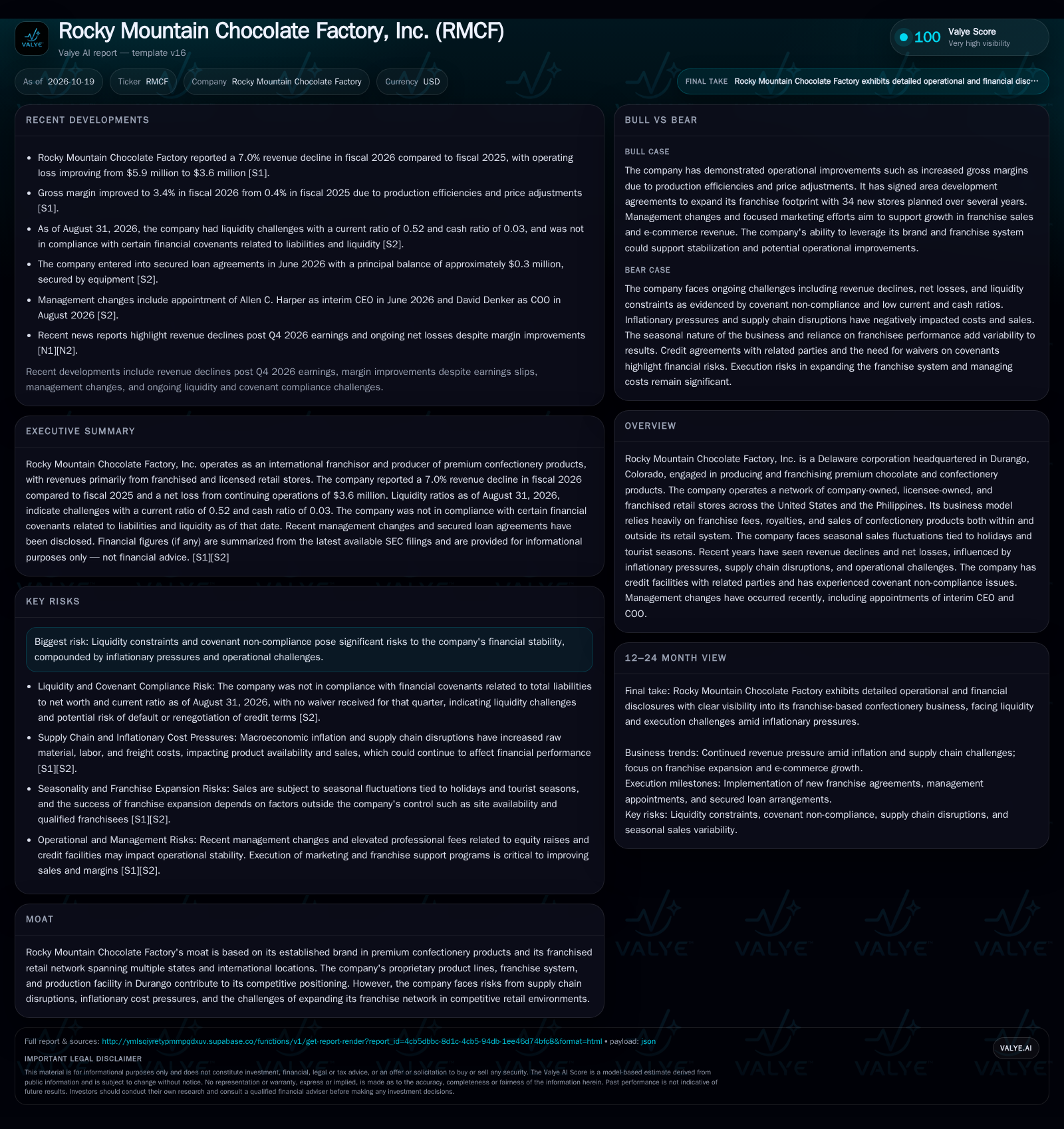
Rocky Mountain Chocolate Factory improved gross margins to 3.4% in fiscal 2026 but saw revenues fall 7.0% and continued to generate net losses. Liquidity is a pronounced concern, with critical covenant non-compliance and a current ratio of 0.52 as of August 31, 2026. New leadership and area development agreements for 34 new franchise stores are intended to reverse revenue declines, but near-term financial stability remains in doubt. [S1] [S2]
Rocky Mountain Chocolate Factory enters fiscal 2027 at a crossroads: operational improvements have nudged gross margins back into positive territory, and new franchise agreements promise longer-term growth. Yet, these incremental wins are overshadowed by falling revenues, ongoing net losses, and a liquidity position that threatens near-term stability. With management turnover and covenant breaches compounding the uncertainty, the company’s ability to extract value from its franchise network and navigate inflationary headwinds will be decisive. The coming quarters will test whether cost discipline and franchise expansion can offset structural pressures in a changing retail confectionery market.
Margin Gains and Liquidity Strain Define the Current Landscape
Rocky Mountain Chocolate Factory saw fiscal 2026 revenues decline 7.0% to $27.5 million, with net losses narrowing from $5.9 million to $3.6 million year-on-year [S1]. Despite this, the company managed a notable gross margin recovery—from 0.4% in fiscal 2025 to 3.4% in 2026—attributed to production efficiencies and price increases [S1]. The company reported a current ratio of 0.52 for the period. [S2] Leadership changes, including an interim CEO and new COO, were implemented in mid-2026 to address operational and strategic gaps [S2]. Four new area development agreements targeting 34 franchise stores over three to five years signal growth ambitions, but cash constraints and compliance issues remain the most pressing near-term risks [S1] [S2].
Franchise Royalties, Product Sales, and the Limits of Operating Leverage
Rocky Mountain Chocolate Factory’s economics are anchored in its franchised/licensed retail network, which generates revenue through royalty streams, initial franchise fees, and the sale of proprietary confectionery products to franchisees and third-party outlets. The franchising model typically offers higher operating leverage and lower capital intensity compared to company-owned retail, as franchisees bear most of the direct retail and labor costs. However, this leverage cuts both ways: franchise royalties and product sales are directly exposed to foot traffic, consumer spending, and franchisee viability—each vulnerable to macroeconomic headwinds and cost inflation.
The company’s gross margin improvement in fiscal 2026 reflects a partial offset to rising input costs via production efficiencies and price adjustments. The company reported cash and liquidity metrics for the period; these figures do not by themselves establish operating runway, investment capacity, financial flexibility, or financing capacity. Expansion through new franchise agreements could boost high-margin royalty and product sales if executed well, but the upfront costs of franchisee onboarding, marketing support, and supply chain scaling may require further funding.
The interplay between franchise royalties and product sales underscores a critical balancing act for Rocky Mountain Chocolate Factory. While royalties provide a relatively stable, recurring revenue stream less sensitive to direct retail volatility, product sales to franchisees and third-party outlets introduce variability tied to inventory turnover and consumer demand fluctuations. This dual dependency means that any disruption in franchisee profitability or consumer purchasing behavior can have a magnified effect on consolidated revenues. Moreover, the company’s ability to negotiate favorable terms and maintain pricing power with franchisees and suppliers will be essential in preserving margin integrity amid inflationary pressures.
Operating leverage in a franchising model is nuanced; although fixed costs at the corporate level may be lower than in a company-operated retail model, certain overhead expenses—such as franchise support, marketing, and supply chain management—do not scale linearly with franchise count. Consequently, the timing and pace of franchise expansion must be carefully managed to avoid periods where incremental costs outpace revenue growth, potentially exacerbating liquidity strain. Additionally, the upfront investments required to support new franchisees, including training and infrastructure, can temporarily depress cash flow even as long-term revenue streams are being established.
Brand Recognition vs. Retail Realities: The Competitive Chessboard
Rocky Mountain Chocolate Factory’s primary competitive assets are its established brand in premium confectionery and its multi-state franchise network, including a presence in high-traffic tourist destinations and shopping centers. Proprietary recipes and branded products offer some product differentiation, but the core retail confectionery market is highly fragmented and faces ongoing threats from private-label brands, specialty chocolatiers, and mass-market candy manufacturers.
The franchised model can enable rapid footprint expansion relative to capital-light competitors, but the company’s ability to attract new franchisees is constrained by the financial health of its current system and the economics of small-format specialty retail. Substitution risk is elevated: consumers can shift to online gifting, direct-to-consumer chocolatiers, or experiential dessert concepts. Meanwhile, inflationary pressures and supply chain disruptions erode any cost advantage the company may once have held. The question is whether Rocky Mountain’s brand and franchise support can sustain store-level economics in a period of weak discretionary spending.
Franchise Expansion and Cost Discipline Spark a Turnaround
A favorable trajectory for Rocky Mountain Chocolate Factory would be catalyzed by smooth execution of its area development agreements, resulting in a steady cadence of new franchise openings over the next three to five years. If new stores ramp up quickly and existing franchisees maintain or improve unit-level sales, the company could see an inflection in royalty and product revenues. Further gains in production efficiency or successful price increases could lift gross margins above current levels, enabling positive operating leverage as fixed costs are spread over a larger revenue base.
Confirmation would come from sequential growth in franchise unit count, rising same-store sales (if disclosed), and sustained margin improvement. Restoration of covenant compliance and a shift to operating cash flow positivity would further support the case. Conversely, delays in franchise openings, persistent net losses, or continued liquidity stress would cast doubt on the turnaround.
Incremental Margin Gains Offset by Structural Pressure
The most plausible outcome is that Rocky Mountain Chocolate Factory continues to eke out modest gross margin improvements through ongoing cost control and selective price increases, but revenue remains pressured by consumer spending headwinds and the slow pace of franchise expansion. The company may stabilize net losses but struggle to return to sustained profitability in the near term, as fixed costs and interest expenses continue to absorb incremental margin gains.
Confirmation of this scenario would include flat or slightly declining revenues, slow but steady increases in gross margin, and ongoing (though narrowing) net losses. Any further covenant breaches or forced renegotiation of credit terms would reinforce the view that operational improvements are insufficient to materially shift the financial trajectory.
Liquidity Crunch Forces Restructuring or Store Closures
The adverse scenario centers on the company’s inability to restore liquidity or achieve covenant compliance, triggering lender actions, forced asset sales, or a restructuring process. Persistent net losses could deplete the remaining reported cash balance, while franchisees facing weak sales or cost inflation may exit the system, further eroding royalty and product revenues.
Evidence for this scenario would include accelerating declines in store count, additional covenant breaches without waivers, delayed vendor payments, or asset impairments. A spike in related-party borrowings or distressed financing efforts would further suggest that the company’s financial position has become untenable.
Milestones That Will Shape Rocky Mountain Chocolate Factory’s Next Chapter
Progress on opening the 34 new franchise stores under area development agreements—quarterly disclosures on new unit openings would help assess momentum.
Trends in gross margin and operating margin—continued improvement would signal that cost efficiencies and pricing actions are taking hold.
Restoration of compliance with financial covenants and any updates regarding waivers or renegotiation of terms.
Net cash from operating activities—movement toward positive cash flow would mark a critical inflection.
Changes in company-owned versus franchised/licensed store mix—a shift toward more franchised units could improve capital efficiency, if disclosed.
Franchisee health metrics such as unit-level sales, closures, or bankruptcies—data here would clarify system stability, if made available.
Updates on supply chain costs and inflationary impact—ongoing commentary or data would help gauge margin risk.
Management commentary on e-commerce or direct-to-consumer growth, which could represent a new revenue lever.
Disclaimer: This is research-only, informational analysis and not investment advice. It may include AI-generated interpretation and general industry context. Always verify important details using primary sources.

Comments