
GE Aerospace: Engine Order Momentum, Liquidity Management, and the Durability of Its Competitive Edge
GE Aerospace enters late 2026 with strong revenue and order momentum in commercial and defense propulsion, but faces tight liquidity management and intensifying industry competition. The path forward hinges on converting major engine wins, sustaining high-margin services, and demonstrating resilience to market cycles and supply chain risks.
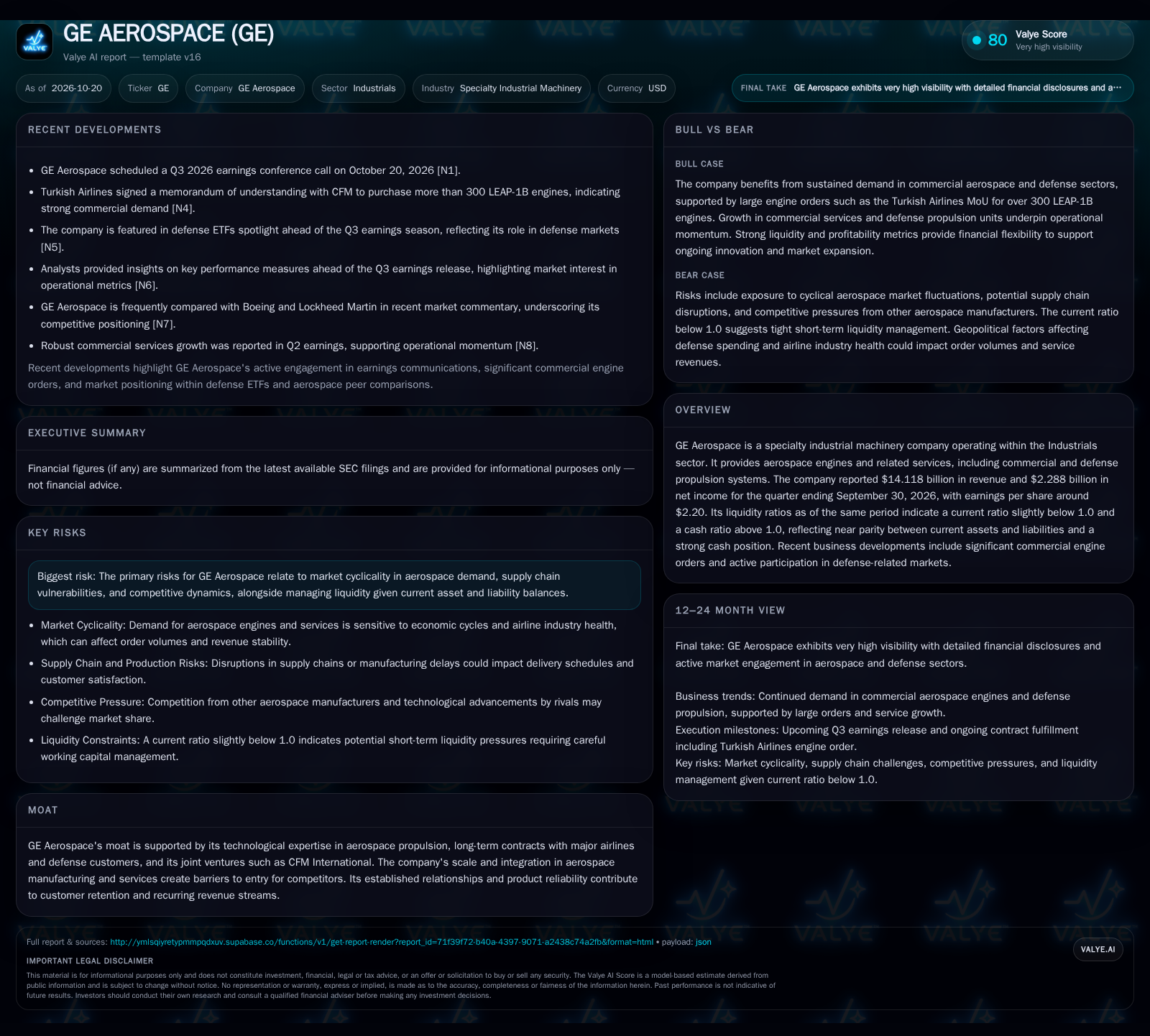
GE Aerospace reported $14.1B in Q3 2026 revenue and secured a major engine order with Turkish Airlines, but its current ratio below 1.0 underscores the need for careful liquidity management. The company’s long-term contracts and joint ventures offer some insulation, yet execution on order fulfillment and service growth will be critical as industry cycles and competitive pressures intensify. Investors should focus on service revenue mix, backlog conversion, and working capital trends for early signals of structural strength or vulnerability. [S2]
GE Aerospace stands at a critical juncture as it leverages robust commercial engine orders and defense propulsion demand to drive near-term growth, reporting $14.1 billion in Q3 2026 revenue and $2.3 billion in net income. As the sector faces cyclical and competitive pressures, GE Aerospace’s ability to convert its backlog into profitable aftermarket services and manage its capital intensity will define the durability of its current momentum. [S2]
Recent Financial Results and Major Engine Wins Define the Current Backdrop
GE Aerospace reported $14.118 billion in revenue and $2.288 billion in net income for the quarter ending September 30, 2026, maintaining its position as a leading provider of commercial and defense propulsion systems. These results reflect ongoing demand across both market segments. The company’s basic and diluted EPS for the period were $2.21 and $2.20, respectively. [S2]
A significant business development is the memorandum of understanding signed with Turkish Airlines for the purchase of over 300 LEAP-1B engines via CFM International, a GE joint venture. This order, while not yet a binding contract, underscores strong market appetite for GE-powered propulsion in commercial fleets and points to a meaningful future installed base.
On the balance sheet, GE Aerospace’s current assets of $41.528 billion versus current liabilities of $42.395 billion result in a current ratio of 0.98, with a cash ratio of 1.02. This indicates the company is operating with near parity between short-term assets and liabilities—a position requiring careful working capital management to avoid liquidity strain. [S2]
How GE Aerospace’s Revenue Model and Cost Structure Shape Value Creation
GE Aerospace’s business economics are anchored in the sale of high-value commercial and military engines, followed by long-term aftermarket services that typically generate recurring, high-margin revenue. The installed base of engines, especially when expanded by large orders such as the Turkish Airlines MoU, is the primary driver for future service contracts—often lasting decades and including maintenance, repair, and overhaul (MRO).
Initial engine sales are generally lower-margin due to competitive pricing and the strategic aim of securing long-term service revenue. The aftermarket—where GE provides parts, upgrades, and scheduled servicing—tends to be more profitable, as customers rely on OEM support for mission-critical reliability and regulatory compliance. This creates operating leverage as the installed fleet grows.
Capital intensity remains high: research and development, production tooling, and working capital needs are substantial, especially as GE must pre-invest in new engine programs and manage elongated customer payment cycles. The company reported cash and liquidity metrics for the period; these figures do not by themselves establish operating runway, investment capacity, financial flexibility, or financing capacity. [S2]
Pricing power in the aftermarket depends on proprietary technology, regulatory entrenchment, and customer switching frictions, but is not immune to competitive or macroeconomic shocks. Volume growth is contingent on airline health, defense budgets, and fleet expansion cycles, while product mix can shift with changes in customer demand or platform adoption.
Competitive Moats and the Pressures of a Consolidating Aerospace Landscape
GE Aerospace’s competitive edge is built on technological leadership in propulsion, long-standing relationships with global airlines and defense agencies, and the substantial barriers to entry in engine certification, reliability, and global support infrastructure. Joint ventures like CFM International further extend reach and risk-sharing.
However, the global aerospace sector remains highly competitive and cyclical. Major manufacturers in both commercial (e.g., global conglomerates with propulsion divisions) and defense (e.g., integrated defense contractors) segments vie for platform wins and aftermarket contracts. Competitors are investing in next-generation engine technologies, sustainable propulsion, and digital MRO solutions—potentially eroding differentiation over time.
Switching costs for customers are significant due to regulatory approvals, integration complexity, and pilot retraining, but new entrants or disruptive technologies (such as hybrid-electric propulsion) could eventually pressure incumbents. The durability of GE’s moat depends on maintaining technical superiority, cost competitiveness, and service reliability.
Capturing Full Value from Order Backlog and Service Expansion Could Unlock Structural Upside
The most favorable trajectory for GE Aerospace is one where robust commercial engine orders—such as the Turkish Airlines MoU—convert into binding contracts and timely deliveries, expanding the active installed base. As these engines enter service, aftermarket revenue streams would grow, driving margin expansion and greater operating leverage.
If the company can sustain high renewal rates for long-term service agreements, cross-sell digital and predictive maintenance offerings, and limit cost overruns, its recurring cash flows and profitability could structurally improve. Ongoing investment in R&D and digitalization would reinforce the company’s technological edge and service differentiation.
Evidence that would confirm this scenario includes: reported growth in service revenue as a percentage of total sales, a rising backlog of contracted (not just announced) orders, higher disclosed aftermarket margins, and stable or improving working capital efficiency. Announcements of major contract conversions and high customer retention rates would strengthen the bull case.
Sustained Demand Balanced by Cyclical and Executional Headwinds
The most plausible path for GE Aerospace is continued steady demand in both commercial and defense propulsion, supported by a mix of new engine deliveries and aftermarket services. Engine orders like the Turkish Airlines MoU provide visibility, but actual backlog conversion, customer payment timing, and supply chain execution will dictate the pace of revenue recognition and cash generation.
Margins are likely to remain solid but subject to pressure from input costs, labor, and potential pricing concessions required to secure large orders.
Confirmation of this scenario would come from stable sequential revenue growth, consistent service revenue contribution, and avoidance of major supply chain or production disruptions. Deterioration in working capital or evidence of customer deferrals would challenge the base case.
Order Deferrals, Supply Chain Disruptions, or Liquidity Stress Could Derail Current Momentum
A negative scenario would emerge if airlines or defense customers defer or cancel engine orders due to macroeconomic shocks, geopolitical instability, or sectoral downturns. Supply chain disruptions—such as shortages of critical materials or labor—could delay deliveries, reduce revenue recognition, or inflate costs.
In such a scenario, GE Aerospace might be forced to slow new investment, negotiate less favorable terms with suppliers, or seek external financing, all of which could compress margins and erode competitive positioning.
Evidence that would support this downside scenario includes: a decline in contracted backlog, rising days sales outstanding (DSO), negative free cash flow trends, and disclosures of production slowdowns or material cost overruns. Negative commentary from major customers or loss of key contracts would also be warning signs.
What Will Determine Whether GE Aerospace Converts Momentum Into Durable Value?
The pace and terms of Turkish Airlines’ LEAP-1B engine order conversion into binding contracts and subsequent deliveries.
Quarterly service revenue growth and its proportion of total revenue, if disclosed, as a signal of recurring margin strength.
Changes in the contracted order backlog and any new multi-year agreements with key commercial or defense customers.
Working capital trends, specifically days sales outstanding and inventory turnover, to assess liquidity management.
Aftermarket margin disclosure, if provided, to gauge the profitability of the installed base.
Supply chain stability as evidenced by on-time delivery rates, supplier commentary, or management updates on input cost trends.
Any announced or rumored new propulsion technologies or digital service offerings that could reinforce (or disrupt) GE Aerospace’s competitive moat.
Disclosures around capital expenditure plans or external financing needs, which would provide insight into the company’s ability to balance growth and liquidity.
Disclaimer: This is research-only, informational analysis and not investment advice. It may include AI-generated interpretation and general industry context. Always verify important details using primary sources.

Comments