
Webstar Technology Group: Real Estate Pivot, Liquidity Constraints, and the Execution Challenge
Webstar Technology Group has shifted from software licensing to specialty real estate development with major projects in Atlanta and resort assets, but current liabilities exceed assets and execution risk looms large as management navigates financing, project milestones, and a new business identity.
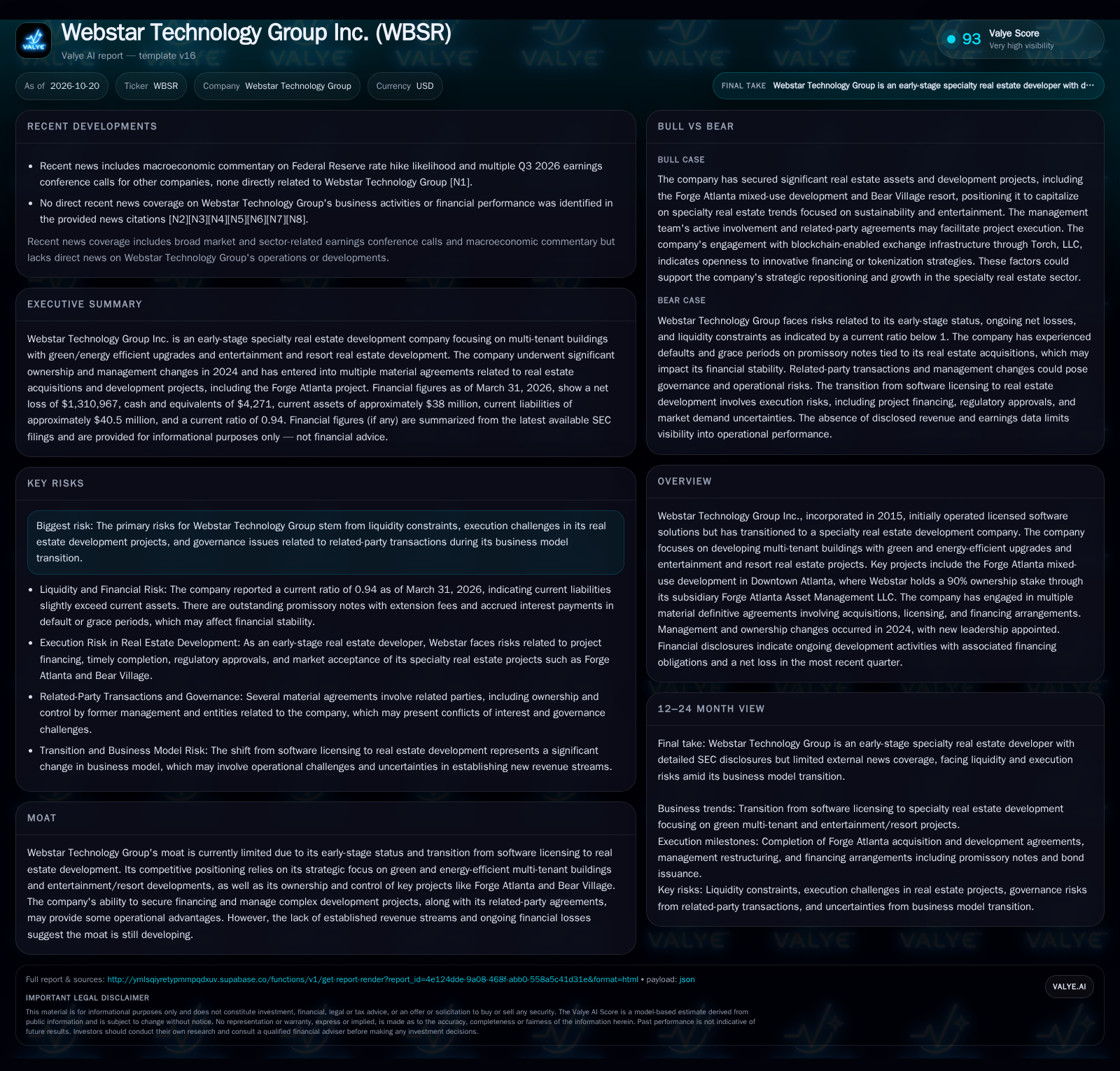
Webstar Technology Group has transitioned into a specialty real estate developer, anchored by the Forge Atlanta mixed-use project and Bear Village resort assets. Execution risk is heightened by the early-stage nature of its projects, recent management changes, and a business model transition. Success will depend on securing project financing, delivering on development milestones, and establishing reliable revenue streams in a competitive and capital-intensive sector. [S2]
Webstar Technology Group’s transformation from a software operator to a specialty real estate developer represents an ambitious pivot into capital-intensive, execution-sensitive territory. With flagship projects such as Forge Atlanta and Bear Village, the company is betting on green, multi-tenant, and entertainment-focused real estate to drive future growth. Yet, as of March 2026, liquidity pressures are acute—current liabilities outstrip assets, and financing defaults have occurred. Management’s ability to secure funding, deliver on development milestones, and professionalize operations will determine whether Webstar can achieve durable value creation or remain mired in early-stage risk.
Liquidity Crunch and Real Estate Bet Define Webstar’s Present
Webstar Technology Group has transitioned to a specialty real estate development model, focusing on green, multi-tenant, and entertainment/resort projects, with key assets including a majority stake in Forge Atlanta and the Bear Village resort. As of March 31, 2026, the company reported current assets of $38.1 million against current liabilities of $40.5 million—a current ratio of 0.94—and a cash position of just $4,271, resulting in a cash ratio of zero. The company is operating at a net loss, with a quarterly loss of $1,310,967. Some promissory notes tied to property acquisitions remain in default or grace periods, highlighting ongoing financing stress. These facts underscore the acute liquidity and execution risks Webstar faces as it attempts to deliver large-scale development projects. [S2]
How Webstar’s Development Model Could (or Might Not) Deliver Profits
Webstar’s new business model is predicated on acquiring, developing, and operating or selling specialty real estate assets—specifically, green multi-tenant buildings and entertainment/resort properties. In such a model, value creation typically depends on the ability to: (1) secure land and entitlements at attractive prices, (2) finance construction and upgrades efficiently, (3) achieve above-market occupancy or sale prices, and (4) manage ongoing operating costs. Real estate development is highly capital-intensive and lumpy in cash flows, with large upfront funding needs followed by multi-year periods before revenue realization.
Revenues could arise from property sales, leasing income, management fees, or, in the case of resorts, direct operations. Margins and operating leverage are often volatile—fixed costs (debt service, property taxes, maintenance) are high, while revenue is contingent on successful completion, market demand, and pricing power. Given the company’s current liabilities and history of payment defaults, Webstar’s ability to fund construction and absorb cost overruns will be critical. At this stage, the absence of established recurring revenue streams or pre-leasing/pre-sales commitments amplifies risk. The company’s exploration of blockchain-enabled tokenization for economic interests could, if executed, broaden investor access or lower capital costs, but such mechanisms are unproven at scale in U.S. real estate and introduce additional execution and regulatory complexity. [S2]
Emergent Differentiators and the Challenge of Standing Out in Real Estate
Webstar’s potential competitive edge is its focus on green/energy-efficient multi-tenant development and entertainment/resort real estate, aiming to capitalize on sustainability and lifestyle trends. However, these are increasingly crowded spaces, with institutional developers, REITs, and boutique players all pursuing similar themes. Webstar’s ability to secure prime land (as with Forge Atlanta) and its willingness to experiment with novel financing (e.g., blockchain tokenization) may provide a temporary edge if executed well.
Counterforces include the company’s early-stage status, limited operational history in real estate, and reliance on related-party agreements, which may raise governance or conflict-of-interest concerns. Larger, established developers benefit from lower cost of capital, deeper relationships with financiers, and proven project delivery records. Switching frictions in real estate are generally low for tenants and buyers, placing a premium on location, amenities, and price. Webstar’s moat is thus embryonic: its future defensibility will depend on execution, brand-building, and the ability to deliver differentiated projects on time and on budget. [S2]
If Financing Falls into Place and Projects Deliver: Unlocking Asset Value
The most favorable scenario for Webstar sees the company securing sufficient financing to complete Forge Atlanta and Bear Village on schedule and within budget. Successful execution would enable the company to either sell or lease these assets at attractive valuations, potentially generating significant cash flow and validating its business model pivot. The green and entertainment-focused positioning could attract premium tenants or buyers, especially if demand for sustainable and experiential real estate remains robust.
The company’s engagement with blockchain-enabled tokenization, if implemented effectively, could lower its cost of capital or attract a new class of investors, further accelerating development. Evidence supporting this scenario would include public announcements of construction progress, successful project financing or bond offerings, pre-leasing or pre-sales commitments, and eventual occupancy or sale at premium prices. Conversely, persistent financing gaps, construction delays, or failure to attract tenants would quickly falsify the upside thesis. [S2]
Incremental Progress Amid Funding Gaps and Execution Hurdles
The most plausible trajectory is one of gradual progress punctuated by ongoing liquidity challenges. Webstar may secure partial funding or renegotiate terms on its promissory notes, allowing it to advance development in phases but not at optimal speed or scale. Management may need to pursue asset sales, joint ventures, or dilutive capital raises to bridge funding gaps. Project timelines could extend, with revenue realization delayed and margins pressured by cost overruns or higher financing costs.
Evidence for this scenario would be continued filings reflecting incremental construction or acquisition milestones, new (but potentially expensive) financing arrangements, and persistent net losses. Any progress in establishing leasing agreements, project partnerships, or partial asset monetization would lend support to this scenario. Falsification would occur if the company either rapidly resolves its liquidity issues and delivers projects on schedule (upside), or if it faces foreclosure, bankruptcy, or asset fire sales (downside). [S2]
Liquidity Crunch, Project Delays, and Governance Risks Derail Value Creation
In the downside scenario, Webstar’s liquidity constraints worsen, with defaults on promissory notes or inability to secure necessary project financing leading to construction stoppages, forced asset sales, or even bankruptcy proceedings. Related-party transactions and recent management changes could exacerbate governance challenges, potentially resulting in unfavorable terms for minority shareholders or regulatory scrutiny.
Project delays or failures would erode credibility and limit future financing options, while the absence of recurring revenue streams would leave the company unable to cover fixed obligations. Unfavorable macro conditions (rising interest rates, real estate market downturns) would amplify these risks. Confirmation of this scenario would come from additional filings indicating defaults, legal disputes, project abandonment, or significant asset impairment. [S2]
What Will Determine Whether Webstar’s Real Estate Ambitions Succeed or Stall?
Updates on the status of promissory note payments, defaults, and extensions related to Forge Atlanta—future filings should clarify whether financing is stabilized or deteriorating. [S2]
Progress milestones for Forge Atlanta and Bear Village: land acquisition closings, construction starts, permitting, and major development contracts. [S2]
Evidence of pre-leasing, pre-sales, or anchor tenant commitments for new developments—if disclosed, these would signal demand and potential revenue visibility.
Operational metrics for completed assets: occupancy rates, leasing spreads, or resort bookings (if disclosed), which would validate the revenue model.
Updates on the implementation and commercial traction of blockchain-enabled tokenization or exchange infrastructure partnerships—early adoption or investor participation would be notable.
Disclosures about related-party agreements, changes in management, or governance practices that could affect decision-making or minority shareholder rights. [S2]
Any filings indicating asset impairments, construction delays, legal disputes, or covenant breaches, which would signal rising downside risk. [S2]
Disclaimer: This is research-only, informational analysis and not investment advice. It may include AI-generated interpretation and general industry context. Always verify important details using primary sources.

Comments