
CLPS Inc: Revenue Scale, Profitability Strains, and the Unanswered Questions of Cross-Border IT Services
CLPS Inc reports substantial annual revenue but remains unprofitable, facing the dual challenge of navigating complex PRC and U.S. tax regimes and demonstrating sustainable business economics.
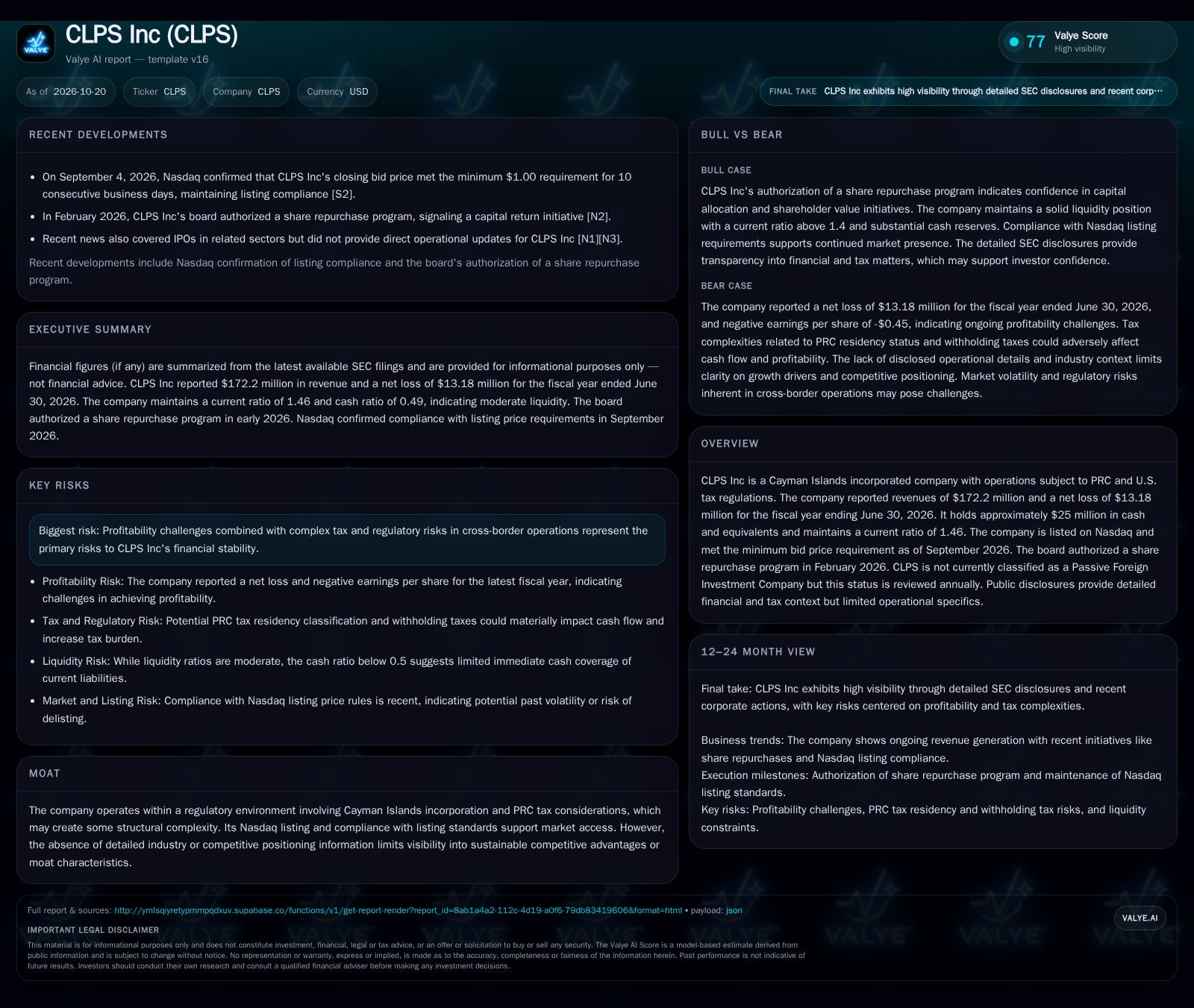
CLPS Inc generated $172.2 million in revenue but posted a net loss of $13.18 million for the fiscal year ending June 2026, with cash and equivalents at $25 million. The company recently regained Nasdaq minimum bid compliance and authorized a share repurchase program, but faces ongoing profitability and regulatory complexity risks. The lack of operational transparency makes it difficult to assess the durability of its business model or its position within the IT services landscape. [S1] [S2] [N2]
CLPS Inc stands at a crossroads: it boasts significant annual revenue, maintains reported liquidity position, and recently averted Nasdaq delisting through compliance with listing requirements. Yet the company posted another year of net losses and negative earnings per share, and the granular mechanics of its business—customer base, pricing power, cost drivers, and industry positioning—remain largely undisclosed. With operations subject to both PRC and U.S. tax regimes, and only limited insight into how its business model converts revenue into profit and cash flow, investors are left to navigate a landscape of regulatory complexity and operational opacity. The next phase hinges on whether CLPS can demonstrate sustainable economics or will continue to struggle with profitability and cash conversion.
Recent Financials Highlight Scale Without Profitability
CLPS Inc reported $172.2 million in revenue for the fiscal year ending June 30, 2026, but posted a net loss of $13.18 million and negative earnings per share of -$0.45. Cash and cash equivalents stood at $25.06 million, while the company’s current ratio was 1.46 and cash ratio 0.49 as of the same date. The company also received confirmation in September 2026 from Nasdaq that it met the minimum $1.00 bid requirement for 10 consecutive trading days, restoring compliance and reducing near-term delisting risk. Additionally, a share repurchase program was authorized earlier in 2026. These developments establish CLPS as a revenue-generating, publicly listed entity with reported liquidity position, but also as one facing persistent losses and uncertain cash flow durability. [S1] [S2] [N2]
How CLPS Might Convert Revenue Into Profitable IT Services
The company’s scale suggests it is not a niche player, but the absence of segment or customer disclosures leaves its core business model unclear. If CLPS operates as an IT services provider—a common structure for cross-border, Cayman-incorporated Chinese firms—its revenue is likely driven by a mix of project-based contracts, ongoing support services, and possibly managed staffing or outsourcing. Margins in this sector can vary widely: recurring managed services typically offer higher gross margins and revenue visibility, while project-based work is more volatile and labor-intensive.
Fixed costs in IT services often include technical staff, management, and compliance infrastructure, with variable costs tied to project delivery. Operating leverage can be favorable if revenue growth outpaces headcount and overhead expansion, but equally, wage inflation and pricing pressure can erode margins. The reported net loss implies that CLPS may be struggling with either pricing power, cost control, or both. The company reported cash and liquidity metrics for the period; these figures do not by themselves establish operating runway, investment capacity, financial flexibility, or financing capacity.
Without detail on customer concentration, sector exposure, or contract duration, the durability of CLPS’s revenue and its ability to scale profitably remain open questions. If its revenue is heavily concentrated in a few large clients or exposed to cyclical sectors, volatility and margin risk would be elevated.
Assessing CLPS’s Place in a Fragmented, Cost-Driven IT Services Market
In the absence of segment or client disclosure, CLPS’s competitive position can be inferred only in broad terms. The IT services industry—particularly in the China-to-global or China-to-China cross-border segment—is highly fragmented, with intense price competition and low switching costs for many commoditized services. Larger, well-established players tend to capture premium contracts and benefit from brand, scale, and deeper customer relationships, while smaller firms compete on price or specialized expertise.
If CLPS serves international or multinational clients, regulatory risk (including data residency and tax compliance) can be both a barrier to entry and a source of cost. However, without evidence of proprietary technology, sticky customer relationships, or high switching costs, it is difficult to argue for a durable moat. The company’s Cayman incorporation and PRC tax exposure may offer some structural flexibility but also add compliance complexity. Its recent Nasdaq compliance supports continued access to public capital markets but is not a competitive advantage in itself.
Potential substitutes include both regional IT consulting boutiques and global outsourcing giants. If CLPS focuses on niche verticals or emerging technology (such as AI, fintech, or cloud integration), margin potential could be higher, but this is not established in the current disclosure.
A Turn to Profitable Growth Through Service Mix Shift and Cost Discipline
The most constructive scenario for CLPS involves shifting its service mix toward higher-margin, recurring revenue streams—such as managed services, proprietary software integration, or niche consulting—while achieving cost discipline in delivery. This could be accomplished by automating low-value tasks, standardizing offerings, or deepening relationships with anchor clients. If CLPS can leverage its scale to negotiate better terms with vendors or invest in proprietary platforms, operating leverage could drive margin expansion.
Evidence supporting this scenario would include a narrowing of net losses or a return to profitability, improved gross and operating margins, increased cash flow from operations, and disclosures about larger or longer-term contracts. Announcements of new service launches, strategic partnerships, or marquee client wins in high-growth sectors would also support the case for a sustainable turnaround.
Falsification would come from continued or widening losses, persistent negative cash flow, or evidence that revenue growth is accompanied by rising cost ratios, suggesting a lack of pricing power or inability to control expenses.
Operational Status Quo: Revenue Persists but Losses Continue
The most plausible near-term trajectory is that CLPS continues to generate substantial revenue but struggles to convert it into profit or free cash flow. Without clear evidence of a service mix shift, cost restructuring, or new competitive advantages, the company may remain caught between price competition and rising delivery costs, especially if wage inflation or regulatory compliance expenses grow.
Confirmation would come from future filings showing ongoing net losses, stable or modestly growing revenue, and little improvement in cash flow metrics. A continued lack of operational detail or new business disclosures would further entrench the status quo.
Falsification of this scenario would require evidence of a material improvement in margins, positive earnings per share, or a significant change in the company’s business mix or cost structure.
Profitability Pressures and Regulatory Complexity Drive Erosion of Value
A more adverse scenario sees CLPS’s losses deepening as revenue growth stalls or contracts, possibly due to client attrition, pricing pressure, or regulatory headwinds—such as adverse PRC tax rulings or new U.S. compliance costs. Cross-border cash repatriation, withholding taxes, or a shift in PFIC status could further constrain potential financial flexibility.
Confirmation would include a worsening net loss, declining cash balances, an increased reliance on short-term borrowing or equity dilution, and any regulatory disclosures indicating new tax or compliance burdens. Delisting risk could re-emerge if the share price falls below Nasdaq thresholds again, particularly in a period of market volatility.
Falsification would require stabilization of margins, improved cash generation, and clear evidence that regulatory and tax headwinds are being successfully managed.
What Will Reveal Whether CLPS Can Create Sustainable Shareholder Value?
Quarterly and annual trends in gross and operating margins—if disclosed—would provide direct visibility into whether CLPS is making progress on cost control and pricing discipline.
Cash flow from operations, not just revenue or earnings, will be critical to track, given the company’s modest cash ratio and persistent losses.
Any disclosure of customer concentration, contract duration, or revenue by segment would help clarify the risk profile and revenue durability.
Material changes in PRC or U.S. tax status—including PFIC designation or new withholding tax liabilities—could have disproportionate impact on cash flow and net income.
Announcements of new service offerings, strategic partnerships, or marquee client wins would suggest a shift toward higher-margin or more defensible business lines.
Updates on the execution of the share repurchase program—including size, pace, and funding source—would signal management’s capital allocation priorities and confidence.
Sustained compliance with Nasdaq listing requirements (minimum bid, market cap, etc.) will remain a necessary condition for continued public market access.
Evidence of cost restructuring, automation initiatives, or headcount optimization—if disclosed—would indicate management action toward margin improvement.
Disclaimer: This is research-only, informational analysis and not investment advice. It may include AI-generated interpretation and general industry context. Always verify important details using primary sources.

Comments