
Iridium Communications: Global Satellite Reach, Government Anchors, and the Uncertainty of a Transformational Merger
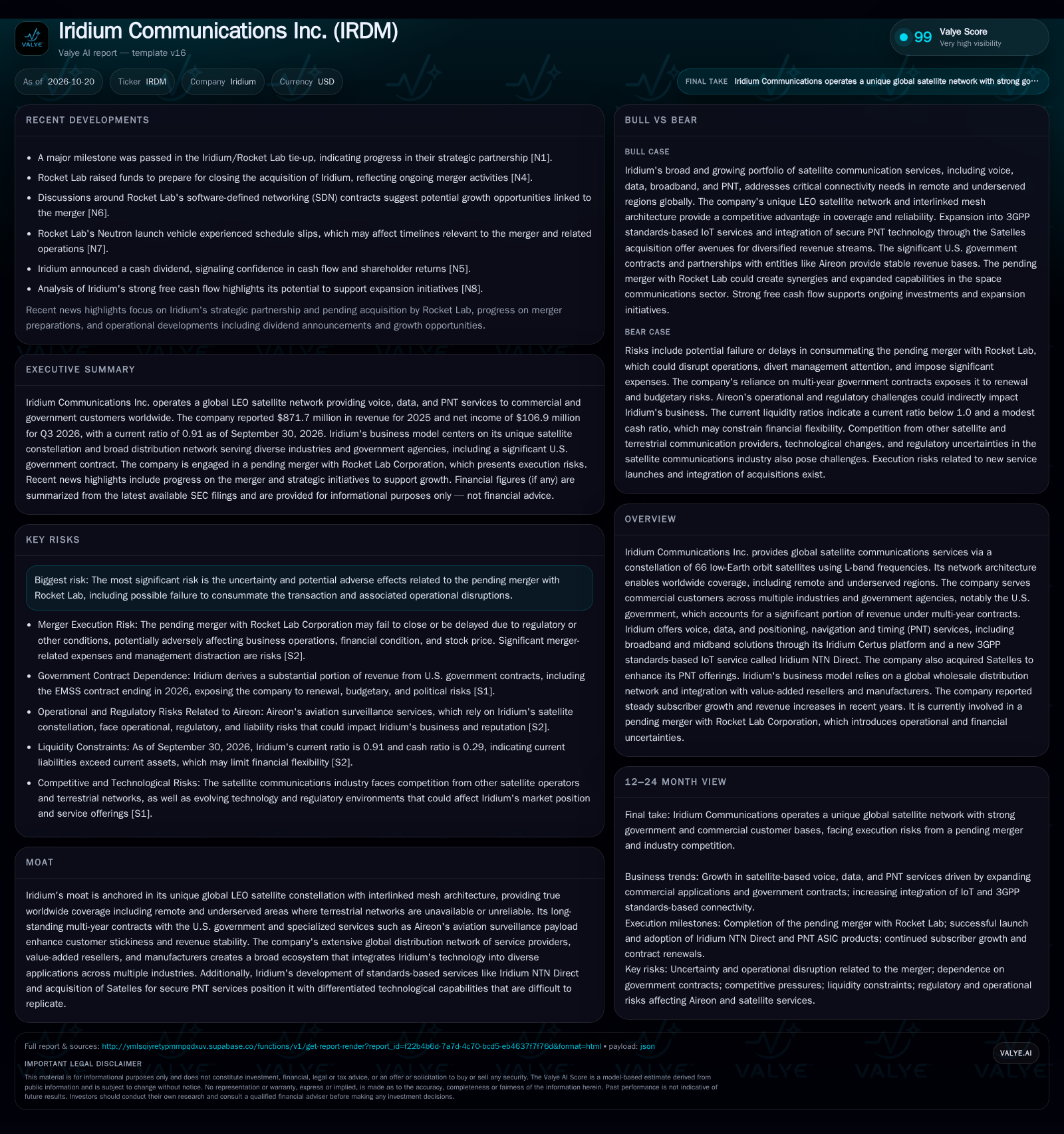
Iridium’s unique LEO satellite network underpins resilient global connectivity and a stable government revenue base, but the pending Rocket Lab merger introduces material execution risk. The company’s future will hinge on its ability to expand IoT and PNT offerings, manage liquidity, and sustain relevance amid intensifying competition and evolving customer needs.
Iridium delivers specialized global satellite communications with a distinctive LEO mesh network, serving government and commercial clients in hard-to-reach areas. Government contracts, especially with the U.S. The upcoming Rocket Lab merger could reshape Iridium’s trajectory, amplifying both opportunity and operational risk as the company pushes into IoT and secure PNT services.
Iridium Communications stands at the intersection of resilient infrastructure and strategic transition. Its LEO satellite network delivers truly global voice, data, and PNT services to customers unreachable by terrestrial providers, anchoring stable government and commercial revenues. The coming quarters will reveal whether Iridium can convert its unique assets into sustainable competitive advantage—or whether merger execution and market shifts will expose its vulnerabilities.
Recent Developments: Merger, Liquidity, and Government Contract Extension
The most material developments shaping Iridium’s current outlook are the pending merger with Rocket Lab, the extension of the company’s largest U.S. government contract, and a liquidity profile that demands careful management. The Rocket Lab transaction, still subject to regulatory and execution risk, could significantly alter Iridium’s operational and financial structure, but also brings the potential for disruption and integration challenges [S2] [N4]. The U.S. Space Force recently exercised its option to extend the Enhanced Mobile Satellite Services (EMSS) contract through March 2027 at the same fixed annual rate, anchoring near-term revenue stability for the 29% of 2025 revenues tied to this relationship [S1] [S2]. [S2]
How the LEO Mesh Model Drives Revenue and Margin Structure
Iridium’s business model is built around its proprietary LEO satellite constellation with cross-linked mesh architecture, enabling voice, data, and PNT services in geographies inaccessible to terrestrial networks. Revenue streams are split among recurring service subscriptions (voice/data airtime), equipment sales, engineering services, and specialized government contracts. The U.S. government EMSS contract provides a fixed annual fee, independent of usage or user count, granting revenue visibility and efficient marginal economics for government traffic. Commercial segments—maritime, aviation, IoT—generate variable revenue based on subscriber growth and usage, but are more exposed to competitive pricing and volume swings [S1] [S2].
The LEO architecture’s high fixed-cost base (satellite deployment, maintenance, ground infrastructure) provides operating leverage as incremental subscribers or usage increase, but also creates substantial sunk costs. Margins in service revenue are typically higher than in hardware sales, which are subject to volume volatility and commoditization pressures, as reflected in the recent decline in subscriber equipment revenue [S2]. The company’s move into 3GPP standards-based IoT (Iridium NTN Direct) and PNT ASIC integration via Satelles aims to open new addressable markets and embed Iridium’s services more deeply into third-party devices, but the magnitude and timing of revenue from these initiatives remain uncertain.
Iridium’s Moat: Global Coverage, Government Ties, and the Race Against New Entrants
Iridium’s most defensible advantage is its global LEO constellation, offering reliable, weather-resilient connectivity in locations where alternatives (terrestrial or geostationary satellite) are impractical or unavailable. This positions Iridium as a provider of last resort for mission-critical communications in aviation, maritime, military, and remote industrial operations [S1]. The company’s mesh architecture minimizes ground infrastructure dependence, enabling service in countries without local presence and supporting resilience during geopolitical or natural disruptions.
Long-term, fixed-price contracts with the U.S. government provide revenue stability and customer stickiness, while the Aireon partnership embeds Iridium’s technology in global aviation surveillance. However, the moat faces erosion from several directions: 1) advancing LEO constellations from new entrants and technology giants promise higher bandwidth or broader integration; 2) terrestrial networks encroach into once-remote areas; 3) open standards and commoditized IoT chipsets could dilute Iridium’s proprietary advantage. The company’s ability to maintain pricing power and relevance will depend on continual technology upgrades, successful integration of PNT/IP, and the stickiness of its distribution and partner ecosystem.
Catalysts for Outperformance: Seamless Merger Integration and IoT/PNT Adoption
A favorable scenario for Iridium would see the Rocket Lab merger close smoothly, unlocking operational synergies, expanded product offerings, and accelerated innovation. If Iridium can rapidly scale its Iridium NTN Direct service—winning design-ins with major IoT device makers and capturing a significant share of standards-based direct-to-device connectivity—service ARPU and subscriber growth could accelerate. Similarly, successful commercialization of Satelles-based PNT ASICs, especially if adopted by critical infrastructure, could create a new, high-margin revenue stream and reinforce Iridium’s role as a trusted provider of secure, resilient timing services [S1].
Confirmation of the upside case would require: (a) evidence of rapid post-merger integration with Rocket Lab (joint product launches, cross-selling wins, combined go-to-market strategies); (b) material increases in IoT and PNT-related revenue, with customer wins in sectors like utilities, logistics, or national security; (c) sustained or accelerated subscriber growth above historical 3% rates; and (d) visible improvement in free cash flow, supporting reinvestment without diluting shareholders.
Sustaining the Core: Stable Government Revenue, Measured Commercial Growth, and Merger Execution Risk
The most plausible near-term outcome is that Iridium continues to anchor its business on the extended EMSS contract and its established commercial base, while executing the Rocket Lab merger amid operational complexity. Modest subscriber growth (in line with historical 3% year-over-year increases) and steady revenue expansion (recently 5%) remain likely, as core maritime, aviation, and land-mobile segments maintain demand for specialized connectivity [S1]. Near-term revenue visibility is supported by the EMSS extension through March 2027, but the transition beyond that date will require contract renewal or replacement.
Integration risk with Rocket Lab may temporarily distract management and create cost overruns or operational inefficiencies, but is unlikely to fundamentally disrupt service delivery if managed prudently. The base scenario is confirmed by steady subscriber and revenue trends, on-time merger closure, and no material negative surprises in government contract renewals or competitive losses.
Adverse Outcomes: Merger Disruption, Contract Risk, and Competitive Erosion
The most acute risk is a failed or prolonged Rocket Lab merger, leading to management distraction, unplanned expenses, and possible customer or partner uncertainty [S2] [N4]. Operational disruption could slow new product rollouts or reduce confidence among key government clients. If the EMSS contract is not renewed beyond March 2027, Iridium would face a material revenue gap, given the U.S. government’s 29% revenue contribution [S1] [S2].
Equipment sales have already shown volume pressure; further declines could indicate commoditization or loss of relevance. Competitive threats—from new LEO constellations offering superior bandwidth, or from terrestrial networks reaching previously inaccessible areas—could accelerate churn or force aggressive price competition, compressing margins. The downside scenario would be confirmed by merger delays or termination, government contract non-renewal or downsizing, sharp declines in equipment or service ARPU, and evidence of customer defections to alternative networks.
What Will Determine Iridium’s Post-Merger Trajectory and Resilience?
Progress milestones and regulatory approvals for the Rocket Lab merger, including timeline to closing and any material changes in deal terms.
Renewal negotiations and ultimate outcome of the EMSS contract with the U.S. government, especially terms post-March 2027.
Quarterly trends in billable subscriber growth, with a useful metric being the mix between traditional satellite services and new IoT/PNT connections, if disclosed.
Revenue and adoption rates for Iridium NTN Direct and PNT ASIC offerings, especially evidence of integration into third-party devices or enterprise contracts.
Free cash flow generation and net leverage ratio, as indicators of Iridium’s capacity to invest in innovation or weather operational shocks.
Trends in equipment revenue and ARPU, which may signal either successful upselling or intensifying price competition.
Operational performance and contract health of Aireon, as disruptions in this segment could have knock-on effects for Iridium’s reputation and revenue.
Disclaimer: This is research-only, informational analysis and not investment advice. It may include AI-generated interpretation and general industry context. Always verify important details using primary sources.

Comments