
FactSet’s AI Ambitions, Margin Compression, and the Challenge of Defending the Financial Data Platform
FactSet’s robust subscription revenue growth and high client retention underscore the company’s embedded platform status, yet rising operating expenses and a tightening liquidity profile raise questions about the sustainability of its margin structure and competitive edge as AI transforms the financial data landscape.
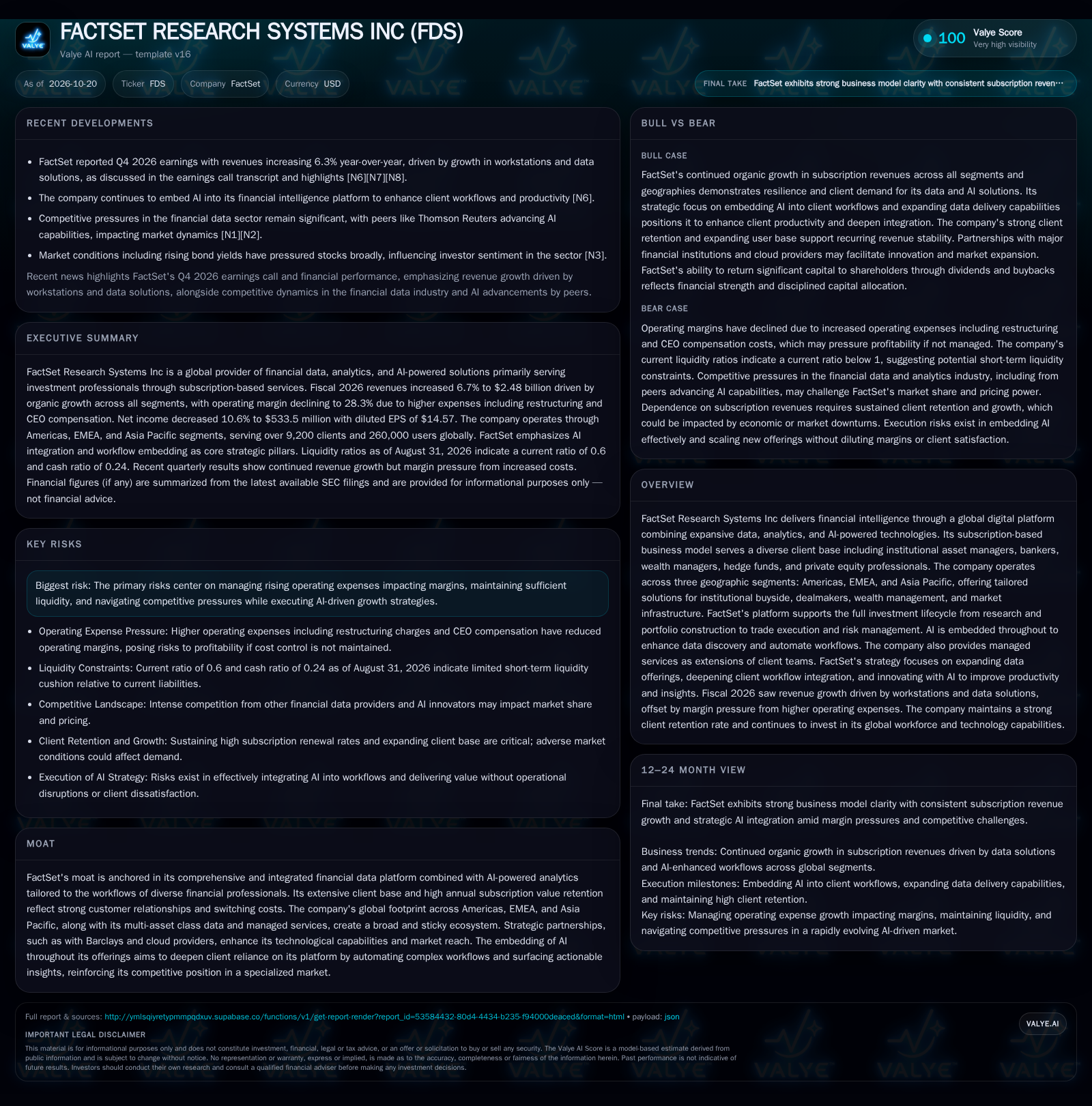
FactSet delivered 6.7% revenue growth in fiscal 2026, driven by data solutions and workstation subscriptions, while its operating margin fell from 32.2% to 28.3% due to increased expenses. The firm maintains retention rates above 95% and continues to embed AI across its platform, but faces competitive and cost headwinds alongside a current ratio of 0.6 as of August 31, 2026. The durability of FactSet’s moat will hinge on its ability to translate AI investments into client value and defend its pricing power as rivals accelerate their own digital innovation strategies. [S1] [S2]
FactSet Research Systems sits at the intersection of finance and technology, providing mission-critical data and analytics to more than 9,200 clients worldwide. The company’s aggressive push into AI-powered workflows could both deepen its moat and accelerate cost structure challenges, as industry peers rapidly advance their own digital offerings. The next phase for FactSet will be defined by its ability to convert AI investments into profitable growth while defending its platform status against intensifying competition. [S1] [S2]
Margin Compression and AI Integration Define FactSet’s 2026 Operating Landscape
FactSet ended fiscal 2026 with revenues up 6.7% to $2.48 billion, continuing its multi-year trend of organic growth in subscription-based data and analytics. The company’s Annual Subscription Value (ASV) increased 7.0% to $2.57 billion, and client retention remained robust with annual ASV retention above 95%. However, operating margin fell sharply to 28.3% from 32.2% a year earlier, primarily due to higher operating expenses—including restructuring charges and CEO compensation. Net income dropped 10.6% to $533.5 million, while diluted EPS declined by 6.3% despite ongoing share buybacks. These trends frame a business that remains sticky and essential to clients but is now contending with cost and balance-sheet pressures even as it invests heavily in AI-driven workflow innovation. [S1] [S2]
The interplay between AI integration and margin compression highlights a critical transitional phase for FactSet’s operating model. While AI investments promise to enhance product differentiation and client value, the upfront costs associated with talent acquisition, infrastructure scaling, and R&D can exert significant pressure on near-term profitability. This dynamic underscores the importance of managing the timing and scale of technology spend relative to revenue growth to avoid prolonged margin erosion. Additionally, the evolving regulatory landscape around data privacy and AI ethics may introduce compliance costs or operational constraints, further complicating the cost-benefit calculus of AI deployment within FactSet’s platform.
Subscription Economics and the Operating Leverage Dilemma
FactSet’s business model is anchored in recurring subscription revenues from multi-asset class data, analytics, and managed services. Pricing is typically structured on a per-seat or enterprise basis, with higher-value contracts linked to advanced analytics, workflow integration, and data delivery solutions. The company’s economics have historically benefited from high gross margins and strong operating leverage, as incremental revenue from new users or expanded solutions often outpaces associated variable costs. However, fiscal 2026 revealed the vulnerability of this model to rising fixed costs—specifically restructuring, elevated executive compensation, and continued technology investment. The drop in operating margin suggests that expense growth, particularly around talent and AI development, is outstripping revenue gains. While AI integration has the potential to automate low-value tasks and improve client productivity (potentially reducing support costs per user), the transition phase may temporarily inflate costs before efficiency gains materialize. [S1] [S2]
The subscription-based revenue model inherently provides a degree of predictability and resilience, yet it also imposes constraints on rapid price increases, especially in competitive markets. FactSet’s ability to leverage AI-enhanced features to justify premium pricing will be crucial in offsetting rising fixed costs. Moreover, the elasticity of demand for advanced analytics and workflow automation solutions will shape how much of the AI-driven value can be monetized. If clients perceive AI enhancements as incremental rather than transformative, willingness to pay may be limited, thereby compressing margins. Conversely, successful embedding of AI into core workflows could create a virtuous cycle of higher retention and upsell opportunities, improving operating leverage over time.
Defending a Platform Moat in an Era of AI-Driven Disruption
FactSet’s moat is built on deep client integration, comprehensive data coverage, and workflow-specific analytics that are embedded in daily decision-making for institutional investors, bankers, and wealth managers. High retention rates and a broad global footprint increase switching costs for existing clients, especially those leveraging FactSet’s managed services and AI-enabled features. However, the competitive landscape is intensifying as rival data providers and technology firms accelerate their own AI initiatives and expand integration into client workflows. The rise of open-source data analytics, cloud-native platforms, and alternative data sources threatens to erode pricing power and lower entry barriers, especially for smaller clients or less differentiated services. FactSet’s ability to defend its premium positioning will depend on maintaining a product and integration lead, particularly in AI-driven automation and insight delivery, and on continuing to justify its value proposition to cost-conscious clients in a more commoditized data environment. Partnerships with major financial institutions and cloud providers could amplify its reach, but also expose the company to new forms of competition and disintermediation.
FactSet’s competitive moat is increasingly tested by the convergence of several disruptive forces. The democratization of AI tools and cloud infrastructure lowers barriers for new entrants and enables incumbent competitors to rapidly innovate. This environment necessitates continuous product evolution and client engagement to sustain differentiation. Furthermore, the shift toward platform ecosystems where data providers, analytics tools, and execution services interoperate introduces risks of disintermediation if FactSet fails to integrate effectively. Strategic partnerships may mitigate these risks by expanding reach and capabilities, but they also require careful management of data governance, revenue sharing, and competitive alignment. Ultimately, FactSet’s success will hinge on its agility in navigating this complex ecosystem while preserving its unique value proposition.
AI-Enabled Workflow Embedding Unlocks Profitable Growth
The most favorable scenario for FactSet is one in which its AI investments translate directly into higher client productivity, deeper workflow embedding, and expanded share of wallet. If AI-driven features—such as automated data extraction, personalized analytics, and predictive insights—become indispensable to core client processes, FactSet could command premium pricing and upsell advanced solutions. This would reinforce high retention rates and potentially accelerate net new client acquisition, especially among digitally native investment firms. Confirmation of this scenario would come from sustained or rising ASV growth above 7%, stabilization or expansion of operating margins despite ongoing tech investment, and evidence of new client wins directly attributed to AI-enabled offerings. Falsification would appear if AI features fail to drive adoption, if clients resist price increases, or if incremental revenues are offset by continued cost inflation.
Revenue Growth Continues, but Margin Remains Under Pressure as AI Transition Unfolds
The most probable near-term outcome is that FactSet sustains mid-single-digit organic revenue growth, driven by incremental adoption of data solutions and continued high retention among core clients. Operating margins, however, are likely to remain compressed in the high-20s as restructuring, compensation, and technology expenses persist through the AI integration phase. Evidence for this scenario would be continued steady ASV growth (5–7%), modest net income declines, and ongoing high client retention, paired with management guidance that prioritizes efficiency and measured technology investment. Falsification would occur if margin compression accelerates, liquidity deteriorates further, or if competitive pressures begin to erode the client base or pricing.
Escalating Cost Structure and Intensifying Competition Undermine Platform Economics
The adverse scenario materializes if FactSet’s cost structure continues to rise faster than revenue, driven by persistent wage inflation, restructuring overruns, or the need to match competitors’ aggressive AI investments. At the same time, if alternative data providers, fintechs, or incumbent rivals succeed in commoditizing core data solutions or undercutting pricing, FactSet could face both client attrition and declining net new sales. Confirmation of this scenario would come from further margin declines into the low-20% range, negative net income growth, slowing ASV expansion, or disclosure of material client losses. If liquidity deteriorates further or the company is forced to raise capital under unfavorable terms, the downside risk to both growth and valuation would be acute.
Metrics and Developments That Will Determine FactSet’s Competitive Trajectory
Sustained ASV growth rates by region and solution line—especially any inflection in Americas or Asia Pacific—would indicate success in defending share and upselling new offerings. [S1]
Quarterly operating margin and expense breakdowns, with particular attention to technology investment and restructuring costs, will reveal whether margin pressures are transitory or structural. [S2]
Trends in annual ASV retention and net new client wins, if disclosed, will show whether FactSet is maintaining its moat or losing ground to competitors.
Adoption rates and client feedback for new AI-enabled features would help test whether innovation is translating into tangible client value.
Liquidity metrics—specifically the current ratio and cash flow from operations—should be monitored for any further deterioration or signs of balance sheet strain. [S1]
Competitive announcements or major product launches from peer data and analytics providers could signal shifts in the industry’s technology baseline and pressure FactSet’s differentiation.
Management commentary on pricing strategy and the balance between investment and cost control will clarify the company’s ability to sustain both growth and profitability.
Disclaimer: This is research-only, informational analysis and not investment advice. It may include AI-generated interpretation and general industry context. Always verify important details using primary sources.

Comments