
Albertsons’ Liquidity Constraints and Margin Pressures: Navigating a Shifting Grocery Landscape
The durability of Albertsons’ business model now hinges on its ability to stabilize profitability, navigate short-term funding needs, and respond to shifting consumer and market dynamics.
The durability of Albertsons’ business model now hinges on its ability to stabilize profitability, navigate short-term funding needs, and respond to shifting consumer and market dynamics. [S2] [N1] [N3] [N4] [N8]
Albertsons Companies stands at a crossroads as it contends with falling profits, liquidity pressures, and a transition in financial leadership. The newly appointed interim CFO inherits a business with substantial assets and diversified product lines, but also faces the challenge of managing legal exposures and restoring margin stability. The next several quarters will test whether Albertsons can leverage its scale and product breadth to regain financial momentum or whether structural pressures will force a more defensive posture.
Recent Profit Decline and Tight Liquidity Define Albertsons’ Near-Term Landscape
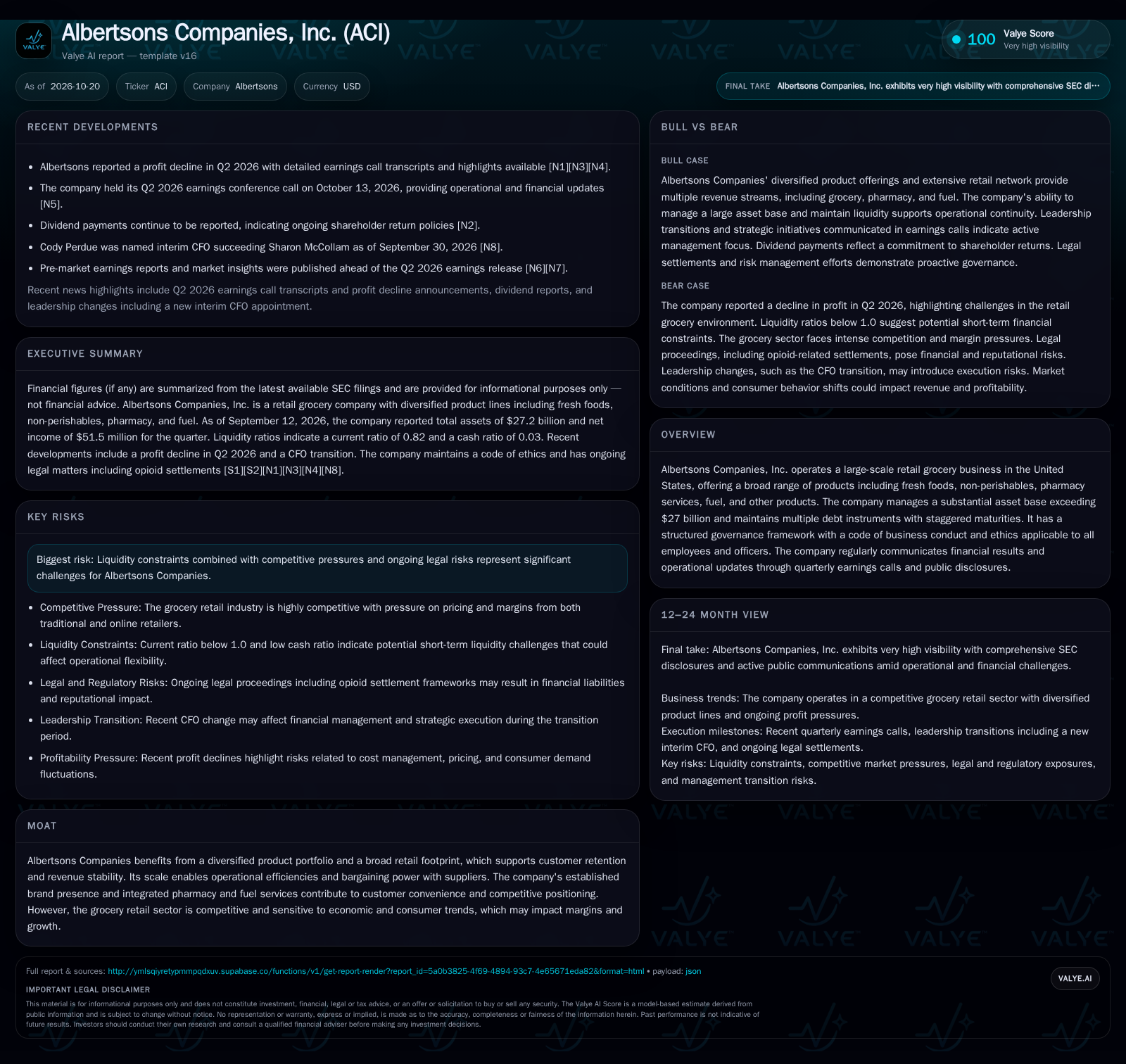
Albertsons Companies reported net income of $51.5 million for Q2 2026, but this represented a profit decline from previous periods—a reversal that underscores intensifying margin and cost pressures in the grocery sector. As of September 12, 2026, the company’s current assets stood at $7.06 billion against current liabilities of $8.65 billion, yielding a current ratio of 0.82. A leadership transition is underway, with Cody Perdue replacing Sharon McCollam as interim CFO as of September 30, 2026. The cited source reports dividend-related activity; that disclosure alone does not establish dividend-policy continuity, management confidence, or a material constraint on capital flexibility. [S2] [N1] [N2] [N3] [N4] [N8]
How Albertsons’ Multi-Segment Model Drives Revenues and Cost Structure
Albertsons’ core revenue streams span retail groceries, pharmacy services, fuel, and ancillary products. The grocery segment is typically characterized by high sales volumes but low gross margins, with fixed costs (labor, real estate, distribution) weighing heavily on profitability. Pharmacy and fuel operations can provide modest margin enhancement and drive store traffic, but are also subject to regulatory and commodity price volatility. The company’s ability to leverage its $10.05 billion in property and equipment suggests substantial fixed cost absorption, but also exposes it to high operating leverage—meaning small changes in sales or margins can have outsized impacts on earnings. Capital needs remain significant due to ongoing store maintenance, technology upgrades, and debt servicing; Albertsons maintains multiple senior notes with maturities from 2027 to 2034. [S2]
Pricing power is inherently limited in the mainstream U.S. grocery sector, as large national and regional chains, discounters, and e-commerce players battle for share and consumers remain highly price sensitive. Mix shifts toward fresh and private-label products can support margins, but volume declines or promotional activity can quickly erode profitability. The cited source reports dividend-related activity; that disclosure alone does not establish dividend-policy continuity, management confidence, or a material constraint on capital flexibility.
Given the high fixed cost structure inherent in Albertsons’ operations, the company’s sensitivity to volume fluctuations is a critical factor in assessing margin durability. In periods of declining sales, fixed costs such as labor and occupancy expenses do not adjust downward proportionally, which can exacerbate margin compression. Conversely, sustained volume growth can leverage these fixed costs more effectively, improving profitability. Therefore, understanding the elasticity of demand in Albertsons’ key markets, as well as the company’s ability to respond flexibly to changing consumer preferences, is essential for projecting earnings stability. Additionally, the interplay between capital expenditures for technology upgrades and the potential operational efficiencies they unlock must be weighed carefully against near-term cash flow constraints.
Competitive Pressures and the Limits of Scale: Where Albertsons Stands
Albertsons’ broad retail footprint and multi-category offering provide some insulation against single-category shocks, but the U.S. grocery environment remains brutally competitive. Big-box retailers, discount grocers, and national e-commerce platforms are all vying for the same consumer dollar, putting persistent pressure on pricing and margins. Online grocery adoption—accelerated by the pandemic—has forced traditional grocers to invest heavily in digital capabilities, curbside pickup, and delivery infrastructure, often at the expense of near-term profitability.
Scale does offer Albertsons some advantages: greater bargaining power with suppliers, the ability to spread logistics and technology costs, and the potential for cross-selling pharmacy or fuel. However, these benefits are not unique and can be matched or exceeded by larger peers. Private-label growth and loyalty programs may help with retention, but switching costs across mainstream grocery banners are low, and brand differentiation is limited in commoditized categories. The company’s exposure to legal settlements—such as opioid litigation—could also constrain its ability to invest in competitive differentiation if liabilities mount.
Albertsons’ competitive positioning also depends heavily on its ability to innovate within a commoditized market. While scale provides some bargaining leverage, it does not inherently translate to sustainable differentiation. The company’s investments in private-label products and loyalty programs must generate sufficient incremental value to justify their costs, particularly as competitors replicate similar strategies. Moreover, the shift toward omnichannel retailing necessitates ongoing capital deployment in digital infrastructure and fulfillment capabilities, which may pressure margins before delivering returns. The balance between maintaining competitive service levels and controlling operational costs will be pivotal, especially as consumer expectations for convenience and personalization continue to evolve rapidly.
Margin Recovery and Strategic Execution Could Reignite Earnings Power
If Albertsons can stabilize margins through improved cost controls, better sourcing, and a favorable sales mix shift toward higher-margin products (such as private label or prepared foods), profitability could rebound even in a slow-growth topline environment. Effective execution on digital transformation and loyalty initiatives might also drive incremental traffic and transaction size, partially offsetting competitive pricing pressures. Successful management of legal exposures, with settlements kept within manageable bounds, would remove a key overhang.
Confirmation of this scenario would include a reversal of recent profit declines, improvement in gross and operating margins, and evidence of positive same-store sales growth. Disclosures of cost savings from supply chain initiatives, digital investments yielding higher e-commerce penetration, or successful renegotiation of supplier contracts would further validate the bull case.
Strategic cost management initiatives could extend beyond traditional sourcing and supply chain improvements to include more sophisticated data analytics and demand forecasting, enabling more agile inventory management and reduced waste. If Albertsons successfully harnesses these capabilities, it could improve gross margins and reduce working capital requirements, thus enhancing liquidity. Furthermore, a targeted focus on high-margin categories and customized marketing could increase basket sizes and customer retention. However, these benefits hinge on effective execution and the ability to scale new initiatives without disruptive operational impacts. The company’s capacity to manage legal liabilities proactively would also free up resources for reinvestment, supporting a virtuous cycle of margin recovery and growth.
Albertsons Faces Ongoing Margin Compression and Operational Balancing
The most plausible trajectory is that Albertsons continues to experience margin and profit pressure amid heightened competition and modest topline growth. Liquidity remains tight but manageable, with the company relying on careful working capital management and disciplined capital spending to avoid a liquidity crunch. Dividend payments persist, but may be reassessed if earnings continue to erode or legal liabilities increase.
In this scenario, the company retains its market presence and diversified revenue streams but struggles to generate meaningful margin expansion or free cash flow. The interim CFO focuses on cost containment, but transformative moves—such as large-scale digital reinvention or aggressive store expansion—are constrained by capital availability. The scenario would be challenged by any sharp deterioration in liquidity ratios, unexpected legal settlements, or loss of key supplier or customer relationships.
Liquidity Stress and Legal Liabilities Could Force Defensive Restructuring
Should competitive pressures intensify further, or if legal liabilities from opioid settlements or other proceedings exceed expectations, Albertsons could face acute liquidity stress. Margin erosion from price wars or rising input costs would exacerbate cash flow strain and reduce strategic flexibility.
Evidence for this scenario would include further deterioration in current and cash ratios, negative free cash flow, or credit rating downgrades. Public disclosure of dividend cuts, forced asset divestitures, or emergency capital raises would confirm that the company is moving into a more defensive posture. Prolonged leadership instability or a failure to resolve legal exposures could accelerate a negative spiral.
Tracking the Crucial Variables Shaping Albertsons’ Financial and Strategic Resilience
Quarterly trends in gross and operating margins, especially in the context of reported cost initiatives and mix changes, will help determine whether margin pressures are abating or intensifying.
Same-store sales growth (if disclosed) is critical for assessing underlying demand and the effectiveness of competitive positioning.
Public disclosures or estimates of legal settlement amounts and timing, particularly related to opioid litigation, will clarify the magnitude of contingent liabilities.
Management commentary and disclosures about digital transformation progress, e-commerce penetration, or technology investments would help gauge the company’s competitive adaptation.
Leadership stability and the long-term CFO appointment will be important for restoring investor confidence and executing strategic pivots.
Debt refinancing activity, new capital raises, or asset sales would indicate stress or a need to reconfigure the capital structure.
Disclaimer: This is research-only, informational analysis and not investment advice. It may include AI-generated interpretation and general industry context. Always verify important details using primary sources.

Comments