
Celularity’s Next Act: Liquidity Strain, Platform Potential, and the Challenge of Commercializing Placenta-Derived Therapies
Celularity’s recent financing, business realignment, and manufacturing partnerships highlight both the urgency and complexity of its regenerative medicine ambitions.
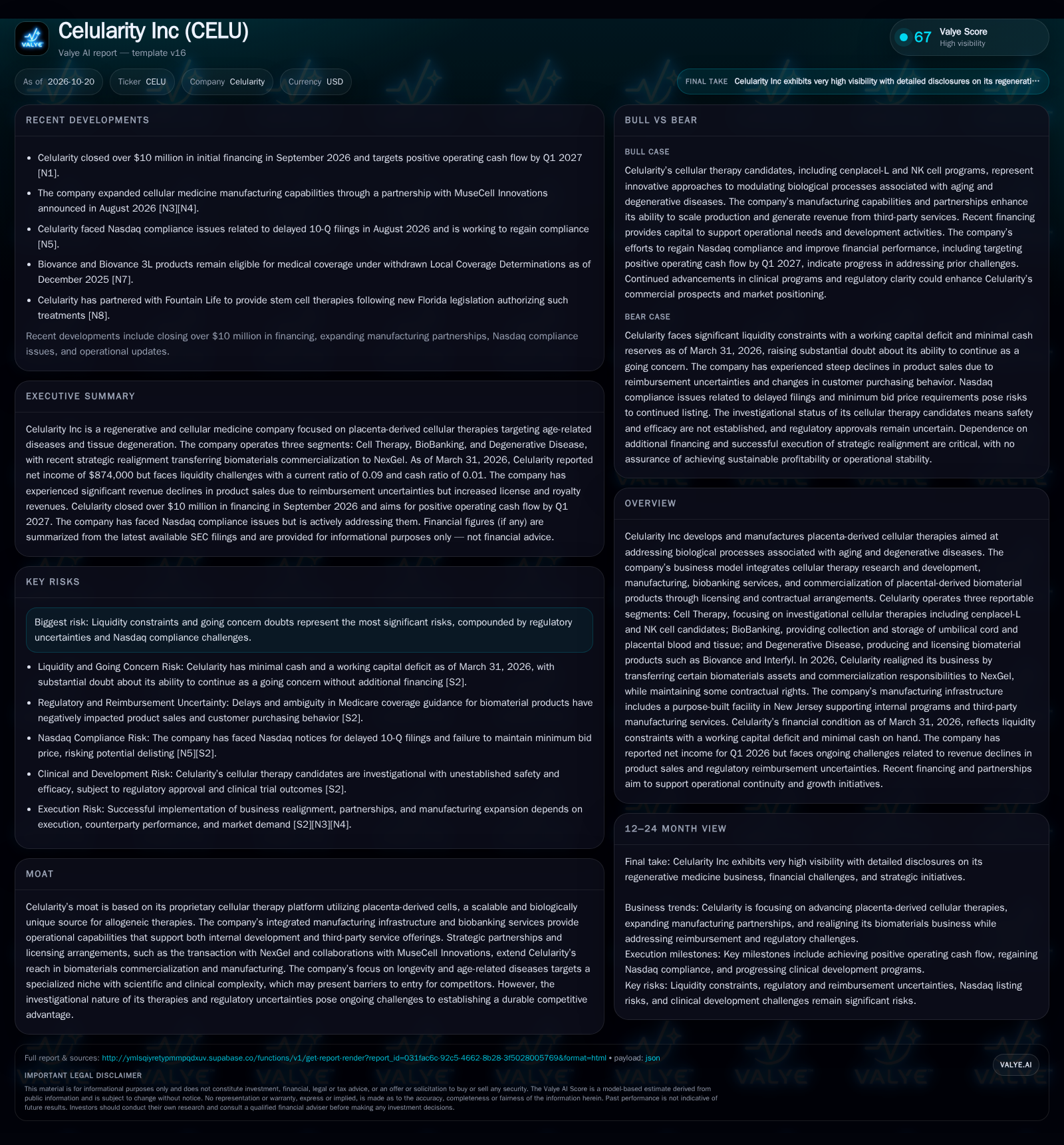
Celularity is attempting to stabilize and reposition itself through new financing, a transfer of biomaterials commercialization to NexGel, and partnerships to expand manufacturing. Its future hinges on clinical progress in placenta-derived cellular therapies, execution of new business arrangements, and the successful navigation of reimbursement and Nasdaq compliance risks. [S2] [N1] [N3] [N4] [N5]
Recent steps—including a $10 million financing, business realignment with NexGel, and new manufacturing collaborations—reflect a company racing to build a sustainable platform before capital and market patience run out. The near-term outlook will hinge on management’s ability to deliver operational execution, clinical progress, and credible pathways to revenue growth, all in the shadow of unresolved Nasdaq compliance and reimbursement headwinds.
Liquidity, Strategic Shifts, and the Urgency of Execution
Celularity’s business fundamentals are defined by a precarious financial position and a recent wave of strategic maneuvers. The company reported cash and liquidity metrics for the period; these figures do not by themselves establish operating runway, investment capacity, financial flexibility, or financing capacity. Despite reporting net income of $874,000 in Q1 2026, Celularity closed over $10 million in new financing in September, a move that provides only near-term breathing room rather than a solution to its chronic capital needs. [S2] [N1]
In parallel, Celularity transferred certain biomaterials commercialization responsibilities to NexGel, aiming to streamline operations and focus resources, while maintaining some contractual rights to future revenue streams. The company also expanded its manufacturing capabilities via a partnership with MuseCell Innovations in August 2026. However, ongoing Nasdaq compliance issues—particularly delayed 10-Q filings and minimum bid price requirements—pose existential risks to continued public listing. [N3] [N4] [N5]
Most critically, Celularity’s product sales remain under pressure due to regulatory and reimbursement uncertainties, with license and royalty revenues now playing a larger role in the revenue mix. These developments set the stage for a company in transition, with execution risk and capital sufficiency as dominant themes.
Revenue Streams, Cost Structure, and the Capital Intensity of Cellular Medicine
Celularity’s economics are shaped by three segments: Cell Therapy (investigational therapies), BioBanking (biological sample storage), and Degenerative Disease (biomaterial product sales and licensing). In principle, each segment offers distinct revenue profiles and cost structures. The Cell Therapy business is inherently high-risk and capital-intensive, requiring sustained R&D investment, clinical trial funding, and regulatory navigation before any commercial payoff can be realized. Revenues here are likely to be lumpy and back-weighted, contingent on successful approval and adoption.
The BioBanking segment provides more stable, albeit lower-margin, revenue via collection and storage services. This business typically exhibits high fixed costs for facilities and regulatory compliance, but once scale is achieved, additional volume can deliver operating leverage. However, the market for biobanking is competitive and price-sensitive.
The Degenerative Disease segment, now partially realigned with NexGel, previously generated revenue from sales and licensing of biomaterial products such as Biovance and Interfyl. The shift to a licensing/contractual model could improve gross margins if recurring royalties materialize, but also shifts execution risk to NexGel and reduces Celularity’s direct control over commercialization. The company’s manufacturing infrastructure—especially its purpose-built New Jersey facility—provides both operational flexibility and potential for third-party manufacturing revenue, but also locks in significant fixed costs and capital requirements.
Overall, Celularity’s path to sustainable profitability depends on the mix and scale of high-margin therapy revenues, recurring licensing income, and the ability to leverage infrastructure through external partnerships. However, the capital needs for clinical development and regulatory approval remain substantial, and positive operating cash flow is not expected until at least Q1 2027. [N1] [S2]
Defensible Niche or Scientific Gamble? Celularity’s Place in Regenerative Medicine
Celularity’s competitive claim rests on its proprietary placenta-derived cell platform, a unique biological source for allogeneic therapies that theoretically offers scalability and differentiation versus autologous or adult stem cell approaches. The company’s integrated manufacturing and biobanking capabilities provide operational breadth, supporting both internal programs and potential third-party services.
However, the field of regenerative medicine is crowded and rapidly advancing, with established pharmaceutical and biotech companies, as well as specialized cell therapy startups, all vying for clinical validation and commercial traction. Many competitors are pursuing alternative cell sources (e.g., bone marrow, cord blood, induced pluripotent stem cells) and a range of therapeutic targets, which increases the risk of technological substitution or obsolescence if Celularity’s platform does not demonstrate clear clinical or economic superiority.
Switching costs for customers are low in the absence of regulatory approval and established clinical outcomes, and the company’s investigational therapies face significant clinical and reimbursement hurdles. The licensing and manufacturing partnerships—such as with NexGel and MuseCell Innovations—may help extend reach and diversify risk but also dilute direct control and profit capture. In this context, Celularity’s moat is more potential than proven, hinging on the ability to convert scientific promise into differentiated products with regulatory and commercial validation.
From Platform to Product: What Would It Take for Celularity to Break Out?
The favorable scenario for Celularity is predicated on several reinforcing dynamics: successful clinical progress of its cellular therapy candidates (such as cenplacel-L and NK cell programs), regulatory clarity and reimbursement approval for its biomaterial and cell therapy products, and realization of operating leverage from its manufacturing partnerships and infrastructure.
If the company can demonstrate strong safety and efficacy data in pivotal trials, secure regulatory approvals, and establish favorable reimbursement pathways, it could unlock high-margin therapy revenues and catalyze adoption in age-related and degenerative disease markets. Expanded manufacturing partnerships—evidenced by the MuseCell Innovations collaboration—could generate incremental third-party revenue and help defray fixed costs, while the NexGel arrangement could provide steady royalty streams if commercialized successfully.
Confirmation of this upside would come from: (1) positive late-stage clinical trial data and regulatory filings; (2) rapid growth in license and royalty revenues; (3) evidence of operating cash flow turning positive by Q1 2027; and (4) restoration of Nasdaq compliance, signaling renewed investor and counterparty confidence. [N1] [N3] [N4] [N5]
Falsification would involve continued clinical setbacks or delays, persistent reimbursement headwinds, and failure to achieve projected operating cash flow or regain compliance, indicating the business model is unable to scale or sustain itself.
Incremental Progress, Persistent Strain: A Likely Near-Term Trajectory
The most plausible near-term scenario is one of incremental improvement, with Celularity making slow headway on clinical, operational, and financial fronts, but remaining constrained by capital needs and market skepticism. The recent $10 million financing and business realignment may buy time to advance clinical programs and operational partnerships, but do not resolve the underlying need for further capital or guarantee commercial success.
Revenue may gradually shift toward licensing and third-party manufacturing, but product sales are likely to remain unpredictable given reimbursement uncertainties. Nasdaq compliance could be restored if delayed filings are resolved and bid price recovers, but the risk of relapsing into non-compliance will persist if operating momentum does not materialize.
This scenario would be confirmed by steady but modest increases in license/royalty and service revenues, maintenance of operational continuity, and incremental clinical milestones. It would be falsified by renewed liquidity crises, failed regulatory filings, or loss of key commercial partnerships.
Liquidity Exhaustion and Strategic Options Under Pressure
The adverse scenario centers on Celularity’s acute liquidity position and persistent execution risk. Should clinical programs stall, reimbursement uncertainties persist, or commercial partnerships underperform, the company could exhaust its recently raised capital before achieving positive cash flow or meaningful regulatory progress.
Failure to regain or maintain Nasdaq compliance could trigger delisting, further limiting access to capital and eroding counterparty confidence. If the NexGel and MuseCell partnerships do not deliver expected revenue streams, Celularity may be forced to pursue asset sales, further business realignment, or even restructuring to preserve value for creditors.
Downside confirmation would involve continued working capital deficits despite financing, missed clinical or regulatory milestones, shrinking revenue, and escalating Nasdaq compliance actions. Falsification would require clear evidence of new capital inflows, operational stabilization, and unexpected clinical or commercial breakthroughs.
Milestones That Will Define Celularity’s Commercial Viability
Net operating cash flow trends quarter-to-quarter, with particular focus on guidance for achieving positive cash flow by Q1 2027. [N1]
Progress in late-stage clinical trials for cenplacel-L or NK cell therapy candidates, including any published data or regulatory submissions, if disclosed.
License and royalty revenue growth, especially from the NexGel arrangement and new manufacturing partnerships—actual figures, if disclosed, would help test the thesis.
Resolution of delayed SEC filings and restoration of full Nasdaq compliance, including minimum bid price maintenance. [N5]
Biovance and Biovance 3L reimbursement status changes, especially in response to evolving Medicare coverage decisions. [N7]
Utilization and revenue contribution from third-party manufacturing agreements, such as with MuseCell Innovations—disclosed contract values or volumes would provide insight. [N3] [N4]
Additional capital raises or evidence of new financing arrangements, with terms and dilution impact, if disclosed.
Execution milestones in business realignment, such as further asset transfers or expanded licensing terms with NexGel, if disclosed.
Disclaimer: This is research-only, informational analysis and not investment advice. It may include AI-generated interpretation and general industry context. Always verify important details using primary sources.

Comments