
Genuine Parts Co: Segment Separation, Acquisition Integration, and the Realities of Margin Compression
Genuine Parts Co’s 2025-2026 performance underscores both the strategic logic and operational challenges of global parts distribution at scale. As the company pursues a historic split of its automotive and industrial arms, margin expansion, acquisition integration, and exposure to legacy liabilities will define its next phase.
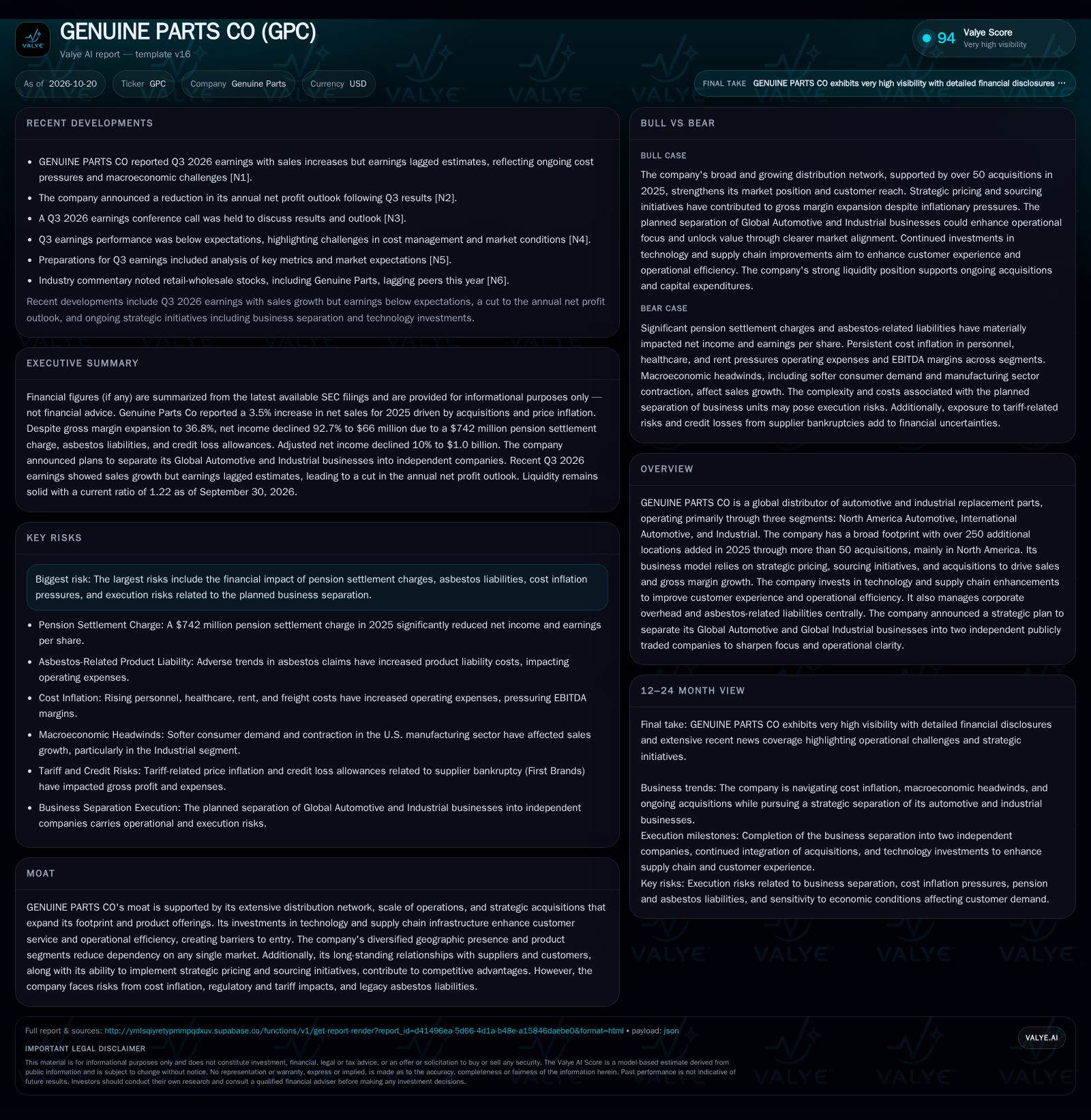
Genuine Parts Co reported 2025 net sales growth of 3.5% to $24.3B, driven by acquisitions and price inflation, but net income plunged 92.7% due to a major pension settlement and asbestos charges. The company is moving forward with a planned separation of its Global Automotive and Industrial businesses, aiming for sharper focus and potential value unlock. While gross margin expanded to 36.8%, persistent cost and liability headwinds pressured EBITDA and earnings. The next 12-18 months hinge on successful business separation and the realization of acquisition synergies amid volatile macroeconomic conditions. [S2] [N2]
Genuine Parts Co’s recent performance reflects the demanding realities of global parts distribution: scale-driven growth through aggressive acquisitions, but also mounting cost inflation, legacy liability drag, and a complex operational environment. The company’s planned separation of its automotive and industrial businesses is a pivotal move that could sharpen focus and unlock value—but also introduces new execution and margin risks. As margin expansion battles with persistent cost headwinds, the next chapter will test Genuine Parts’ integration discipline, pricing power, and ability to realize the strategic promise of its sprawling footprint.
Separation Plans and the Impact of Legacy Liabilities Define the Current Moment
Genuine Parts Co reported 2025 net sales of $24.3 billion, up 3.5% year-over-year, with growth driven by over 50 acquisitions and price inflation. Despite this, net income plunged 92.7% to $66 million, as a $742 million pension settlement charge and higher asbestos-related liabilities weighed heavily on earnings. Adjusted net income fell 10% to $1.0 billion, indicating that even after normalizing for extraordinary items, operational pressures remain material. The company is advancing a major structural change: the planned separation of its Global Automotive and Global Industrial businesses into independent public companies, targeted for completion in the first quarter of 2027. This separation aims to enhance operational clarity and strategic focus but introduces significant execution risk and transitional costs [S1] [S2] [N2].
Margin Expansion Tactics Meet the Realities of Operating Leverage and Integration Costs
Genuine Parts’ revenue model is built on a high-volume, relatively low-margin distribution engine with three major segments—North America Automotive, International Automotive, and Industrial. Gross margin expanded to 36.8% in 2025, supported by strategic pricing, sourcing initiatives, and the revenue mix from recent acquisitions. However, the company’s operating expenses rose sharply, due to inflation in wages, healthcare, rent, and integration costs tied to its aggressive M&A strategy. Segment EBITDA declined in both major automotive units despite top-line growth, highlighting that incremental sales are not translating to proportional profit gains. The business is inherently capital-intensive, requiring ongoing investment in inventory, logistics, and technology to maintain service levels and competitive positioning. The separation of business units will likely increase overhead in the short term as duplicate corporate functions are established, and synergies from prior integration could be temporarily disrupted. Long-term operating leverage will depend on the company’s ability to drive cost efficiencies and realize acquisition synergies faster than expense growth.
Distribution Scale and Supplier Relationships: Durable Advantages, But Not Immune to Disruption
Genuine Parts’ competitive edge comes from its extensive distribution network, broad product portfolio, and long-standing supplier and customer relationships. The scale achieved through more than 10,800 locations globally and frequent bolt-on acquisitions creates logistical advantages, local market penetration, and some degree of purchasing power. In the automotive aftermarket and industrial distribution sectors, barriers to entry are meaningful due to inventory depth, delivery infrastructure, and the complexity of managing SKUs across geographies. However, the company faces persistent counterforces: digital-first competitors, direct manufacturer-to-customer models, and price-based competition from both regional and global distributors. Technology investments in supply chain visibility and customer-facing platforms are necessary to defend share, but may not yield immediate pricing power or customer lock-in. The question is whether Genuine Parts can maintain its moat as the market shifts toward more technologically enabled, data-driven supply solutions and as customers increasingly expect omnichannel service.
Unlocking Value Through Separation and Acquisition Synergy Realization
If Genuine Parts successfully executes its planned separation, both the Global Automotive and Global Industrial businesses could benefit from enhanced management focus, clearer capital allocation, and sharper strategic alignment. The upside scenario assumes the company efficiently integrates its 2025 acquisitions, achieves targeted cost synergies, and leverages its scale to negotiate favorable supply terms. Margin expansion would be supported by disciplined pricing, improved sourcing, and technology-driven operational efficiencies. The separation could unlock latent value by allowing each segment to pursue tailored growth strategies and attract investor bases aligned with their unique risk-return profiles. Confirmation of this scenario would include sustained gross margin improvement, evidence of successful cost containment post-separation, growing adjusted EBITDA, and above-market sales growth in both segments. Falsification would be indicated by continued EBITDA margin compression, integration setbacks, or a failure to deliver on announced synergy targets.
Incremental Growth Amid Margin Pressure and Transitional Costs
The most plausible scenario is that Genuine Parts delivers modest organic growth, primarily through incremental sales from recent acquisitions and selective market share gains. Gross margin may stabilize at current elevated levels, but operating expense inflation and separation-related costs will likely keep EBITDA margins under pressure in the near term. The company will continue to invest in technology and supply chain initiatives, but benefits will accrue gradually. Adjusted net income could remain below prior peaks as the company absorbs the financial and operational costs of restructuring and separation. Confirmation would include steady, if unspectacular, sales growth, gross margin maintenance, and manageable increases in SG&A relative to revenue. Falsification would involve a significant decline in segment sales, persistent margin erosion, or major setbacks in separation execution that disrupt customer service or supplier relationships.
Cost Inflation, Execution Missteps, and Legacy Liabilities Erode Value
In the adverse case, cost inflation outpaces Genuine Parts’ ability to pass through price increases or realize efficiency gains, leading to further EBITDA margin compression. The separation of business units could prove more disruptive and expensive than anticipated, resulting in duplicated costs, management distraction, and loss of scale-driven synergies. Failure to integrate acquisitions effectively could create operational bottlenecks and erode customer trust. Confirmation of this scenario would be visible in declining adjusted EBITDA, negative free cash flow, missed synergy targets, rising legal and restructuring charges, and potential downgrades in credit metrics. Falsification would require clear evidence that cost inflation is being offset by price or efficiency gains and that separation milestones are met without major operational disruption.
Milestones and Metrics That Will Define Post-Separation Value Creation
Gross margin trend: Ongoing expansion or contraction in gross margin will be a critical signal of pricing power, sourcing effectiveness, and acquisition integration.
Segment-level EBITDA: If disclosed, tracking EBITDA by segment will indicate whether operational leverage is being realized or if cost pressures are overwhelming top-line gains.
Separation execution milestones: Progress toward the Q1 2027 target for the business split, including updates on legal, regulatory, and operational readiness.
Acquisition synergy realization: Specific disclosures on cost savings, integration progress, and post-acquisition performance would help test the thesis.
SG&A as a percentage of revenue: Monitoring this ratio will reveal whether expense discipline is keeping pace with sales growth, especially during the transition.
Legacy liability cash outflows: Updates on asbestos-related payments, pension funding, and other extraordinary charges will signal future earnings drag or relief.
Organic sales growth versus inflation-driven growth: A breakdown, if disclosed, would clarify whether volume gains are being achieved or if headline growth is masking underlying weakness.
Technology and supply chain investment ROI: Evidence of operational improvement or customer retention attributable to technology upgrades would support the long-term moat argument.
Disclaimer: This is research-only, informational analysis and not investment advice. It may include AI-generated interpretation and general industry context. Always verify important details using primary sources.

Comments