
MSCI Inc.: Subscription Strength, Asset Exposure, and Building a Durable Competitive Edge
MSCI’s robust recurring-revenue model and expansion in sustainability analytics have powered recent earnings growth, but mounting fee pressures, asset-management consolidation, and regulatory crosswinds create both opportunity and risk. The company’s ability to sustain high client retention and extend its platform integration will define its resilience as industry dynamics evolve.
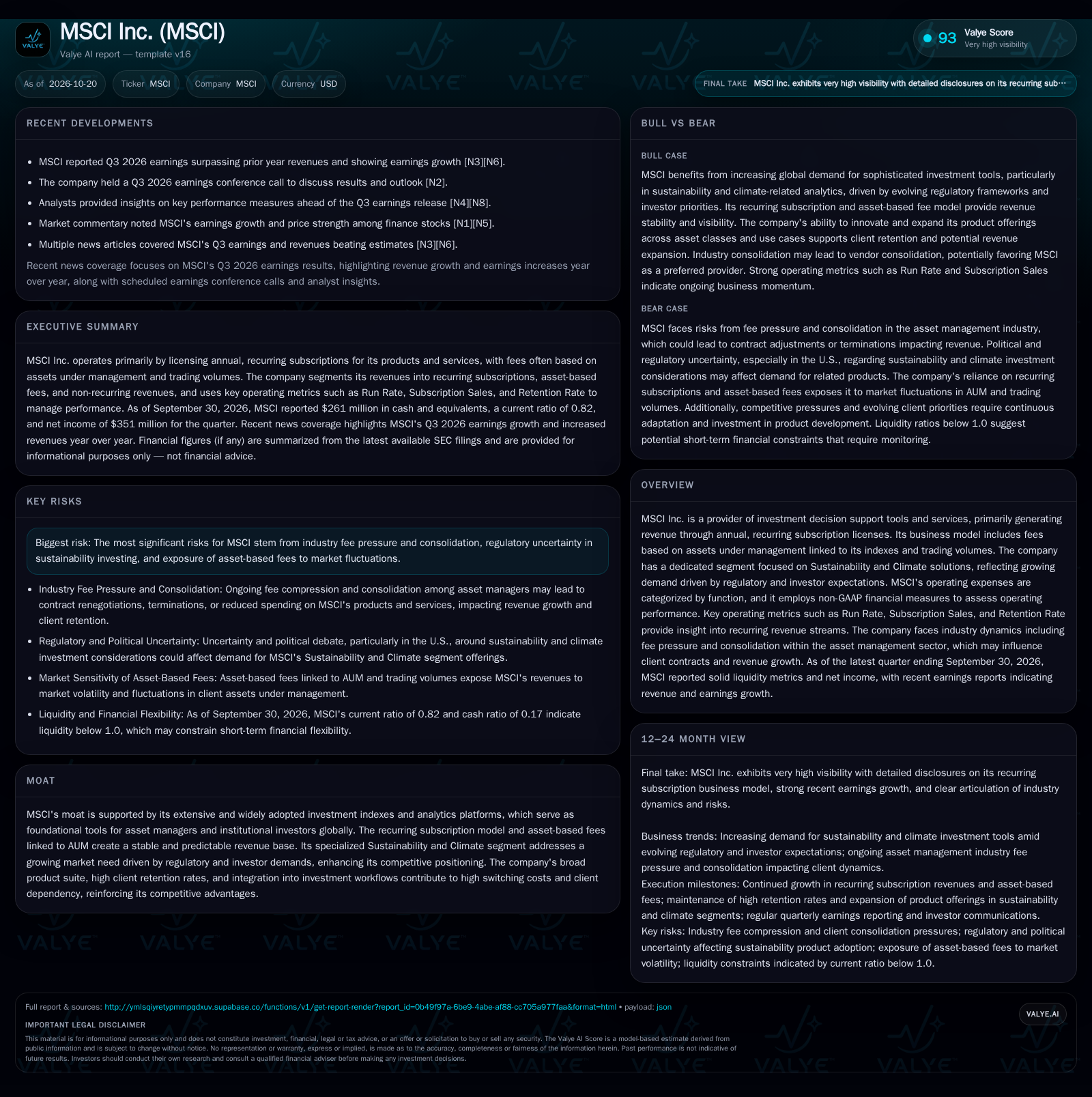
MSCI Inc. demonstrated strong Q3 2026 earnings and revenue growth, driven by its annual subscription and asset-based fee model. While demand for sustainable investment analytics is rising, the company faces fee compression and consolidation among asset managers, which could reshape client relationships. Ongoing regulatory and market volatility remain material watchpoints for future performance. [S1] [S2] [N3] [N6]
MSCI Inc. sits at the crossroads of two powerful forces: the long-term shift toward data-driven, sustainable investing and the near-term squeeze facing asset managers from fee compression and industry consolidation. Its business model—anchored by high-visibility recurring subscriptions and asset-based fees—has delivered strong recent earnings, but the company’s exposure to client AUM and regulatory crosscurrents means the path forward is anything but linear. As the investment landscape evolves, MSCI’s ability to deepen workflow integration, defend retention, and innovate in sustainability analytics will determine whether its moat proves enduring or vulnerable to the shifting tides.
Recent Earnings Strength, Subscription Dominance, and Financial Position
For the quarter ending September 30, 2026, MSCI reported net income of $351 million, with basic and diluted EPS at $4.87 and $4.86, respectively. This performance reflects ongoing earnings momentum, supported by both recurring subscription revenue and asset-based fees. Notably, MSCI’s revenue streams remain anchored in annual, recurring subscriptions, with a significant portion still sensitive to asset managers’ AUM and trading volumes. The recent renaming of the ESG and Climate segment to Sustainability and Climate signals a broadening of focus, in line with regulatory and client demand for sustainable investment analytics. [S1] [S2] [N3] [N6]
Decoding MSCI’s Revenue Model: Subscription Stability Versus Asset-Based Volatility
MSCI’s core business model revolves around licensing annual, recurring subscriptions for its indexes, analytics, and data tools—generating predictable, ratable revenue recognized over the license period. This model fosters high gross margins and operating leverage, as incremental sales of data and analytics typically require limited variable cost. Asset-based fees, however, introduce volatility: these are tied to client AUM and trading activity in MSCI-linked investment products, exposing a portion of revenue to market cycles and investor flows.
The company’s key operating metrics—Run Rate, Subscription Sales, and Retention Rate—are designed to provide forward visibility into recurring revenue. High retention and strong new subscription sales support a compounding growth dynamic, but the economics are sensitive to industry-wide fee compression, which can limit pricing power and require ongoing investment in product innovation. Operating expenses span cost of revenues, sales and marketing, R&D, and G&A, with scale efficiencies possible as fixed costs are spread over a growing revenue base. However, as asset managers consolidate and seek to rationalize vendor spend, MSCI may face upward pressure on client acquisition costs and downward pressure on contract values.
Workflow Integration and Switching Costs: The Anatomy of MSCI’s Moat
MSCI’s competitive advantage derives from its deeply embedded indexes and analytics, which are foundational to portfolio construction, risk management, and regulatory reporting for asset managers and institutional investors. This integration creates significant switching frictions—clients face operational, compliance, and performance risks in migrating away from MSCI’s platforms. The breadth of its product suite, particularly in sustainability and climate analytics, further entrenches its role as a critical data provider.
However, the competitive landscape is intensifying. Alternative index providers, specialized ESG data vendors, and large technology firms are all vying for wallet share. The threat of substitutes is particularly acute in sustainability, where regulatory definitions and client preferences are evolving rapidly. Fee compression across the asset management sector may also trigger vendor consolidation, amplifying the risk that price becomes a primary differentiator. MSCI’s ability to innovate, expand its data ecosystem, and maintain high retention will be tested as clients demand more value for less.
How Product Expansion and Regulatory Tailwinds Could Unlock Accelerated Growth
In a favorable scenario, MSCI capitalizes on heightened regulatory and investor focus on sustainability, driving accelerated adoption of its Sustainability and Climate analytics. European regulations mandating ESG disclosures could force asset managers to deepen reliance on MSCI’s data, while global asset growth lifts both recurring and asset-based fees. Continued innovation—such as new factor models, climate risk tools, or AI-driven analytics—could further differentiate MSCI’s platform and could support premium pricing.
Evidence that would confirm this scenario includes sustained double-digit growth in Subscription Sales, rising Run Rate, and expanding Retention Rate, particularly within the Sustainability and Climate segment. AUM-linked fee growth outpacing market benchmarks, and new marquee client wins or long-term renewals, would also validate the thesis. Conversely, stagnation in these metrics or signs of regulatory pushback would challenge the upside case.
Steady Growth Tempered by Fee Compression and Client Consolidation
The most plausible trajectory is one where MSCI continues to grow recurring revenue at a healthy—if moderating—pace, supported by its embedded role in institutional investment workflows and gradual expansion of sustainability offerings. Fee compression and asset manager consolidation, however, limit pricing power and may drive some contract renegotiations or churn, offsetting organic growth. Asset-based fees track broader market levels, introducing periodic volatility but not derailing the long-term compounding effect of high retention and incremental sales.
Confirmation of this scenario would come from stable (if modestly decelerating) growth in Run Rate and Subscription Sales, high but not expanding Retention Rates, and asset-based fees that fluctuate in line with industry AUM trends. Early warning signs would include a material decline in retention or an uptick in contract terminations following major asset manager mergers.
When Industry Headwinds and Structural Shifts Undermine Resilience
In a negative scenario, intensifying fee pressure and accelerated consolidation among asset managers trigger widespread contract renegotiations, vendor consolidation, and reduced spending on external data providers. If regulatory momentum behind sustainability analytics stalls—especially in the U.S.—demand for MSCI’s newer offerings could falter. Asset-based fee revenue would be particularly vulnerable in a market downturn, compounding the impact of lost subscriptions.
This scenario would be confirmed by a marked decline in Subscription Sales and Retention Rate, negative Run Rate trends, and significant reductions in contract values or outright terminations. A sharp contraction in asset-based fees—especially if out of proportion to market declines—would further signal structural vulnerability. Liquidity constraints, as indicated by a further deterioration in current or cash ratios, could amplify operational risk.
Benchmarks for Testing MSCI’s Moat and Subscription Growth Thesis
Quarterly trends in Run Rate, Subscription Sales, and Retention Rate—especially in the Sustainability and Climate segment—would help test the durability of recurring revenue growth.
Disclosure of new or expanded multi-year contracts with large asset managers would indicate resilience in the face of industry consolidation and fee pressure.
Updates on the proportion of revenue from asset-based fees versus recurring subscriptions would clarify exposure to market volatility.
If disclosed, customer concentration metrics—such as percentage of revenue from top 10 clients—would illuminate the risk of contract renegotiation or loss.
Progress in new product launches or workflow integrations, particularly in AI-driven analytics or regulatory compliance solutions, would signal competitive differentiation.
Any regulatory developments in key regions (notably the U.S. and Europe) affecting sustainability analytics or index construction could materially shift demand.
Industry reports or client commentary on vendor selection criteria, pricing benchmarks, or satisfaction with MSCI’s offerings would provide early warning of competitive or pricing shifts.
Disclaimer: This is research-only, informational analysis and not investment advice. It may include AI-generated interpretation and general industry context. Always verify important details using primary sources.

Comments