
DT Cloud Star Acquisition Corp: SPAC Execution Pressures Mount as Biotech Deal Nears Critical Stage
The company’s ability to deliver value now hinges on successfully closing the deal, managing redemptions, and navigating regulatory hurdles under the shadow of a severely strained balance sheet.
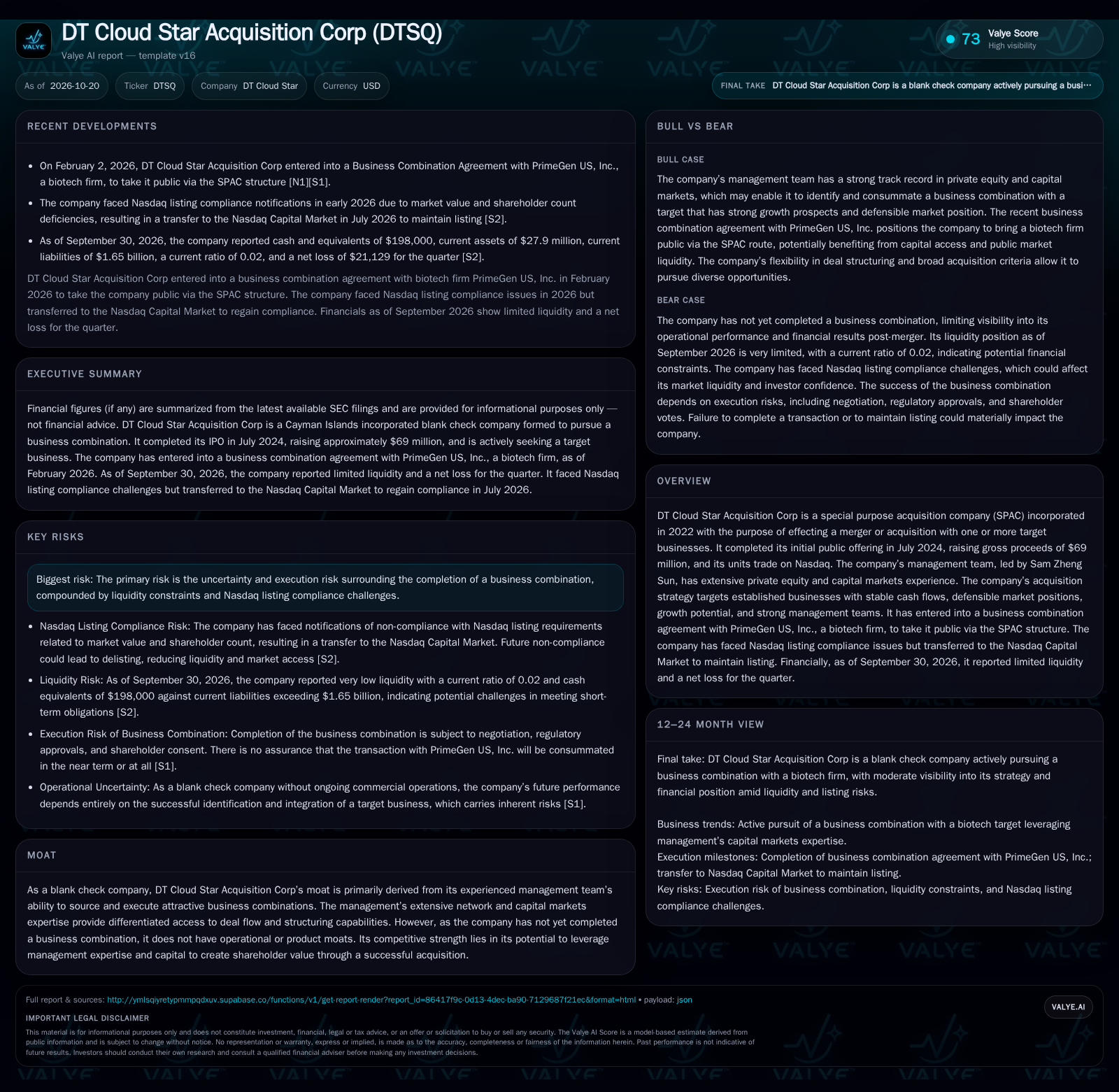
DT Cloud Star Acquisition Corp, a SPAC that raised $69 million in its 2024 IPO, faces acute liquidity and Nasdaq compliance pressures as it seeks to close a business combination with biotech firm PrimeGen US, Inc. The outcome now depends on managing redemptions, securing regulatory and shareholder approvals, and maintaining its listing.
DT Cloud Star Acquisition Corp stands at a pivotal juncture: it has secured a business combination agreement with PrimeGen US, Inc., aiming to bring a biotech firm public via the SPAC route. Yet, this potential catalyst is overshadowed by acute liquidity pressures and recent Nasdaq compliance setbacks. The next phase will test the management’s ability to execute the merger, manage shareholder redemptions, and navigate regulatory and listing requirements in a high-stakes environment [S1] [S2].
Liquidity Strain and Listing Pressures Define the Immediate Outlook
Three facts dominate DT Cloud Star’s current situation. First, the company entered into a business combination agreement with PrimeGen US, Inc., a biotech company, in February 2026, setting the stage for a SPAC merger [S1]. [S2] Third, DT Cloud Star faced Nasdaq non-compliance notifications and was forced to transfer its listing from the Global Market to the Capital Market in July 2026 to maintain public trading status [S2].
SPAC Economics: Capital Pools, Redemption Dynamics, and Post-Merger Uncertainty
DT Cloud Star’s economics are typical of a blank-check company: it raised $69 million in gross IPO proceeds and additional private placement funds, with the vast majority of capital initially held in trust for the benefit of public shareholders [S1]. The business model is predicated on sourcing and closing a merger with a private company, providing that target with public market access and liquidity, while sponsors and early investors may benefit from warrants, rights, or founder shares if the deal is consummated.
However, the economic viability of a SPAC hinges on several variables: (1) the amount of capital remaining after redemptions at the time of merger close, (2) the attractiveness and market-readiness of the target, and (3) the ability to raise additional PIPE (private investment in public equity) financing if redemption rates are high. With only $198,000 in cash on the balance sheet as of September 2026, DT Cloud Star demonstrates minimal operating flexibility outside the trust account [S2]. Should redemptions be substantial, the post-merger company could be left undercapitalized, undermining both growth prospects and public market appeal.
SPAC Field Dynamics: Sponsor Reputation Versus Structural Headwinds
DT Cloud Star competes in a crowded SPAC landscape where sponsor reputation, deal sourcing, and execution speed are critical. Its management team, led by Sam Zheng Sun, brings private equity and cross-border capital markets experience, which may help in identifying and negotiating with attractive targets [S1]. However, the explosion of SPACs in recent years has led to intense competition for high-quality targets, compressing sponsor economics and increasing the risk of suboptimal deals or failed mergers.
Unlike traditional operating companies, DT Cloud Star’s competitive advantage is not in product or technology, but in the ability to source, structure, and close a deal that meets public market standards and investor expectations. The company’s broad acquisition mandate offers flexibility, but also reflects the reality that many SPACs have been forced to extend deadlines or liquidate due to the scarcity of willing and qualified targets.
The recent transfer to the Nasdaq Capital Market and ongoing compliance issues may further weaken DT Cloud Star’s standing versus other SPACs that have retained premium listings or already closed successful transactions.
Successful PrimeGen Merger Unlocks Public Market Value—If Redemptions Remain Manageable
The most favorable scenario for DT Cloud Star is the successful completion of the PrimeGen US, Inc. merger with manageable shareholder redemptions, ensuring that sufficient capital remains to fund the biotech’s growth and meet public market requirements. Should PrimeGen prove to have a compelling growth story—especially in a sector like biotech where public market access is highly valued—public investors may choose to hold rather than redeem, preserving the trust account and enabling a well-capitalized debut.
Evidence that would support this scenario includes: (a) positive proxy statements and regulatory filings confirming progress toward deal close, (b) PIPE investments or backstop arrangements to offset redemptions, (c) strong shareholder engagement or low redemption intent, and (d) post-close trading stability and liquidity for the merged entity.
A successful de-SPAC could allow DT Cloud Star’s sponsor and early investors to realize value through founder shares and rights, while PrimeGen gains access to growth capital and public market visibility.
Merger Moves Forward Amid High Redemptions and Ongoing Listing Compliance Strain
The most plausible scenario is that DT Cloud Star proceeds with the PrimeGen merger, but faces significant shareholder redemptions—possibly depleting most of the trust account—while continuing to operate under the limitations of the Nasdaq Capital Market.
The scenario would be confirmed by: (a) high redemption rates disclosed in SEC filings, (b) lack of or limited PIPE financing to supplement the trust account, (c) continued Nasdaq listing compliance warnings, and (d) a tepid or volatile trading debut for the post-merger company. In this path, value creation for sponsors and public shareholders is highly uncertain and dependent on future capital market access and the operational execution of the new public entity.
Deal Failure or Delisting Triggers SPAC Liquidation and Value Erosion
The most adverse scenario is the failure to close the PrimeGen merger—either due to regulatory delays, inability to secure shareholder approval, or excessive redemptions—combined with continued Nasdaq non-compliance leading to delisting. In this event, DT Cloud Star could be forced to liquidate, returning remaining trust account funds to shareholders and leaving sponsors with sunk costs and no upside.
Evidence for this scenario would include: (a) repeated or escalated Nasdaq compliance failures, (b) withdrawal or termination of the business combination agreement, (c) no PIPE or outside capital raised to support the deal, or (d) explicit liquidation announcements. Given the current liquidity position and compliance history, this scenario cannot be discounted, especially if market conditions worsen or PrimeGen’s fundamentals fail to excite public investors.
Milestones That Will Determine the Fate of the DT Cloud Star–PrimeGen Transaction
Monitor SEC filings and proxy statements for definitive progress on the PrimeGen business combination, including shareholder meeting dates and regulatory approvals.
Track the level of public shareholder redemptions prior to merger close; high redemption rates would signal acute capital risk for the post-merger company.
Observe announcements of PIPE investments, backstop agreements, or any alternative financing arrangements to offset redemptions and shore up the trust account.
Watch for any further Nasdaq compliance notifications or potential delisting warnings, as continued listing is critical for deal completion and public market access.
Follow PrimeGen’s own business developments, clinical milestones, or commercial updates, as these will influence investor sentiment and redemption behavior.
If disclosed, review updates on the sponsor’s willingness or ability to provide bridge financing or working capital loans to keep the transaction on track.
Evaluate the trading performance and liquidity of DTSQ and DTSQR securities, as shifts may indicate market sentiment regarding the likelihood or quality of the merger.
Pay special attention to any announced amendments to the business combination agreement or changes in transaction terms, which may signal execution risk or renegotiation.
Disclaimer: This is research-only, informational analysis and not investment advice. It may include AI-generated interpretation and general industry context. Always verify important details using primary sources.

Comments