
Aura Systems: Axial Flux Motor Innovation Meets Liquidity Pressure and Market Hurdles
Aura Systems has developed advanced axial flux induction motors that avoid rare earths, offering size, cost, and efficiency benefits for industrial and military uses.
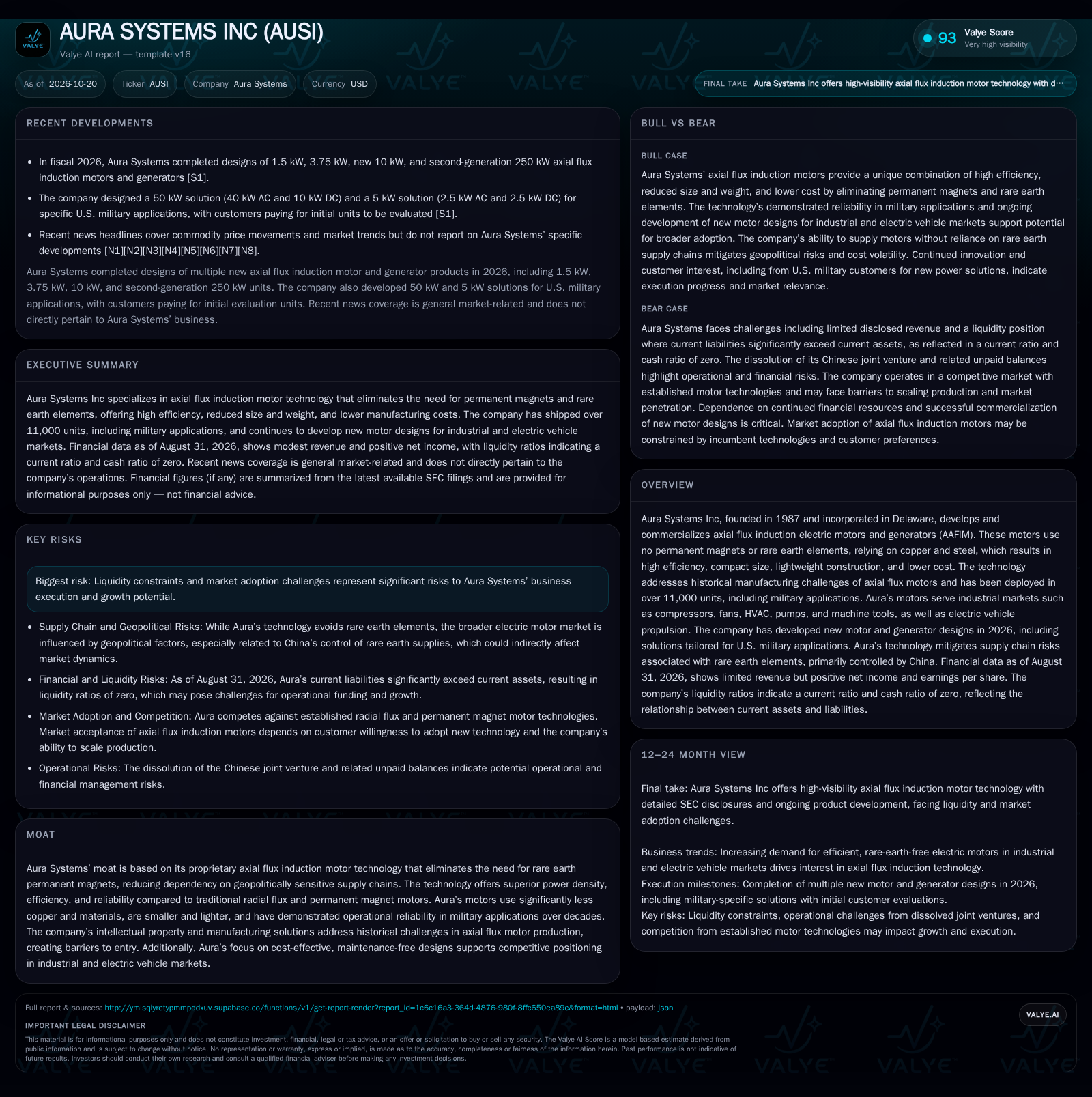
Aura Systems has developed advanced axial flux induction motors that avoid rare earths, offering size, cost, and efficiency benefits for industrial and military uses. Despite shipping over 11,000 units and launching new models—including military-evaluated designs—the company’s financials reflect minimal revenue, a sharply negative liquidity position, and unresolved liabilities from a dissolved China JV. Success hinges on overcoming adoption inertia and securing the funding needed to commercialize its next-generation products in a crowded market with established alternatives. [S1] [S2]
Aura Systems stands at a crossroads: its axial flux induction motor technology offers clear material and efficiency advantages over conventional motors, particularly by sidestepping the rare earth supply chain dominated by China. The company’s long operational history and successful military deployments validate the robustness of its designs. However, Aura’s financials reveal a stark mismatch between technical promise and commercial traction, with minimal revenue and a liquidity crunch that could impede further progress. The coming year will test whether the company can translate engineering leadership into sustainable business growth—or whether capital constraints and market inertia will stall the next phase of adoption. [S1] [S2]
Recent Financials and Product Launches Set the Stage for a Make-or-Break Period
Aura Systems has shipped more than 11,000 axial flux induction motors, including over 3,000 for military applications, indicating a proven operational record in demanding environments. In 2026, the company introduced several new motor and generator designs—including 1.5 kW, 3.75 kW, and a second-generation 250 kW model—while also developing military-specific 50 kW and 5 kW solutions that have entered initial customer evaluation. [S1]
Despite these technical milestones, Aura reported just $34,000 in revenue for the period ending August 31, 2026, with current assets of $101,000 dwarfed by current liabilities of $50.7 million. The company’s cash balance stood at $11,000, and both its current and cash ratios registered zero. Notably, Aura posted $3.4 million in net income, a figure that warrants scrutiny given the negligible revenue and the company’s persistent liquidity shortfall. [S2]
The company’s dissolved China joint venture and $700,000 in related-party notes payable further underline operational and financial complexity. These facts frame a business that is technologically ambitious but financially precarious, with its future hinging on the successful commercialization of its latest product designs and the resolution of outstanding liabilities. [S1] [S2]
How Aura’s Axial Flux Motors Could Reshape Cost and Efficiency Profiles—If Commercialized at Scale
Aura’s axial flux induction motors fundamentally differ from traditional radial flux and permanent magnet designs. By eliminating permanent magnets and rare earth elements, Aura’s motors use only copper and steel, leading to roughly 60% less copper usage and a size and weight reduction to about one-third of comparable induction motors. This material efficiency could yield lower bill-of-materials costs and simpler, more scalable manufacturing processes—assuming demand materializes and production is ramped successfully. [S1]
If Aura’s claims of equal or superior efficiency to top-tier permanent magnet motors hold in volume deployments, end customers in industrial, HVAC, heavy equipment, and electric vehicle markets could see both upfront capex and lifecycle opex benefits. The absence of scheduled maintenance and a wider operating speed range may further enhance total cost of ownership. However, the company’s revenue base remains extremely small, suggesting that either pricing, order volume, or both have yet to reach a level that supports operating leverage or sustainable gross margins.
The capital required to scale production, support customer qualification, and fund working capital is likely significant. With current liabilities vastly exceeding assets and cash, Aura’s business economics remain largely theoretical until the company demonstrates that it can move from prototype and pilot-scale shipments to recurring, high-volume sales. The question is whether the underlying cost advantages can be captured before liquidity pressures force operational retrenchment or dilution.
Competing Against Incumbents: Can Aura’s Rare Earth-Free Design Carve Out a Defensible Niche?
Aura’s most distinctive competitive lever is its avoidance of rare earth elements, which are subject to price and geopolitical volatility due to China’s dominance in mining and processing. For customers sensitive to supply chain security—such as the U.S. military and manufacturers worried about raw material shocks—this is a compelling value proposition. [S1]
However, the electric motor market is mature and crowded, dominated by established players with deep manufacturing expertise, broad product lines, and entrenched customer relationships. Permanent magnet synchronous motors and traditional induction motors are proven, widely supported, and benefit from extensive supply chains. While Aura’s technology offers technical advantages, switching frictions—including the need for customer requalification, integration engineering, and risk aversion—could slow adoption.
Aura’s long-standing military deployments demonstrate reliability but do not automatically translate into commercial contracts or recurring revenue. The company’s dissolved China joint venture illustrates the operational and geopolitical risks of global expansion. As competitors also seek to reduce rare earth dependence through alternative motor topologies or hybrid designs, Aura must demonstrate that its intellectual property and manufacturing know-how create a lasting barrier to entry.
From Niche Validation to Broader Adoption: What a Successful Commercial Ramp Could Look Like
The bullish scenario hinges on Aura leveraging its demonstrated track record in military applications to win larger production contracts—either from defense procurement or industrial OEMs seeking rare earth-free, high-efficiency motors. Successful customer evaluation and qualification of the new 50 kW and 5 kW military solutions would serve as strong validation, potentially leading to multi-unit or multi-year orders. [S1]
If Aura can secure the financing needed to expand manufacturing and meet initial demand, the resulting scale could drive down unit costs, improve gross margins, and attract additional customers wary of rare earth supply risks. Evidence of recurring orders, rising backlog, or a major industrial/OEM partnership would confirm the upside scenario. Robust cash flow from operations, rather than sporadic income, would further validate the shift from prototype sales to commercial adoption.
Falsification would come from the absence of follow-on orders post-evaluation, inability to resolve liquidity constraints, or continued negligible revenue despite technical milestones. If customers do not migrate from incumbent technologies or if Aura is forced to dilute existing shareholders to sustain operations, the path to scale would be in doubt.
Plausible Trajectory: Technical Progress Continues, but Commercial Traction Lags Funding Needs
The most likely outcome is that Aura continues to innovate and deliver technical proof points—such as new product launches and successful pilot deployments—without yet achieving the scale or revenue consistency needed to self-fund growth. Military or niche industrial customers may continue to evaluate Aura’s solutions, but conversion to large, recurring orders remains slow due to customer inertia and the burden of integration risk.
In this scenario, Aura remains reliant on external financing or strategic partnerships to bridge the gap between R&D-driven milestones and commercial scale. The company may need to restructure liabilities or secure bridge financing to avoid operational disruptions. Confirmation would come from modest but growing order volumes, announcements of new pilot programs, and incremental improvements in working capital, but not yet a full commercial breakthrough.
Falsification would be a deterioration in customer engagement, a halt in product development, or an inability to secure any new funding—each of which would point toward operational retrenchment.
Liquidity Crisis or Market Rejection: How Aura’s Story Could Unravel
The primary risk is that Aura’s acute liquidity constraints force a rapid scaling back of operations, layoffs, or a distressed asset sale before it can convert technical promise into commercial traction. With current liabilities vastly exceeding assets and cash, the company could fail to meet obligations, lose key suppliers, or default on debt, particularly if new funding is unavailable. [S2]
Alternatively, even if Aura survives the immediate liquidity crunch, the market may simply not adopt axial flux induction motors at scale—due to customer conservatism, the entrenchment of incumbent technologies, or competing rare earth-free solutions from better-capitalized rivals. The lack of revenue growth despite ongoing technical development would be a strong indicator of this scenario.
Evidence confirming the downside case would include missed payroll, loss of key personnel, default events, or public disclosure of going concern warnings. Continued minimal revenue, absence of new contracts, or negative feedback from customer evaluations would further support this outcome.
Milestones That Will Determine Whether Aura’s Technology Translates to Sustainable Business
Progression from initial military evaluation to follow-on orders or multi-unit contracts for the 50 kW and 5 kW motor solutions.
Quarterly revenue growth and evidence of a recurring revenue stream, not just sporadic sales or prototype shipments.
Disclosure of backlog, new customer wins, or long-term supply agreements—if disclosed—to gauge commercial traction.
Updates on the resolution of the $700,000 notes payable related to the dissolved China JV, as persistent liabilities could constrain strategic options.
Announcements of external financing, equity raises, or strategic partnerships that materially improve liquidity and working capital.
Evidence of cost structure improvements or margin expansion as production scales, supporting the case for operating leverage.
Customer testimonials, published field data, or independent efficiency/lifecycle cost studies that validate Aura’s performance claims and support broader adoption.
Disclaimer: This is research-only, informational analysis and not investment advice. It may include AI-generated interpretation and general industry context. Always verify important details using primary sources.

Comments