
ClimateRock: A SPAC at a Critical Liquidity and Execution Crossroads
With significant working capital deficits, reliance on related-party loans, and overdue SEC filings, the company’s future hinges on timely deal execution and the quality of its eventual acquisition target.
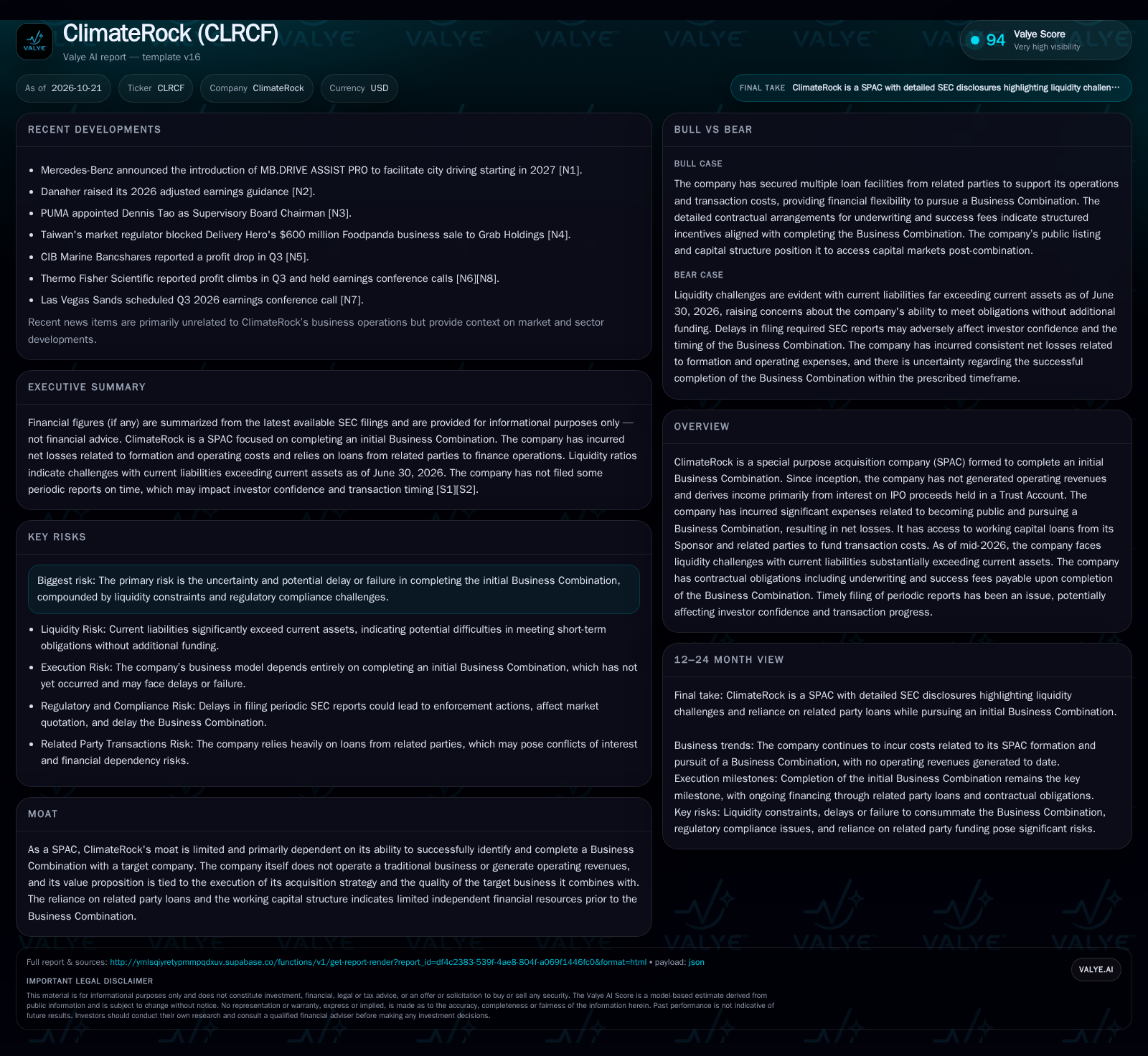
ClimateRock is a SPAC with no operating revenues, substantial working capital deficits, and mounting regulatory and liquidity pressure as of mid-2026. The company relies on related party loans to fund ongoing expenses while searching for a Business Combination. Delays in required filings and looming obligations put its ability to close a deal—and thus realize any value for shareholders—at risk. The core thesis is now dominated by execution, funding, and regulatory risk, not target selection or post-merger upside. [S1] [S2]
ClimateRock, a special purpose acquisition company (SPAC) formed to identify and merge with a target in climate-related sectors, has reached a pivotal moment. As of mid-2026, the company faces a severe working capital deficit, near-zero cash outside its trust account, and ongoing net losses. With no Business Combination completed and regulatory filings in arrears, ClimateRock’s future depends on its ability to secure funding, meet compliance requirements, and close a deal before time—and investor patience—runs out.
Liquidity, Reporting Delays, and the Business Combination Clock
As of June 30, 2026, ClimateRock reported current assets of just $5,070 against current liabilities of $8,231,018, resulting in a current and cash ratio of 0 and a working capital deficit exceeding $8 million [S2]. The company reported cash and liquidity metrics for the period; these figures do not by themselves establish operating runway, investment capacity, financial flexibility, or financing capacity. [S1] It continues to incur net losses—$124,477 in Q2 2026—primarily due to formation, administrative, and due diligence expenses, with no operating revenue [S1] [S2].
Complicating matters, ClimateRock has not filed certain required SEC reports within prescribed timeframes, which could undermine investor confidence and delay or jeopardize the consummation of its initial Business Combination [S2]. The company’s ability to survive and deliver value is now tightly linked to both regulatory compliance and the timely execution of a transaction.
SPAC Economics: Costs, Funding, and Dilution Risks
ClimateRock’s business model is fundamentally transactional: it raises capital via an IPO, holds funds in a Trust Account, and seeks to merge with a private operating company. Until a deal is completed, the only income is interest on Trust Account balances. All other costs—legal, administrative, due diligence, and public company expenses—must be covered by working capital or sponsor loans.
The company’s economics are heavily front-loaded with fixed costs, while variable expenses are minimal until a Business Combination is completed. Recent redemptions have removed a significant portion of IPO proceeds from the Trust Account, reducing both future capital available to a target and interest income potential. At the same time, contractual obligations such as underwriting or success fees are only triggered if a deal closes.
To fund ongoing expenses, ClimateRock relies on unsecured, non-interest-bearing loans from related parties, which may be convertible into warrants. This structure provides short-term cash but introduces dilution risk for existing shareholders if the SPAC survives and completes a merger. If no Business Combination is achieved, these loans may not be repaid, and the company would likely be liquidated.
SPAC Competition and the Challenge of Target Selection
As a SPAC, ClimateRock’s competitive edge is not in traditional operating advantages, but in its ability to source, negotiate, and close a high-quality merger before its deadline. The current market is saturated with SPACs, many of which are chasing targets in climate, renewable energy, and ESG-adjacent sectors. This competition drives up valuations for promising companies and can force less well-capitalized SPACs to accept weaker terms or risk running out of time.
ClimateRock’s acute liquidity issues, limited public float after significant redemptions, and dependence on related-party funding erode its negotiating position relative to better-funded or more credible SPAC peers. The company’s ability to attract a compelling target may be further constrained by its recent difficulties with SEC filings, as regulatory uncertainty can deter potential merger partners.
What Success Would Require: Timely Deal and Reinvigorated Capital Structure
A favorable outcome for ClimateRock would involve securing a credible, attractive target and closing a Business Combination before additional redemptions or regulatory delays threaten the process. In this scenario, sponsor loans bridge the liquidity gap, and the merged entity leverages the public listing to raise new capital, pay down obligations, and invest in growth.
Confirmation of this scenario would include: (1) timely SEC filings and restored compliance status; (2) announcement of a definitive merger agreement with a high-quality, growth-oriented target; (3) clear communication of funding plans to address working capital and deal expenses; and (4) evidence of strong post-announcement investor interest (e.g., limited redemptions, PIPE commitments, or secondary market support).
This pathway could deliver value for remaining shareholders—especially if the target business offers a compelling growth story and the SPAC structure allows for efficient capital deployment. However, the window for this outcome is narrowing as liquidity and time dwindle.
Most Likely Outcome: Protracted Search, Ongoing Costs, and Erosion of Value
The most plausible scenario is that ClimateRock continues to incur administrative and due diligence expenses while searching for a viable target, but struggles to close a deal before its extended deadline. Ongoing liquidity constraints force increased reliance on related-party loans, further diluting potential deal value and raising governance risks.
If SEC filing delays persist, investor confidence may erode further, potentially triggering additional redemptions or making it more difficult to secure a PIPE or backstop financing. The eventual Business Combination, if completed, may be with a less attractive or distressed target, or on unfavorable terms. Shareholders could face significant dilution and limited upside, particularly if the Trust Account is further depleted by redemptions and expenses.
Evidence for this scenario would be continued delays in filings, limited public updates on transaction progress, growing working capital deficits, and a lack of high-profile target announcements.
Failure to Close: Liquidation and Loss of Shareholder Value
In the adverse scenario, ClimateRock fails to complete a Business Combination before its deadline, either due to an inability to secure a target, regulatory non-compliance, or insurmountable funding obstacles. In this case, the SPAC would be forced to liquidate, returning remaining Trust Account funds to public shareholders after deducting expenses and obligations—often resulting in returns below original investment, especially after redemptions and cost leakage.
Confirming evidence would include repeated SEC filing deficiencies, resignation of key directors or sponsors, rapidly dwindling working capital, and public statements about potential wind-down or liquidation. This scenario would likely be accelerated if regulatory or exchange actions are taken against the company due to non-compliance.
Milestones and Metrics That Will Determine ClimateRock’s Next Chapter
The timing and content of the next SEC filings: Delays or restatements would further undermine confidence and could trigger regulatory action.
Announcement of a definitive Business Combination agreement: The quality of the target and deal terms will be critical to shareholder value.
Changes in working capital deficit or evidence of new funding: If disclosed, improvements here would indicate reduced risk of near-term insolvency.
Level of public shareholder redemptions: High redemption rates would shrink the Trust Account and reduce value for remaining shareholders.
Sponsor or affiliate loans: New or increased related-party lending, especially if convertible to equity or warrants, would increase dilution risk.
PIPE or backstop financing commitments: If disclosed, these would shore up deal certainty and post-merger funding capacity.
Changes in board composition or sponsor support: Resignations or sponsor withdrawals could signal elevated risk of failure to close a deal.
Progress on regulatory compliance or exchange status: Any news of SEC or listing authority actions would immediately affect scenario probabilities.
Disclaimer: This is research-only, informational analysis and not investment advice. It may include AI-generated interpretation and general industry context. Always verify important details using primary sources.

Comments