
Adial Pharmaceuticals: Clinical Pivot, Funding Needs, and the Search for Genetic Precision in Addiction Therapeutics
Adial Pharmaceuticals is navigating a critical period: refocusing its portfolio around AD04 for genetically defined alcohol use disorder, contending with persistent net losses, and pursuing both regulatory validation and commercial partnerships. The company's future hinges on clinical trial enrichment strategies, capital access, and the credibility of its biomarker-driven approach.
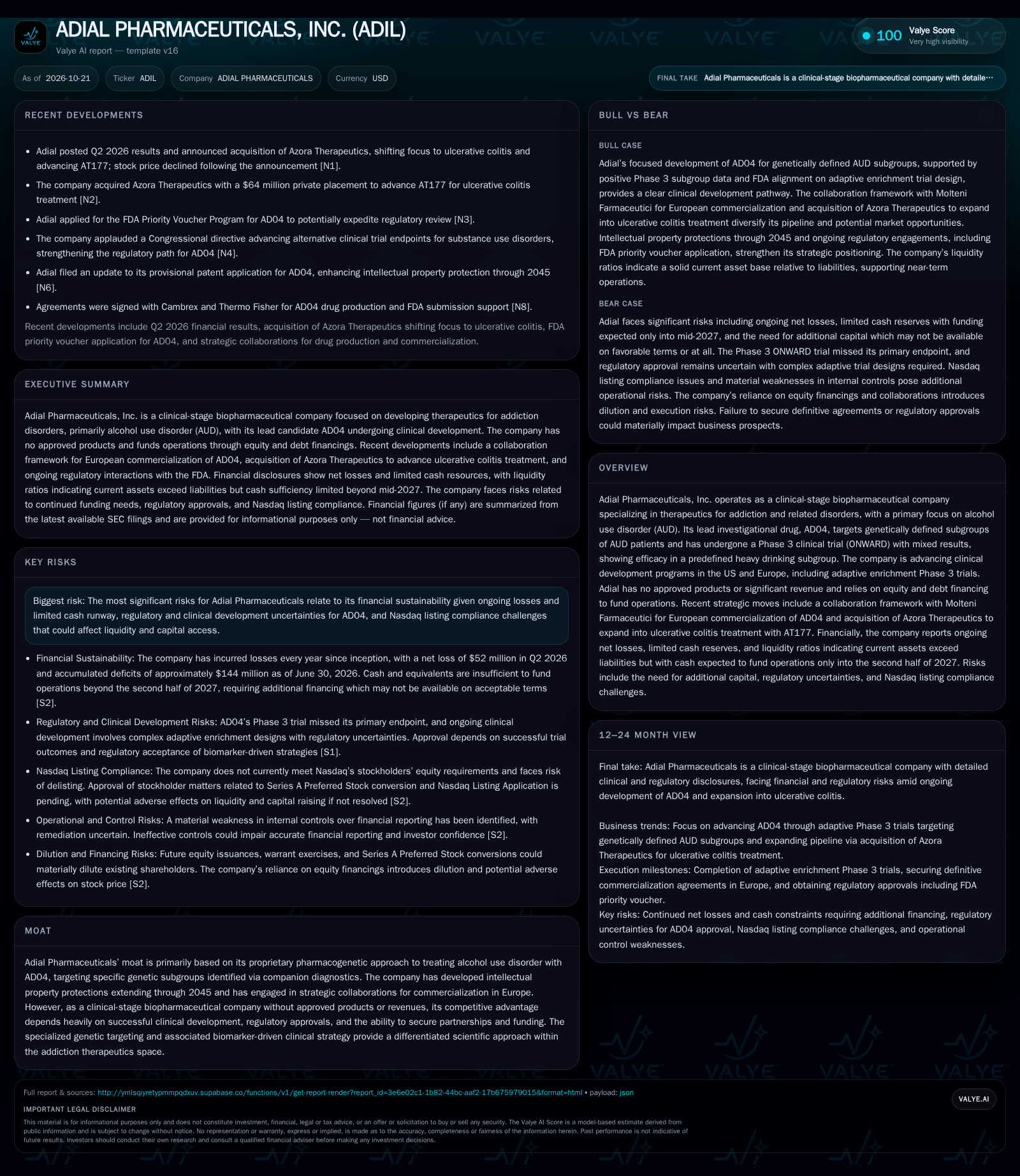
Adial Pharmaceuticals remains a clinical-stage biotech with no approved products, focusing on AD04 for genetically defined alcohol use disorder.
Adial Pharmaceuticals stands at a pivotal crossroads. The company’s lead asset, AD04, is being developed for alcohol use disorder (AUD) in genetically defined subgroups—a differentiated, biomarker-driven strategy that may unlock regulatory and commercial value if successful. Adial’s future now depends on the execution of adaptive enrichment trials, the ability to secure additional capital, and the realization of partnership opportunities—each with its own set of hurdles and dependencies.
Recent Shifts: Clinical Focus, Financial Pressures, and a Strategic Acquisition
Adial Pharmaceuticals is currently advancing its lead candidate, AD04, for alcohol use disorder (AUD) in genetically defined subgroups. The ONWARD Phase 3 trial of AD04 missed its primary endpoint but demonstrated statistically significant efficacy in a predefined heavy drinking population—a result that has prompted a renewed focus on biomarker-driven patient selection [S1]. The company recently announced the acquisition of Azora Therapeutics, signaling a parallel interest in ulcerative colitis and expanding its pipeline beyond addiction therapeutics, though the stock declined on the news as investors weighed the shift in focus [N1]. The company reported cash and liquidity metrics for the period; these figures do not by themselves establish operating runway, investment capacity, financial flexibility, or financing capacity. [S1] [S2] Meanwhile, Adial continues to pursue regulatory engagement, including an FDA priority voucher application for AD04, and has signed framework and manufacturing agreements to support eventual commercialization [N3] [N8].
Potential Economics of a Targeted Addiction Therapeutic
Adial’s business model is predicated on the successful development and approval of AD04, a genetically targeted therapy for alcohol use disorder. If approved, AD04 would likely be commercialized via specialty pharmaceutical channels, potentially commanding premium pricing due to its precision-medicine approach and companion diagnostic requirement. However, the commercial opportunity is tightly linked to the size of the genetically defined patient subpopulation, and the economics depend on both diagnostic adoption and payer willingness to reimburse for a niche therapy.
Absent any approved products, Adial currently generates no significant revenue and supports operations through periodic equity and debt financings [S1]. The company’s cost structure is heavily weighted toward R&D and regulatory activities, with significant fixed costs related to clinical trials and regulatory submissions. Operating leverage would only materialize if AD04 or other pipeline assets reach the market. Capital needs remain high: the company’s latest cash balance of $5.9 million is insufficient for the next 12 months, and ongoing clinical development will require further infusions of capital, likely through equity or partnership deals [S2].
If AD04 succeeds, the economics could be attractive due to exclusivity (IP protection through 2045 [N6]) and the potential to expand into additional indications or geographies. However, generic ondansetron—the active ingredient in AD04—limits pricing power absent robust clinical and pharmacoeconomic differentiation.
Differentiation and the Challenge of Biomarker-Driven Addiction Therapy
Adial’s competitive differentiation rests on its pharmacogenetic approach—targeting AUD patients with specific genetic profiles using AD04 and a companion diagnostic. This strategy sets it apart from traditional addiction therapeutics, which generally target broader patient populations. If validated, this approach could confer regulatory advantages (e.g., priority review or orphan designation), facilitate payer negotiations, and support higher pricing.
However, the company faces several counterforces. First, there are established generic and branded pharmacotherapies for AUD (such as naltrexone, acamprosate, and disulfiram) that are widely accessible and well-studied, albeit with modest efficacy in unselected populations. Second, AD04’s active ingredient, ondansetron, is available generically, which could constrain pricing unless Adial’s clinical data and IP strategy clearly differentiate the product. Third, larger pharmaceutical companies and academic groups are pursuing both small-molecule and biologic approaches to addiction, some with more resources and broader pipelines.
Adial’s reported collaboration framework with Molteni Farmaceutici could open exclusive commercialization channels in Europe, but execution risk remains until definitive agreements are signed [S1]. Ultimately, the company’s competitive position will be determined by the strength of its clinical evidence, the credibility of its biomarker-driven model, and its ability to secure commercial partners or acquirers.
Unlocking Value Through Regulatory Success and Strategic Partnerships
The most favorable outcome for Adial would follow a sequence in which adaptive enrichment Phase 3 trials for AD04 demonstrate robust efficacy and safety in genetically defined subgroups, leading to regulatory approval in the US and Europe. The company’s ongoing engagement with the FDA—including alignment on trial design and a priority voucher application—could accelerate review timelines, while positive Congressional signals regarding alternative clinical trial endpoints for substance use disorders may further ease regulatory hurdles [N3] [N4].
Commercially, the execution of a definitive agreement with Molteni Farmaceutici or a similar partner would provide both upfront funding and a pathway to European market access, with milestone and royalty payments supporting ongoing operations [S1]. Intellectual property protection through 2045 and successful adoption of the companion diagnostic would help defend pricing and market share. Validation of the biomarker-driven strategy could also position Adial as a credible acquisition target for larger players seeking precision medicine assets in addiction.
Evidence that would confirm this scenario includes successful completion of pivotal trials with statistically significant subgroup results, regulatory acceptance of adaptive endpoints, and signed commercial agreements with material upfront and milestone economics.
Clinical and Financial Uncertainty Defines the Near-Term Outlook
The most plausible trajectory for Adial is continued advancement of AD04 through adaptive enrichment trials, punctuated by incremental regulatory feedback and ongoing capital raises. The next 12–24 months are likely to be characterized by sequential milestones: completion of further Phase 3 studies, possible readouts in genetically defined cohorts, and efforts to secure definitive commercialization agreements in Europe and the US.
Given current cash constraints, the company will likely need to pursue additional equity or convertible debt offerings, with attendant dilution risk for current shareholders [S2]. Regulatory timelines may extend if additional data or trial modifications are required, and partnership discussions could stall if clinical results are equivocal. The base scenario assumes no near-term product approvals and continued net losses, with value inflection contingent on positive clinical data and progress toward commercialization partnerships.
Evidence supporting this outcome would include steady but slow progress on trial enrollment, modest capital raises, and regular regulatory updates without major breakthroughs or setbacks.
Potential for Clinical Setbacks, Funding Shortfalls, and Loss of Listing
A negative sequence would involve one or more of the following: failure of AD04 to demonstrate statistically significant efficacy in further trials, regulatory rejection of adaptive enrichment strategies or endpoints, or inability to secure a definitive commercialization agreement in Europe after the framework stage [S1]. These setbacks would likely exacerbate existing financial pressures, forcing the company to seek dilutive emergency financings or face the risk of running out of cash.
Operationally, failure to resolve Nasdaq listing compliance issues could result in delisting, further restricting access to capital and potentially triggering technical defaults or loss of investor confidence [S2]. Persistent net losses and the absence of a viable commercial product could lead to workforce reductions, program discontinuations, or even consideration of strategic alternatives such as asset sales or liquidation.
Evidence supporting this scenario would include negative or inconclusive trial results, adverse regulatory feedback, failure to raise new capital, or notification of delisting from Nasdaq.
Milestones That Will Define the AD04 Thesis and Adial’s Trajectory
Completion and outcome of adaptive enrichment Phase 3 trials for AD04 in genetically defined AUD subgroups.
Regulatory feedback and acceptance of alternative clinical trial endpoints by the FDA and European agencies.
Execution of a definitive commercialization agreement with Molteni Farmaceutici or another European partner, including disclosure of upfront and milestone economics.
Updates regarding the adoption, validation, and reimbursement status of the companion genetic diagnostic—if disclosed.
Progress on the FDA priority voucher application and any impact on review timelines for AD04.
Disclosure of additional financing events, including terms and the degree of shareholder dilution.
Resolution of Nasdaq listing compliance issues, including conversion and approval of Series A Preferred Stock.
Remediation of identified material weaknesses in internal controls and improvements in financial reporting quality.
Disclaimer: This is research-only, informational analysis and not investment advice. It may include AI-generated interpretation and general industry context. Always verify important details using primary sources.

Comments