
Danaher’s Strategic Acquisitions and Innovation Bets: Margin Pressures, Segment Divergence, and the Road to AI-Enabled Healthcare
Danaher’s recent Diagnostics expansion via Masimo, coupled with a push into AI-powered solutions and automation, highlights a multi-pronged growth strategy. Yet, margin compression and uneven segment performance raise questions about the pace and sustainability of value creation.
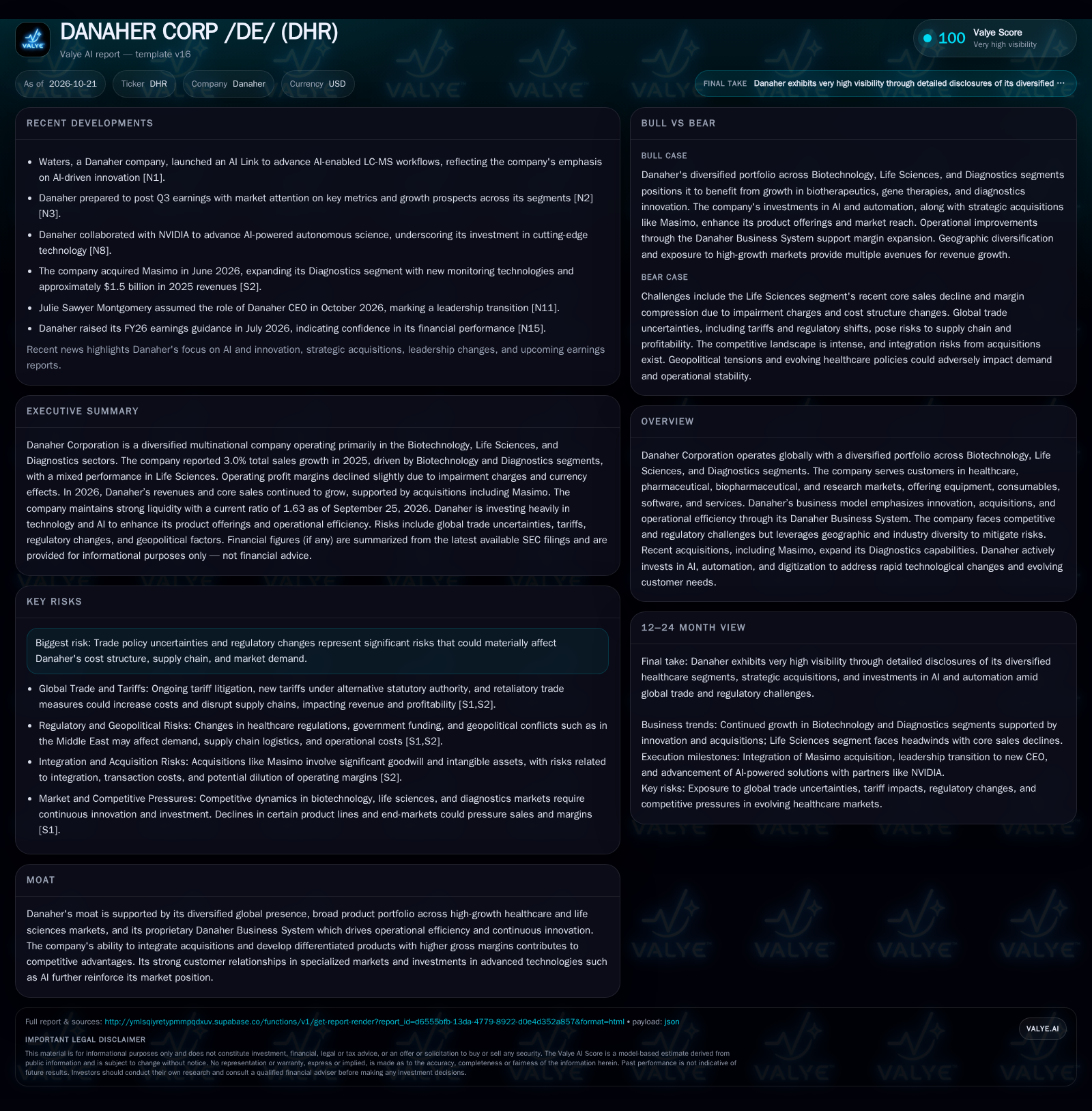
Danaher’s 2025-2026 results show a company leveraging acquisitions and innovation—particularly in Diagnostics and Biotechnology—to offset headwinds in Life Sciences and margin compression. The Masimo acquisition expands Diagnostics capabilities, while AI initiatives and automation signal long-term ambition. However, Life Sciences weakness and broader margin pressures complicate the outlook. Monitoring integration progress, margin recovery, and technology adoption will be key in assessing the company’s ability to deliver on its diversified growth thesis. [S1] [S2]
Danaher’s diversified portfolio strategy is being stress-tested as the company pushes further into Diagnostics through the Masimo acquisition, ramps up AI and automation investments, and contends with margin pressures and mixed segment results. While Biotechnology and Diagnostics are fueling growth, Life Sciences softness and recent margin compression highlight execution and integration challenges. The company’s ability to harness AI, integrate acquisitions, and navigate regulatory and geopolitical headwinds will determine whether its multi-segment approach can deliver sustainable value in a rapidly evolving healthcare technology landscape. [S1] [S2] [N8]
Recent Acquisitions, Segment Divergence, and Margin Compression Shape Danaher’s Outlook
Danaher’s 2025 results underscore a company in transition: total sales grew 3.0% year-over-year, driven by Biotechnology and Diagnostics, while Life Sciences core sales declined 1.5% and segment margins contracted sharply. The June 2026 acquisition of Masimo added approximately $1.5 billion in 2025 revenues to Diagnostics, supporting a 6.5% sales lift from acquisitions in Q3 2026. Meanwhile, consolidated operating profit margins decreased by 130 basis points in 2025, reflecting impairment charges and currency headwinds, with only the Biotechnology segment posting a margin improvement. The company reported cash and liquidity metrics for the period; these figures do not by themselves establish operating runway, investment capacity, financial flexibility, or financing capacity. [S1] [S2]
How Danaher’s Multi-Segment Model Delivers Growth and Faces Margin Risk
Danaher’s economic engine rests on a blend of recurring revenue from consumables, service contracts, and software—particularly in Biotechnology and Diagnostics—alongside higher-ticket capital equipment in Life Sciences. The Masimo acquisition further tilts the mix toward Diagnostics, potentially increasing exposure to healthcare provider budgets and reimbursement cycles but also deepening recurring revenue streams via patient monitoring solutions. Pricing power is uneven: highly specialized consumables and proprietary instruments may command premium pricing, but competitive and regulatory pressures can limit pricing flexibility in core diagnostics and lab equipment markets.
Operating leverage is a function of manufacturing scale, the Danaher Business System’s efficiency initiatives, and the company’s ability to integrate acquisitions without diluting margins. 2025 margin contraction suggests that impairment charges and cost structure changes—especially in Life Sciences—can offset gains from volume growth elsewhere. Capital needs remain significant due to ongoing R&D, automation, and the integration of acquired platforms, while technology investments in AI and digitization aim to drive long-term productivity and create new high-margin offerings. If Danaher can accelerate the mix shift toward software-enabled and AI-powered solutions, operating leverage could improve, but integration costs and the risk of stranded assets remain real counterforces.
The balance between recurring revenue streams and capital equipment sales also introduces complexity in cash flow predictability and investment prioritization. Conversely, capital equipment sales, often characterized by longer sales cycles and higher variability, may cause fluctuations in cash flow and pressure to maintain competitive pricing. This dynamic necessitates a careful allocation of resources to ensure that investments in new technologies, particularly AI and automation, do not outpace the company’s ability to generate sustainable returns. Moreover, the extent to which Danaher can convert its recurring revenue base into higher-margin software and digital offerings will be critical in mitigating margin risks associated with commoditized hardware segments.
Another layer of margin risk arises from the integration of acquisitions like Masimo, which often involves upfront costs, restructuring expenses, and potential redundancies that can temporarily depress profitability. The success of these integrations depends heavily on Danaher’s ability to standardize processes, eliminate overlapping functions, and capture procurement and operational synergies. However, if integration timelines extend or cultural mismatches impede collaboration, the anticipated margin benefits may be delayed or diluted. Additionally, the evolving regulatory environment could impose compliance costs or restrict certain operational flexibilities, further complicating margin recovery. Therefore, margin expansion is contingent not only on organic growth and technology adoption but also on disciplined integration and proactive risk management.
Innovation, Scale, and Integration: Danaher’s Edge and Its Limits
Danaher’s competitive advantages lie in its global scale, breadth of offerings, and the operational rigor of its business system. Its ability to cross-sell across Biotechnology, Life Sciences, and Diagnostics creates switching frictions, particularly for large research and clinical customers who value integrated workflows and service reliability. The acquisition of Masimo deepens its Diagnostics portfolio, potentially allowing bundled offerings and broader data integration in patient monitoring.
However, the competitive landscape is intense: global conglomerates, focused diagnostics and life sciences firms, and emerging digital health players all vie for share. Technology substitution risk is rising as AI, automation, and digital platforms compress differentiation in traditional hardware and reagents. Danaher’s push into AI—highlighted by collaborations with NVIDIA and the launch of AI-enabled workflows at subsidiaries—may provide a temporary edge, but the sustainability of this moat depends on execution, speed of adoption, and continued investment. Integration risk is non-trivial; the ability to realize synergies from acquisitions without eroding margins or focus will be a key differentiator.
AI-Driven Productivity and Seamless Integration Unlock Margin Expansion
A favorable scenario sees Danaher rapidly integrating Masimo, extracting cost and cross-selling synergies, and leveraging its AI-driven automation investments to boost productivity and develop differentiated, high-margin offerings. The adoption of AI-powered workflows could enable premium pricing and enhance customer lock-in for both Diagnostics and Biotechnology customers. If software and automation become a greater share of the revenue mix, gross margins could expand beyond pre-2025 levels, offsetting the recent contraction.
Evidence supporting this scenario would include a sequential improvement in consolidated and segment operating margins, accelerating core sales growth in AI- and automation-adjacent products, and customer wins tied directly to new technology platforms. Early validation of cross-selling between Masimo’s portfolio and Danaher’s existing installed base would further confirm the upside.
Portfolio Balances Growth and Headwinds, With Margin Recovery Dependent on Execution
The most plausible path is for Danaher to continue posting modest top-line growth, with Biotechnology and Diagnostics offsetting persistent Life Sciences softness. Operating margins may gradually recover as impairment charges abate and integration of Masimo progresses, but structural headwinds—such as pricing pressure in commoditized segments and the need for ongoing investment in R&D and digital capabilities—limit near-term expansion.
Confirmation would come from stable or slightly improving segment margins, continued mid-single-digit core sales growth, and successful onboarding of Masimo without material incremental charges or revenue disruption. Delays or cost overruns in integration, or persistent margin compression, would challenge this scenario.
Integration Stumbles and Regulatory Shocks Erode Profitability
A negative outcome could materialize if the Masimo integration proves more costly or disruptive than anticipated, leading to further margin contraction and management distraction. Additional impairment charges—especially if Life Sciences continues to underperform—could weigh on consolidated results. External shocks, such as adverse tariff rulings, new regulatory barriers in major markets, or supply chain disruptions tied to geopolitical conflict, could amplify cost pressures and reduce demand for capital equipment and consumables.
Evidence would include further sequential declines in segment and consolidated operating margins, missed sales targets in acquired or core businesses, and negative revisions to guidance tied to integration or external risk events.
Milestones and Metrics That Will Clarify Danaher’s Value-Creation Trajectory
Track consolidated and segment operating profit margins quarterly to assess whether margin compression is reversing or becoming structural.
Monitor core sales growth rates in Diagnostics and Biotechnology for evidence of sustained demand and successful cross-selling, particularly from Masimo integration.
Watch for updates on AI-enabled product launches, customer adoption rates, and the revenue mix shift toward software and automation—if disclosed.
Assess progress in integrating Masimo, including realization of targeted synergies and cost savings, as well as any incremental acquisition-related charges.
Follow regulatory and trade policy developments, especially outcomes of ongoing tariff litigation and potential new supply chain disruptions.
Evaluate capital allocation priorities—whether Danaher continues to prioritize R&D and digitization or shifts focus to further acquisitions or shareholder returns.
If disclosed, track customer retention and contract renewal rates in Diagnostics and Biotechnology, particularly for new digital and AI-driven offerings.
Monitor executive commentary on Life Sciences recovery and any restructuring or portfolio optimization initiatives aimed at addressing that segment’s weakness.
Disclaimer: This is research-only, informational analysis and not investment advice. It may include AI-generated interpretation and general industry context. Always verify important details using primary sources.

Comments