
Stride, Inc.: Long-Term Contracts and Platform Investment Anchor Education Tech Ambitions
Stride, Inc. leverages multi-year school-as-a-service contracts and ongoing platform enhancements to build a defensible position in the competitive U.S. online education market, but faces renewal, regulatory, and integration risks as digital learning demand evolves.
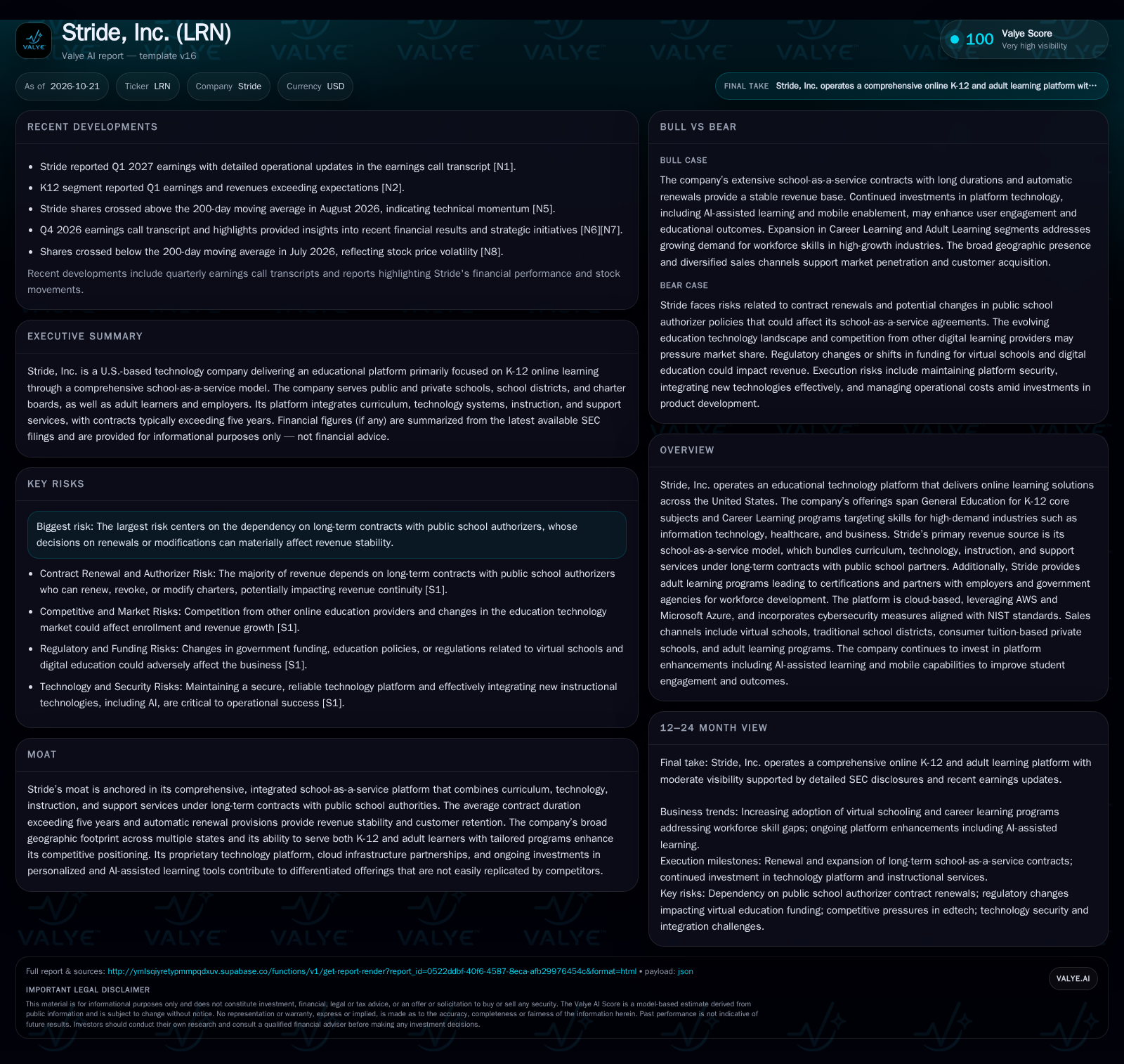
Stride, Inc. operates a comprehensive online education platform with the majority of revenue secured through multi-year, automatically renewing contracts with public school authorities. The company’s breadth across K-12 and adult learning, plus a diversified channel mix, supports resilience, but future performance will hinge on contract renewals, regulatory stability, and the ability to differentiate in a crowded edtech landscape. [S1] [S2]
Stride, Inc. has carved out a defensible niche in the U.S. education technology sector by delivering an integrated, cloud-based online learning platform primarily to K-12 schools and districts. The company's school-as-a-service contracts, typically spanning more than five years with automatic renewals, underpin a recurring revenue stream that supports both operational scale and ongoing investment in digital learning innovation.
Multi-Year Contracts and Platform Investment Shape Stride’s Financial Profile
Stride’s business model is anchored by comprehensive school-as-a-service contracts with public school authorities, averaging over five years in duration and featuring automatic renewal provisions. This structure provides a stable and predictable revenue base, as evidenced by $639.38 million in revenue and $64.92 million in net income reported for the quarter ended September 30, 2026. The company reported $547.75 million in cash and $241.43 million in short-term investments, with a current ratio of 2.56 and a cash ratio of 1.15. Stride continues to invest in platform enhancements—such as AI-assisted learning and mobile enablement—to improve engagement and outcomes, signaling a commitment to both product differentiation and long-term growth. [S1] [S2]
The multi-year contract model not only stabilizes revenue but also influences Stride’s capital allocation and strategic planning. With predictable cash flows, the company can prioritize long-term investments in technology and content development without the pressure of short-term earnings volatility. However, this model also requires careful contract management and customer relationship strategies to mitigate the risk of non-renewal or renegotiation, which could disrupt revenue streams. Additionally, the automatic renewal clauses may create inertia that benefits Stride, but they also necessitate continuous platform relevance and compliance with evolving educational standards to avoid contract attrition.
How Stride Converts Platform Scale into Revenue and Margin
Stride’s economics are defined by the bundling of curriculum, technology infrastructure, instruction, and support services into a single, multi-year contract for K-12 customers. The all-in-one school-as-a-service model creates high switching costs for institutional clients, as operational and pedagogical dependencies increase over time. Revenue is recognized as services are delivered, smoothing cash flows and supporting operational planning.
The company’s fixed cost base—cloud infrastructure (AWS, Azure), proprietary software development, and centralized curriculum creation—supports operating leverage as enrollment scales. Variable costs are primarily tied to instructional staffing and support services, which flex with student volumes. The adult learning segment, sold to consumers and employers, likely carries higher gross margins due to lower regulatory and service overhead, but may be more volatile in demand and pricing.
Stride’s capital needs are moderate, focused on technology and content investment rather than physical infrastructure. The company reported cash and liquidity metrics for the period; these figures do not by themselves establish operating runway, investment capacity, financial flexibility, or financing capacity.
The bundling approach inherently creates a complex cost structure that balances fixed and variable components, enabling operating leverage as the user base scales. However, this leverage is contingent on maintaining or growing enrollment levels; a decline could disproportionately impact profitability due to the fixed nature of infrastructure and content development costs. Furthermore, the integration of AI and mobile technologies, while potentially enhancing efficiency, introduces new layers of technical complexity and ongoing maintenance expenses. Strategic prioritization of investments that yield the highest incremental engagement or retention gains is critical to maximizing returns on capital deployed in platform enhancements.
Defensibility in a Crowded EdTech Landscape
Stride’s competitive position rests on three pillars: the breadth and integration of its platform, the duration and automatic renewal of its customer contracts, and the scale of its geographic reach across 31 states and DC in General Education and 25 states and DC in Career Learning. These elements create a high barrier for new entrants and make rapid displacement by single-point solution providers less likely.
However, established edtech competitors and new entrants—ranging from learning management system vendors to direct-to-consumer supplemental education brands—continue to push digital learning innovation. Districts and states may pursue in-house solutions or alternative providers if Stride’s platform fails to keep pace in areas like AI personalization, mobile engagement, or compliance.
Switching friction is high due to the complexity of migrating curriculum, student data, and instructional practices, but not insurmountable. Regulatory shifts or changes in public sentiment toward virtual learning could accelerate churn or force renegotiation of contract terms. Stride’s ability to serve both K-12 and adult learners is a differentiator, but the core K-12 business remains the primary moat.
Technology-Led Differentiation Unlocks Expansion Opportunities
The most compelling upside scenario for Stride is the successful leveraging of its ongoing investments in AI-assisted learning, mobile capabilities, and advanced analytics to measurably improve student outcomes and engagement. If these enhancements translate into better academic results, higher retention, and more compelling value propositions for districts and states, Stride could see increased contract renewals, larger deal sizes, and new market wins—especially as workforce skills and digital fluency become policy priorities.
Expansion of Adult and Career Learning programs into adjacent markets or deeper partnerships with employers and government agencies could provide incremental margin and revenue diversity. Evidence confirming this scenario would include accelerated growth in contract value, new multi-state or national partnerships, and third-party validation of efficacy improvements tied to platform upgrades. Conversely, if platform innovation fails to drive measurable outcome gains or customer expansion, the upside case would be weakened.
Sustained Contract Renewal and Measured Growth Remain Central
The most plausible trajectory is that Stride maintains a stable K-12 customer base through steady contract renewals and modest enrollment growth, with incremental improvements in platform capabilities. The company’s recurring revenue structure and diversified channel mix should support continued profitability and moderate expansion in both K-12 and Adult Learning segments.
This scenario is confirmed by ongoing renewal rates at or above historical averages, stable or improving gross margins despite investment in technology, and gradual increases in average contract value. Falsifying evidence would include material declines in renewal rates, deteriorating margins due to cost overruns, or policy changes that significantly reduce virtual school funding.
Contract Disruption or Regulatory Shock Erodes Revenue Base
A negative scenario would unfold if a material portion of Stride’s long-term contracts are not renewed due to changes in public school authorizer policies, regulatory mandates, or competitive displacement. Such disruptions could quickly cascade into lower enrollment, reduced revenue visibility, and margin compression as fixed costs are spread over a smaller base.
Additional downside could result from adverse regulatory changes—such as funding cuts for virtual schools or new compliance burdens—that raise costs or limit market access. Operational missteps in integrating new technologies or maintaining cybersecurity could further erode trust and contract wins. Confirmation of this scenario would come from a sudden drop in contracted schools, negative enrollment trends, or a wave of public school contract losses or terminations.
What Will Determine Stride’s Staying Power in Digital Education?
Renewal rates and average duration of school-as-a-service contracts—if disclosed—relative to historical levels.
Net enrollment growth in both General Education and Career Learning segments, with attention to churn and new school wins.
Gross margin trends, especially as platform investments in AI and mobile features scale.
Incremental revenue and margin contribution from Adult Learning and employer/government partnerships.
The pace, adoption, and efficacy of new platform features—such as AI-assisted learning—demonstrated through customer testimonials or third-party studies.
Regulatory and policy developments at the state and federal level impacting virtual school funding or digital education mandates.
Incidents or disclosures related to cybersecurity breaches or technology integration failures.
Cash flow from operations and capital allocation to R&D versus share buybacks or dividends, indicating management’s growth versus return focus.
Disclaimer: This is research-only, informational analysis and not investment advice. It may include AI-generated interpretation and general industry context. Always verify important details using primary sources.

Comments