
Winnebago Industries: Navigating Macroeconomic Headwinds with Brand Strength and Segment Adaptability
Winnebago faces a challenging consumer environment, with declining Towable and Marine volumes offset by growth in Motorhome RVs and stable gross margins. The company's diversified product portfolio, dealer-centric distribution, and focus on operational consolidation will shape its resilience and recovery as macro pressures persist.
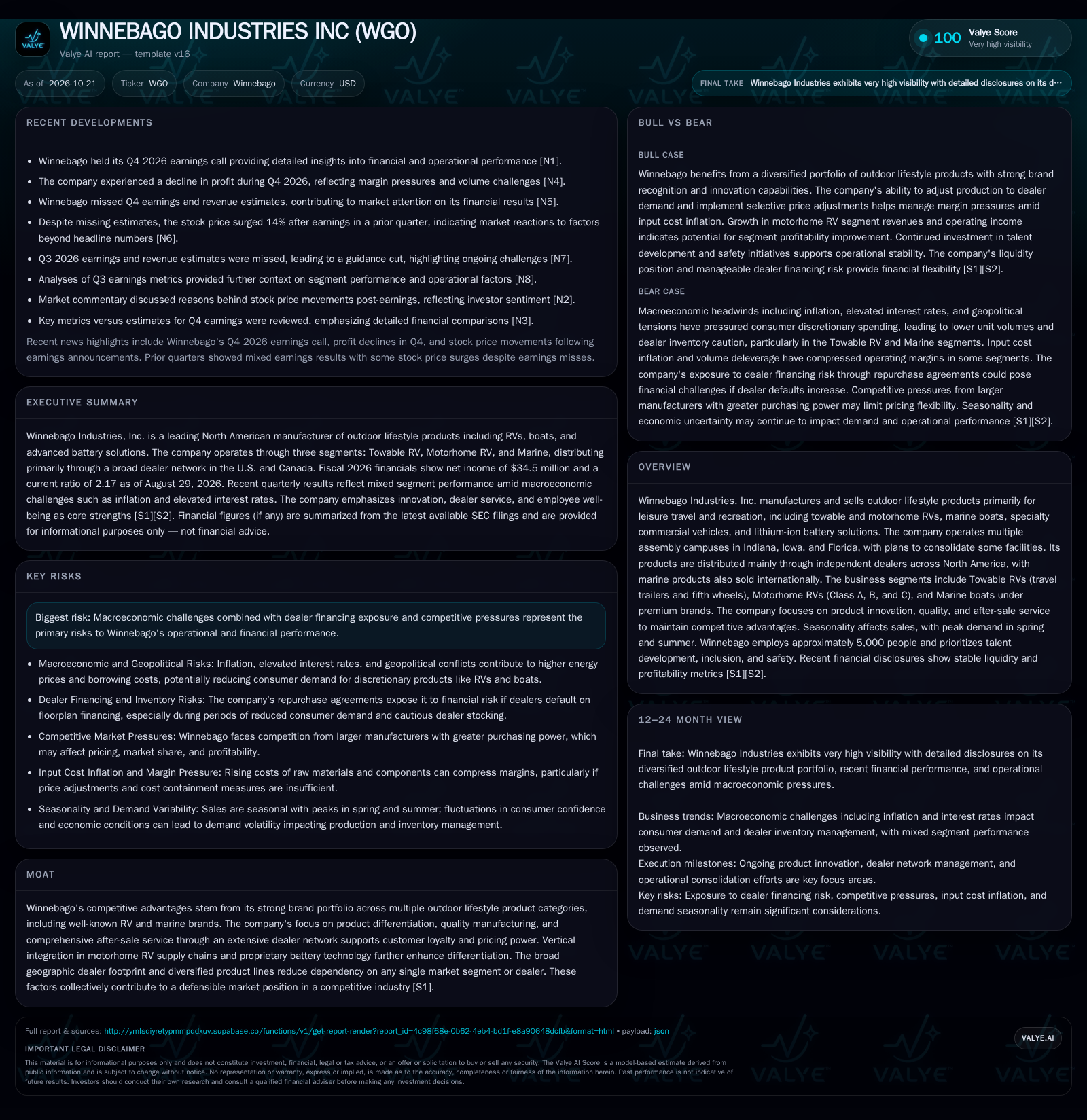
Winnebago's 2026 results show net income of $34.5 million and reported liquidity position, but segment performance is mixed amid inflation, elevated rates, and soft consumer demand. Motorhome RVs outperformed, while Towables and Marine suffered volume declines. The company is responding with price adjustments and operational consolidation, but remains exposed to dealer risk and competitive pressures. Execution on innovation, margin discipline, and dealer relationships will determine recovery pace and long-term positioning. [S1] [S2]
Winnebago Industries enters 2027 at a critical juncture: while its legacy as a premium outdoor lifestyle brand remains intact, the company is confronting pronounced macroeconomic pressures that are reshaping demand for RVs and boats. Fiscal 2026 results highlight both the resilience and vulnerability of its diversified model. With Motorhome RVs gaining ground but Towable and Marine segments lagging, Winnebago is relying on strategic price adjustments, operational consolidation, and its entrenched dealer network to weather the storm. The next phase will test whether brand strength and operational discipline can overcome cyclical headwinds and mounting competition.
Recent Performance Highlights Shifting Segment Dynamics
Winnebago reported fiscal 2026 net income of $34.5 million, with a current ratio of 2.17 and cash of $181.4 million at period end [S1]. This liquidity snapshot suggests the company is not under immediate financial stress, but it is contending with mixed segment performance: Towable RV and Marine revenues declined due to lower unit volumes and product mix, while Motorhome RV revenue and margin improved on higher volume and selective price increases [S2]. Gross profit margin overall was stable despite these headwinds, reflecting price discipline and cost management, but operating income margins in Towable and Marine segments were pressured by input cost inflation and volume deleverage [S2]. Macroeconomic challenges—specifically inflation, elevated interest rates, and weak consumer confidence—have directly impacted dealer inventory management and consumer discretionary spending, shaping the company’s near-term outlook [S2].
How Winnebago Makes Money: Pricing, Volume, and Margin Mechanics
Winnebago’s revenue engine is built on the sale of high-ticket, discretionary outdoor lifestyle products—towable RVs, motorhome RVs, and premium boats—distributed primarily through independent dealers. Pricing spans from $23,000 for entry-level towables to nearly $1.9 million for luxury motorhomes, and up to $893,000 for marine offerings [S1]. This wide range allows for both volume-driven and margin-driven strategies: Towable RVs typically depend on higher unit volumes with narrower margins, while Motorhome RVs and Marine segments target affluent buyers with greater pricing power and margin potential.
Fixed costs are significant—spanning manufacturing facilities in multiple states and a 5,000-person workforce—making the business sensitive to volume swings. Variable input costs (raw materials, components, labor) have risen with inflation, pressuring margins unless offset by price increases or cost controls. Operating leverage can work both ways: rising volumes in Motorhome RVs have improved margin, while declines in Towables and Marine have amplified deleverage effects [S2]. The company’s reliance on dealer floorplan financing means that sales are recognized at shipment to dealers, but true end-user demand is subject to broader economic conditions and dealer inventory management. Repurchase agreements with lenders create contingent financial risk if dealer defaults rise during downturns [S1].
Brand Portfolio, Dealer Relationships, and the Reality of Industry Competition
Winnebago’s competitive positioning hinges on its multi-brand portfolio (Winnebago, Grand Design, Newmar, Chris-Craft, Barletta, Lithionics Battery) and its extensive dealer network—over 750 locations in North America [S1]. The company claims differentiation through quality, innovation, and after-sale service, but faces competition from larger manufacturers with greater purchasing power and operational scale. Product features, design, and customer experience are key battlegrounds, with pricing and dealer incentives playing a major role in shifting share.
Switching costs for dealers and consumers are moderate: while brand loyalty and after-sale service matter, price sensitivity and financing terms can lead to share shifts, especially in downturns. The company’s international exposure remains limited (less than 10% of revenue), so its fortunes are closely tied to North American economic cycles. The vertical integration in motorhome supply chains and proprietary battery technology offers some differentiation, but these advantages must continuously be refreshed to maintain relevance and margin.
Recovery Catalysts: Demand Rebound and Operational Execution
A favorable outcome for Winnebago would be driven by a cyclical recovery in consumer discretionary demand, potentially triggered by easing inflation, lower interest rates, or a rebound in consumer confidence. If dealer inventories normalize and sell-through improves, Towable and Marine segments could return to volume growth, while Motorhome momentum could sustain higher-margin gains. Operational consolidation—such as planned assembly campus reductions—could further boost efficiency and margin.
Confirmation of this scenario would come from sequential volume growth in Towable and Marine units, stable or rising operating margins, and evidence of dealer restocking. Improved cash flow generation and reduced exposure to repurchase obligations would also support this view. Conversely, if volume recovery fails to materialize or if margin gains in Motorhomes reverse, the upside case would weaken.
Segment Divergence Persists as Macroeconomic Pressures Linger
The most plausible course for Winnebago over the next 12-24 months is a continuation of mixed segment performance. Motorhome RVs may retain relative strength due to their higher-income customer base and differentiated features, while Towable and Marine segments remain challenged by consumer caution and dealer destocking. Gross margins could remain stable if price adjustments keep pace with input costs, but operating leverage is likely to be muted until volumes recover.
Supporting evidence would include continued growth in Motorhome shipments and margins, flat or modestly declining volumes in Towable and Marine, and stable cash/liquidity metrics. Signs of improvement in consumer sentiment or interest rate relief could gradually lift the entire portfolio, but persistent inflation or new macro shocks would reinforce the base case.
Escalating Dealer Risk and Prolonged Demand Weakness
The primary risk to Winnebago is a deeper or more prolonged downturn in consumer discretionary spending, exacerbated by high interest rates, inflation, or geopolitical shocks. In this scenario, dealer inventories could remain elevated or even increase as sell-through stagnates, leading to lower shipments and greater exposure to repurchase obligations if dealer defaults rise. Input cost inflation could outpace further price increases, compressing margins across all segments.
Confirmation would come from sharp sequential declines in unit volumes, rising inventory days at dealers (if disclosed), increased provisions for dealer repurchase obligations, and negative operating cash flow. Deterioration in the current ratio or cash balance, combined with adverse market share trends, would further corroborate this scenario.
Milestones and Metrics That Will Shape Winnebago’s Next Chapter
Sequential unit volume growth or decline in Towable, Motorhome, and Marine segments—reported quarterly—will indicate the direction of end-market demand.
Operating income margin trends by segment, particularly the ability to sustain or expand Motorhome margins, will signal pricing power and cost discipline.
Dealer inventory levels and days-on-lot—if disclosed—would clarify whether shipments are translating into retail demand or just channel inventory.
Provisions or actual losses related to dealer repurchase obligations, especially during periods of dealer stress, will test the company’s financial risk management.
Progress on planned manufacturing campus consolidation, including realized cost savings and operational efficiency gains, should be tracked in management commentary and filings.
Gross profit margin evolution, and the extent to which price adjustments can offset input cost inflation, will be critical for profitability.
Any shift in competitive positioning—such as share gains/losses, new product launches, or dealer defections—will provide early warnings or confirmation of strategic execution.
Disclaimer: This is research-only, informational analysis and not investment advice. It may include AI-generated interpretation and general industry context. Always verify important details using primary sources.

Comments