
CRESUD INC: Asset-Heavy Agribusiness at the Intersection of Argentine Volatility and Real Asset Value
CRESUD’s scale in Argentine agriculture and real estate creates both strategic optionality and deep exposure to macroeconomic and regulatory turbulence. Its current asset base and recent capital actions provide resilience, but the company’s future will be shaped by how it navigates commodity cycles, policy shifts, and evolving capital market structures.
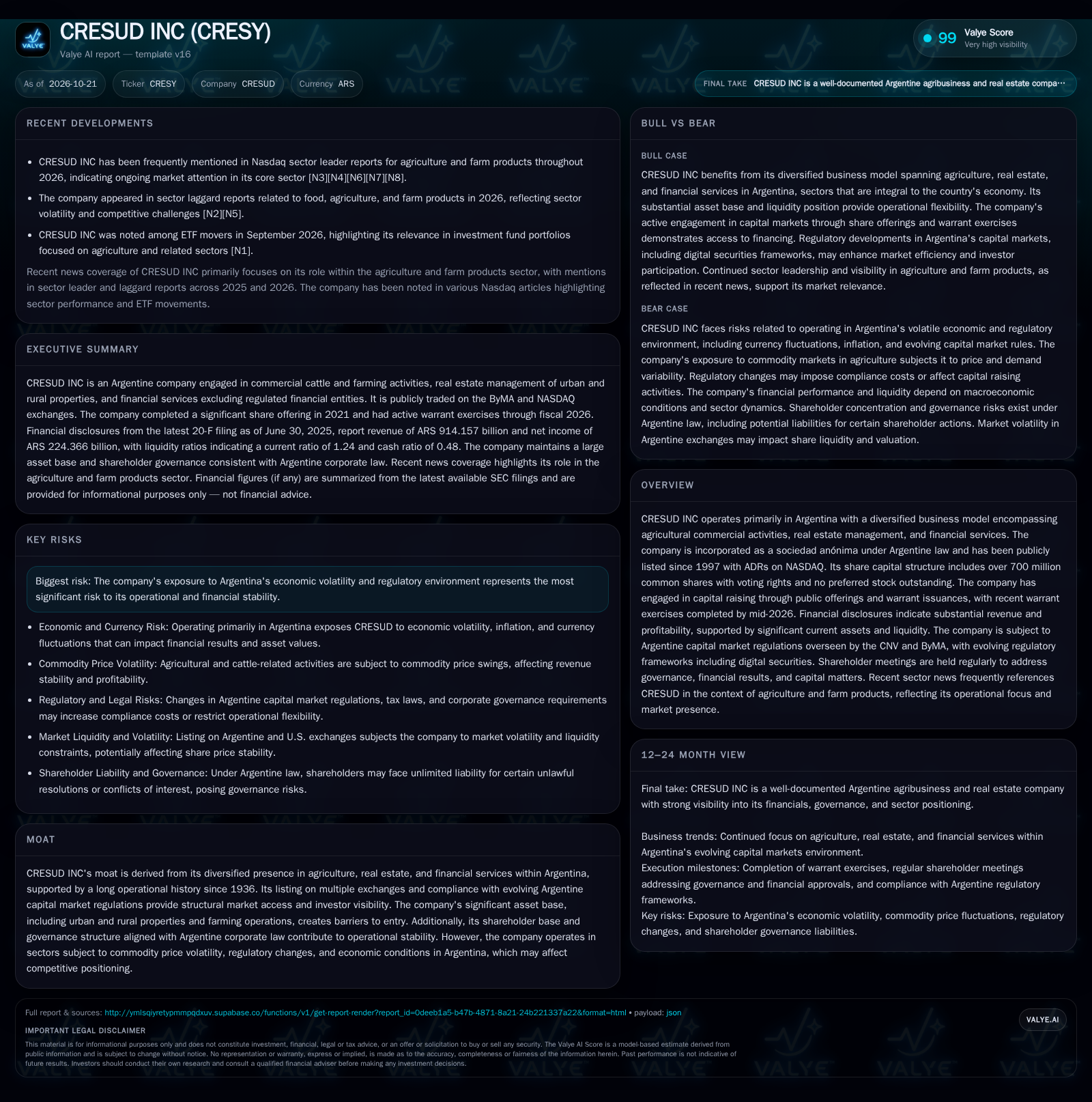
CRESUD INC stands as a diversified Argentine operator with major positions in agriculture, real estate, and select financial activities. Recent financials show substantial revenue and net income, underpinned by significant current assets and completed warrant exercises that have bolstered equity capital. The company’s fortunes remain closely tied to Argentina’s volatile economic climate, commodity cycles, and changing regulatory frameworks. Its large asset base provides potential for both defensive value and operational leverage, but external shocks and compliance burdens are ever-present risks. Monitoring capital allocation, asset monetization, and regulatory adaptation will be key to understanding CRESUD’s trajectory over the next cycle. [S1]
CRESUD INC operates at the heart of Argentina’s real asset economy, blending large-scale agricultural production with urban and rural property holdings. Recent financial results and capital actions underscore its ability to generate substantial revenue and maintain a robust asset position, but the company’s future will be shaped by its responses to the country’s persistent macroeconomic instability, volatile commodity cycles, and an evolving legal-regulatory landscape. Asset-heavy businesses like CRESUD can offer resilience and optionality, but also face amplified risks from external shocks and policy unpredictability. The company’s operational and capital allocation choices over the coming cycle will determine whether its scale and diversification translate into durable value.
Recent Capital Actions and Asset Position Define the Near-Term Landscape
As of June 30, 2025, CRESUD reported ARS 914.157 billion in revenue and ARS 224.366 billion in net income, signaling a period of strong profitability that reflects both operational scale and the impact of macroeconomic factors in Argentina. During the fiscal year ending June 2026, the company completed the exercise of all outstanding warrants, issuing 95.2 million new common shares and raising USD 24.5 million in proceeds, which enhanced its equity base and eliminated overhang from dilutive securities. The balance sheet showed ARS 1.246 trillion in current assets against ARS 1.002 trillion in current liabilities, yielding a current ratio of 1.24 and cash plus short-term investments totaling ARS 477.069 billion. These developments position CRESUD with a sizable liquidity buffer and increased shareholder capital at a time of notable volatility in Argentine capital markets. However, the company’s exposure to shifting local economic conditions and regulatory frameworks remains significant. [S1]
How CRESUD’s Diversified Asset Base Drives Earnings and Risk
CRESUD’s economic engine is built on three pillars: large-scale agricultural operations (cattle, crops, and related activities), management and development of both urban and rural real estate, and select financial activities restricted to non-regulated segments. In agriculture, revenue and margin are highly sensitive to commodity price cycles, weather, and export policy, with scale enabling some efficiency but little insulation from market shocks. Real estate operations can provide more stable, albeit cyclical, income through leasing, rent, and asset appreciation, but liquidity and valuation are deeply affected by macroeconomic conditions and capital controls.
The company’s asset-heavy model offers operating leverage: fixed costs are high, but incremental volume or price improvement can drive significant bottom-line gains. Conversely, in downturns, the same fixed structure can amplify losses. Capital needs are material—ongoing investment in land, equipment, and property development is necessary to maintain or grow output, and external financing (including recent equity raises) is often required, especially given Argentina’s inflationary and credit-constrained environment. The mix between agricultural output and real estate monetization is a potential lever for value creation, but also introduces complexity in capital allocation and risk management.
In summary, CRESUD’s ability to generate and sustain earnings is a function of asset productivity, market conditions, and the company’s agility in reallocating capital between segments as cycles shift.
Barriers and Vulnerabilities in the Argentine Real Asset Arena
CRESUD’s competitive strengths are rooted in its scale, land holdings, and multi-decade operating history. Control over large tracts of productive land and a portfolio of urban and rural properties creates high barriers to entry for would-be competitors, especially given local land market illiquidity and regulatory hurdles. The company’s public listings on both ByMA and NASDAQ provide structural access to capital and investor visibility that most domestic peers lack.
However, these advantages are counterbalanced by several persistent vulnerabilities. The Argentine agriculture and real estate markets are highly fragmented, with numerous local and regional players. CRESUD’s scale is an advantage in terms of operational efficiency and bargaining power, but exposes it to systemic risks—currency devaluation, inflation, export quotas, and sudden shifts in property law or taxation. International competitors, while less present in direct land ownership, may compete indirectly through export markets, technology, and global supply chains.
Potential substitutes for CRESUD’s offerings include alternative protein sources, synthetic foods, and urban development models that bypass traditional landholdings. Regulatory changes—such as digital securities frameworks or new land-use rules—could also reshape the competitive landscape, either by lowering barriers or introducing new compliance costs.
If Asset Monetization and Macro Stabilization Align: The Case for Value Unlock
A favorable scenario for CRESUD would see a combination of macroeconomic stabilization in Argentina, recovery in agricultural commodity prices, and successful monetization of real estate assets. In this environment, the company’s large-scale land holdings and property portfolio could be revalued upward, supporting higher book value and potential capital returns. Agricultural operations would benefit from improved export conditions, currency stability, and perhaps targeted policy support, driving both top-line and margin expansion.
Evidence supporting this scenario would include rising land and property prices, improved export volumes, a narrowing of the discount between Argentine asset values and international benchmarks, and visible progress in asset sales or development partnerships. Additional confirmation would come from lower inflation, currency stability, and a benign regulatory environment that reduces compliance drag and supports capital market access.
This scenario would likely drive increased investor interest, higher share liquidity, and the potential for dividend distributions or further equity accretion.
Operational Resilience Amid Policy Flux and Commodity Volatility
The most plausible path over the next cycle is one of ongoing operational resilience punctuated by bouts of volatility. CRESUD continues to generate substantial revenue from its diversified base, but must regularly adapt to shifting Argentine economic policies, currency movements, and commodity price swings.
Regulatory changes—such as digital securities adoption or capital controls—create both opportunities and administrative burdens, but CRESUD’s established governance structure and public market access provide relative stability. Margin compression may occur during periods of adverse price movements or cost inflation, but asset sales or development initiatives periodically replenish capital and support bottom-line results.
This scenario would be confirmed by continued positive net income, stable (if not rapidly growing) revenue, regular shareholder meetings approving financials and dividends, and the absence of major regulatory disruptions or asset impairment events.
When Macro Shocks and Policy Headwinds Override Scale
A negative scenario for CRESUD materializes if Argentine macroeconomic instability intensifies—marked by sharp currency devaluation, runaway inflation, or severe capital controls. Under such conditions, asset values could deteriorate rapidly, export revenue could be curtailed by protectionist policies or taxes, and property development activities might stall due to lack of demand or regulatory blockage. The company’s fixed-cost structure would amplify losses as revenue contracts, and access to new financing could be constrained by market turmoil or loss of investor confidence.
Confirmation of this adverse chain would include a pronounced drop in revenue and net income, asset write-downs, liquidity stress (as evidenced by declining cash ratios and mounting short-term liabilities), and delays or cancellations of planned real estate projects. Regulatory or tax changes that increase compliance costs or restrict capital repatriation would further exacerbate downside risk.
In such a scenario, CRESUD’s scale and diversification could offer only limited protection, and the company might be forced into defensive asset sales or restructuring measures.
What Will Determine CRESUD’s Value Creation and Risk Absorption?
Progress on asset monetization: Announcements or results from property sales, joint ventures, or development completions would clarify whether CRESUD is realizing value from its land and real estate portfolio.
Agricultural output and pricing: If disclosed, trends in harvested acreage, yield per hectare, and average realized commodity prices would indicate core business health.
Net income and margin evolution: Quarterly or annual changes in net income, operating margins, and segment profitability would help test operational resilience.
Regulatory/policy changes: New Argentine laws affecting land ownership, export quotas, or capital market operations could materially alter CRESUD’s risk and opportunity profile.
Shareholder actions and governance: Outcomes from shareholder meetings, including dividend approvals, board changes, or capital structure adjustments, would provide insight into management priorities.
Capital market access: Evidence of further equity or debt issuance, or changes in listing status, would reveal how external financing conditions are evolving for CRESUD.
Sector news and peer performance: Relative performance versus other Argentine agribusinesses or real estate operators would contextualize CRESUD’s strategy and execution.
Disclaimer: This is research-only, informational analysis and not investment advice. It may include AI-generated interpretation and general industry context. Always verify important details using primary sources.

Comments