
Armour Residential REIT: Active Capital Management and Prepayment Risk in a Crowded MBS Arena
Despite recent quarters of outperformance versus expectations, Armour Residential REIT’s core challenge remains: converting active capital deployment into sustainable returns amid sector-wide prepayment volatility, dilution risk, and fierce competition for agency mortgage-backed securities.
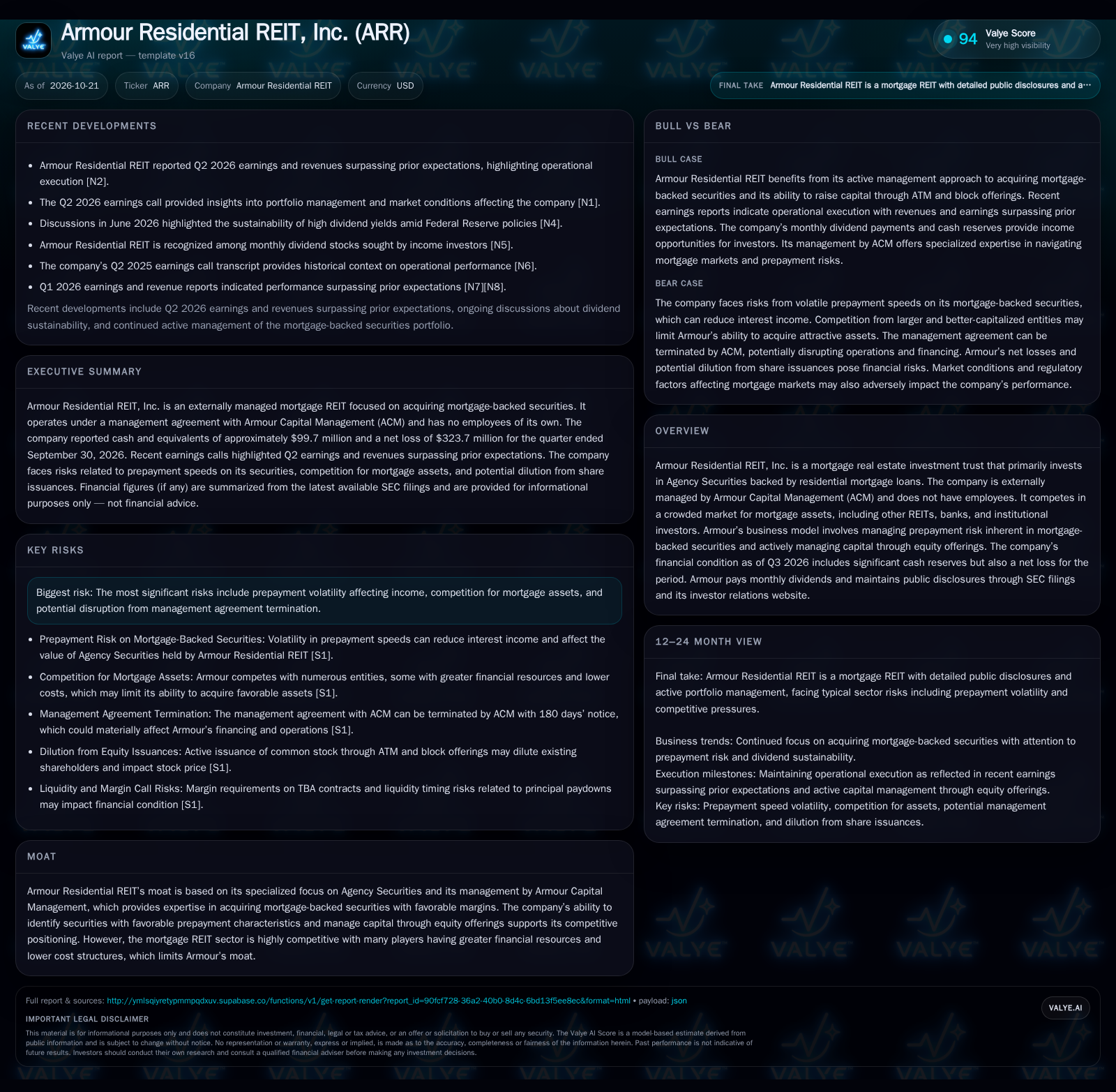
Armour Residential REIT has exceeded recent earnings expectations, but its business model—investing in agency mortgage-backed securities—faces persistent prepayment and dilution risks. The company’s reliance on external management, capital raises, and navigating a highly competitive landscape will shape future returns. Key watchpoints include prepayment trends, funding costs, and management continuity.[N1] [N2] [S1] [S2]
Armour Residential REIT operates at the intersection of opportunistic capital deployment and structural sector headwinds. Its externally managed, agency MBS-focused model has delivered recent earnings above expectations, but persistent net losses and reliance on share issuance highlight core fragilities. With prepayment speeds, funding costs, and competitive pressure all in flux, the company’s ability to translate tactical portfolio moves into long-term shareholder value remains to be proven. The next chapters will be defined by how well Armour balances capital-raising needs, portfolio risk, and management continuity in a changing mortgage market.
Recent Earnings Surprises Mask Persistent Structural Challenges
Armour Residential REIT, Inc. reported a net loss of approximately $323.7 million and basic and diluted earnings per share of -$2.26 for the quarter ended September 30, 2026, while maintaining cash and cash equivalents of about $99.7 million.[S2] Despite this loss, recent quarterly results—especially in Q2—surpassed prior expectations, suggesting tactical success in portfolio management and capital deployment.[N1] [N2]
The company continues to actively issue new shares via at-the-market and block offerings, enabling ongoing investment in agency mortgage-backed securities but also creating dilution risk for existing shareholders.[S1] Armour remains externally managed by Armour Capital Management (ACM), with operational continuity contingent on the terms of this management agreement, which ACM can terminate with 180 days’ notice—a factor that could materially disrupt financing and day-to-day operations.[S1]
How Armour’s Agency MBS Model Translates Capital into Income (and Losses)
Armour Residential REIT’s core economic engine is acquiring and holding agency mortgage-backed securities (MBS), earning net interest income on the spread between yields on these securities and the company’s own funding costs. Because these are agency-backed, credit risk is limited, but prepayment risk is high: when mortgage holders refinance or pay off loans early, Armour’s higher-yielding assets are replaced with lower-yielding ones or cash, compressing net interest margins.
The company’s economics are highly sensitive to changes in short-term funding rates, prepayment speeds, and the shape of the yield curve. Fixed costs are relatively low due to external management, but variable costs (especially funding and hedging) can be volatile. The active capital-raising model (via frequent share issuance) provides flexibility to scale the portfolio but dilutes returns if the new capital cannot be invested at attractive spreads.
Operating leverage is limited in this model; incremental capital can be deployed, but net income is ultimately capped by the spread environment and market pricing for MBS. Periods of spread widening or rapid prepayment can quickly erode profitability, as seen in the recent net loss despite tactical outperformance on revenue and earnings expectations.[S2] [N2]
The interplay between prepayment risk and funding cost volatility creates a dynamic where Armour’s portfolio duration and convexity management become crucial. If prepayments accelerate unexpectedly, the company faces reinvestment risk at lower yields, which can erode net interest margins unless offset by a favorable yield curve shift or hedging strategies. Conversely, slowing prepayments extend portfolio duration, potentially increasing exposure to interest rate risk if rates rise. Armour’s ability to tactically adjust portfolio composition and hedge interest rate exposure, while balancing the timing and scale of capital raises, directly influences its income stability and loss mitigation. This nuanced management of portfolio sensitivities is a key determinant of sustainable profitability.
Competing for Yield: Sector Crowding and Cost Structure Gaps
Armour competes with a wide spectrum of mortgage REITs, banks, insurance companies, and institutional investors—all seeking similar agency MBS assets.[S1] Many of these entities have greater scale, lower funding costs, or more diversified business lines, which can provide structural advantages in asset acquisition and risk management.
The company’s externally managed model can offer specialized expertise in navigating MBS markets and prepayment dynamics, but it also introduces potential cost drag relative to internally managed peers. Armour’s ability to outmaneuver larger competitors depends on nimble capital deployment and identifying securities with favorable prepayment characteristics.
Switching frictions are low for investors in agency MBS, and the product is highly commoditized, limiting sustainable pricing power. In this environment, the main competitive lever is timing and tactical execution—buying when spreads are wide, raising capital when share prices are favorable, and managing risk exposure actively.
In a crowded agency MBS market, Armour’s cost structure and capital agility are pivotal competitive differentiators. Externally managed REITs often face higher fee burdens compared to internally managed peers, which can compress net returns, especially in tight spread environments. Armour’s reliance on frequent equity offerings to fund portfolio growth introduces timing risk; capital raised when share prices are depressed may dilute returns, whereas well-timed raises during market strength can enhance accretion. Additionally, Armour’s relative scale limits its ability to negotiate lower funding costs or access diverse funding sources, placing a premium on efficient capital deployment and active risk management to preserve competitive positioning amid aggressive asset bidding.
If Prepayment Volatility Eases and Capital Deployment Remains Accretive
A favorable scenario for Armour would see prepayment speeds stabilize or slow, preserving higher-yielding assets for longer and supporting net interest income. If funding costs remain contained and agency MBS spreads widen (e.g., due to macro volatility or reduced competition), Armour could deploy new capital at attractive yields, offsetting dilution from share issuance.
Operational outperformance, as recently demonstrated, would need to become the norm, with consistent positive surprises on earnings and book value. The company would also benefit from stable management continuity—minimizing disruption risk from ACM’s potential termination.
Evidence confirming this scenario would include consecutive quarters of positive net income, book value growth, and strong dividend coverage—paired with disclosures showing successful capital deployment at attractive spreads and manageable prepayment rates.
Active Management Delivers Mixed Results in a Volatile Yield Environment
The most plausible middle path for Armour is one of continued active capital management, with periodic outperformance offset by sector-wide headwinds. Prepayment risk, funding cost volatility, and competition for assets will likely produce choppy results, with some quarters exceeding expectations and others showing net losses.
Dilution from ongoing share issuance will remain a tradeoff—supporting portfolio growth but pressuring per-share metrics. Management continuity is assumed, but the risk of ACM terminating the agreement will be an overhang. Dividend payments may be maintained, but coverage could fluctuate depending on the spread environment.
Falsifying evidence would include a sustained positive or negative inflection in any of these metrics, or a material change in the management arrangement.
Rapid Prepayments, Funding Shocks, or Management Disruption Trigger Erosion
A negative outcome for Armour would likely be driven by a combination of rapid prepayment speeds (compressing asset yields), rising funding costs (squeezing net interest margins), and/or market turbulence that depresses agency MBS prices. In this environment, the company could struggle to deploy capital accretively, leading to persistent net losses and pressure on dividend sustainability.
If ACM were to terminate the management agreement, operational disruption could compound these pressures—potentially triggering forced asset sales, higher external fees, or difficulty raising new capital. Dilution from share issuance could accelerate if capital is needed to meet margin calls or offset losses.
What Will Distinguish Armour’s Value Creation in the Next Cycle?
Quarterly trends in prepayment speeds on the agency MBS portfolio—a disclosed metric would clarify risk to net interest income.
Net interest margin (NIM) evolution, if reported, as a measure of spread management effectiveness and funding cost discipline.
Book value per share changes, which will show the impact of market volatility, dilution, and portfolio performance.
Frequency, size, and pricing of new share issuances—especially ATM and block offerings—as a direct indicator of capital raising and dilution tradeoffs.
Dividend coverage ratio (or payout ratio), if disclosed, to assess sustainability of distributions in light of earnings volatility.
Management fee structure and any early warnings on the ACM agreement—watch for 8-Ks or proxy statements addressing potential termination.
Portfolio turnover and asset yield disclosures, which would help test whether new capital is being deployed at accretive spreads.
Sector-level developments: changes in agency MBS spreads, Fed policy, or housing finance reform that could shift the competitive landscape.
Disclaimer: This is research-only, informational analysis and not investment advice. It may include AI-generated interpretation and general industry context. Always verify important details using primary sources.

Comments