
GlobalTech Corp: Cross-Border Ambitions Meet Funding Constraints in Telecom and Retail Expansion
GlobalTech Corp has built a dual-pronged business—telecom infrastructure in Pakistan and retail technology in the UK—through a series of acquisitions.
The company’s future hinges on its ability to monetize core assets, secure funding, and navigate governance complexity as it seeks to integrate and grow in two highly competitive sectors. [S2]
GlobalTech Corp’s evolution from a Pakistan-focused broadband operator to a cross-border holding company with both telecom and UK retail assets is a bold diversification play. The next phase will test whether GlobalTech’s asset base and regulatory positioning can be effectively monetized—or whether structural and financial constraints will force retrenchment or strategic realignment.
Liquidity Stress and Governance Complexity Define the Immediate Landscape
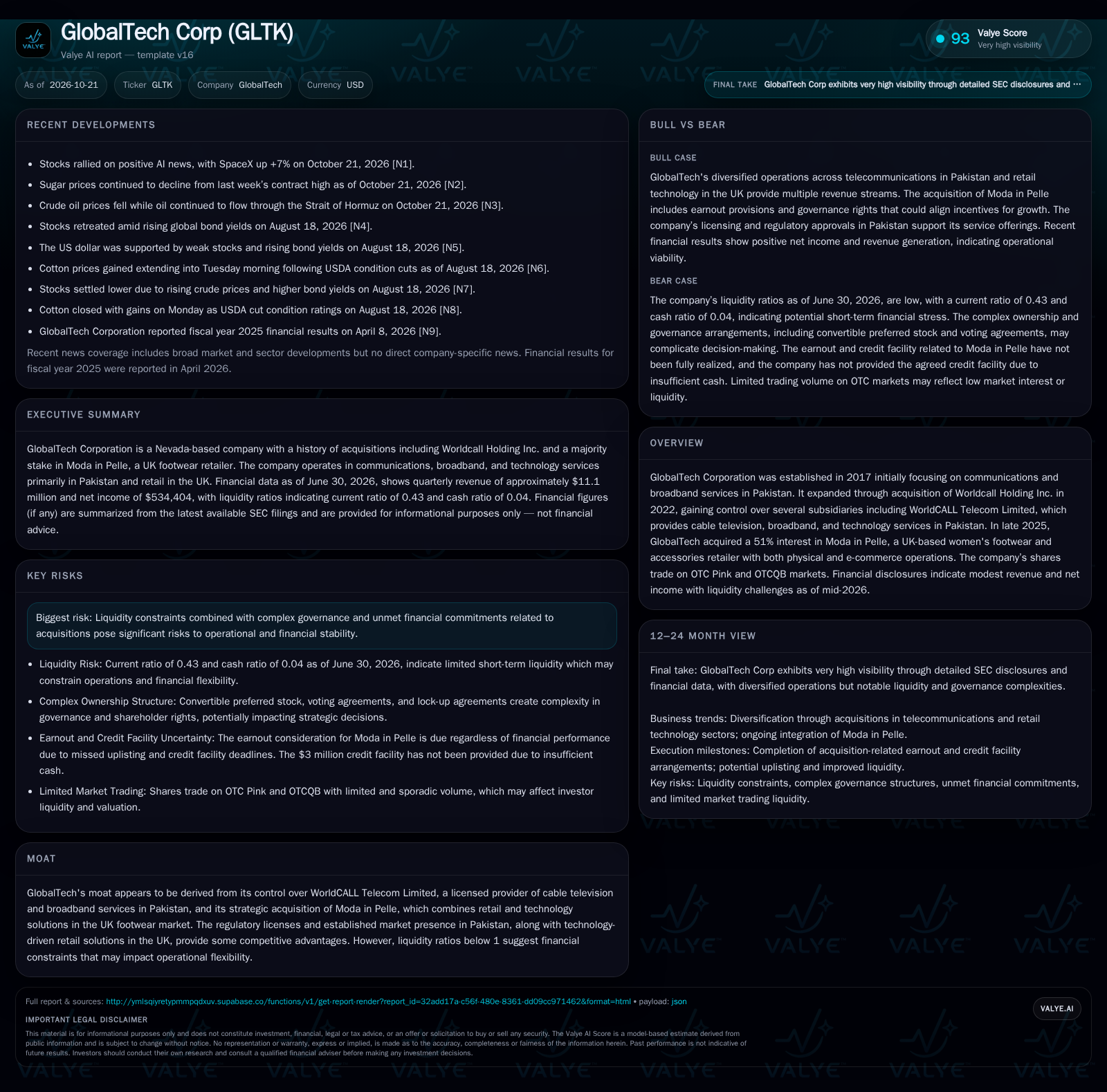
As of June 30, 2026, GlobalTech Corp’s financial position is precarious: cash and equivalents stood at $796,306, short-term investments at $1,026,306, and current assets totaled $22,047,154, against current liabilities of $50,773,516. This yields a current ratio of 0.43 and a cash ratio of just 0.04, signaling acute short-term liquidity stress. The company has not funded a $3 million credit facility promised to Moda in Pelle—a key acquisition—due to insufficient cash. Compounding these financial pressures, the company’s ownership and governance are entangled in convertible preferred stock, voting agreements, and shareholder rights tied to acquisition earnouts. These factors jointly threaten operational flexibility and could complicate both day-to-day management and larger strategic moves. [S2]
The interplay between liquidity constraints and governance complexity can create a feedback loop that exacerbates operational challenges. For instance, convertible preferred stock and voting agreements may limit management’s ability to swiftly pivot or restructure capital, especially under distress. This can delay critical decisions such as asset divestitures or capital raises, increasing the risk of missed opportunities or deeper financial deterioration. Moreover, earnout obligations tied to acquisitions introduce contingent liabilities that can strain cash flow unpredictably, complicating forecasting and budgeting. The company reported cash and liquidity metrics for the period; these figures do not by themselves establish operating runway, investment capacity, financial flexibility, or financing capacity.
How the Business Mix Could Generate Value—If Capital Flows Cooperate
GlobalTech’s economics are anchored in two very different value chains: regulated telecommunications infrastructure in Pakistan and retail (both online and offline) in the UK. The telecom segment benefits from high fixed costs (network build-out, regulatory compliance) and, if subscriber growth materializes, the potential for significant operating leverage. Revenue streams include broadband, cable TV, and international voice/data termination, with the latter seeing recent volume growth from Middle East-originating calls into Pakistan. This segment’s economics are sensitive to subscriber acquisition costs, ARPU, network utilization rates, and regulatory fees. The retail segment, via Moda in Pelle, introduces different dynamics: product margins, inventory management, channel mix (store vs. e-commerce), and the scalability of digital sales platforms. The technology solutions developed for e-commerce could improve margins if they drive conversion and retention, but retail is inherently more variable and exposed to consumer demand swings. Both arms require ongoing capital: telecom for network upgrades and expansion (notably FTTH transitions), retail for inventory and marketing. The company’s current liquidity constraints risk underfunding both, jeopardizing growth and integration synergies.
The dual-sector business model introduces inherent complexity in capital allocation decisions, particularly under constrained funding. Telecom infrastructure investments typically require long lead times and upfront capital before realizing subscriber growth and operating leverage, while retail operations demand more agile inventory and marketing spend to respond to consumer trends. If capital is limited, prioritizing one segment over the other could yield suboptimal outcomes; for example, underinvesting in network upgrades might erode telecom competitiveness, while insufficient retail funding could stunt digital channel growth. A disciplined approach to capital deployment, possibly guided by segment-level return on invested capital (ROIC) analysis, would help optimize resource use. Additionally, cross-segment synergies—such as leveraging telecom technology expertise to enhance retail digital platforms—could improve overall economics if effectively executed.
Market Access and Regulatory Licenses Offer Advantages—But Are Not Moats Without Scale
In Pakistan, GlobalTech’s control of a licensed cable and broadband operator with nearly 1,900 km of fiber infrastructure affords it privileged access to urban subscriber bases and the ability to terminate international voice traffic—a market typically protected by regulatory barriers and economies of scale. However, competition from other cable, broadband, and mobile operators is intense, and price competition or regulatory changes could erode margins. In the UK retail sector, Moda in Pelle’s blend of physical and digital channels is a differentiator, especially if its proprietary e-commerce technology can improve customer experience and loyalty. Yet, the UK footwear market is crowded and highly price sensitive, with both established brands and digital-native challengers. GlobalTech’s real advantage will hinge on its ability to fund growth, leverage its local licenses and assets, and execute integration—none of which are assured given present liquidity and governance constraints.
While regulatory licenses and infrastructure provide initial competitive advantages, these benefits can diminish without scale economies and continuous innovation. In telecom, maintaining and expanding fiber networks is capital intensive, and competitors with deeper pockets or government backing may outpace GlobalTech in coverage and technology upgrades, such as 5G integration or advanced broadband services. Similarly, in retail, proprietary e-commerce technology must evolve rapidly to keep pace with consumer expectations and competitor innovations like personalized marketing or omnichannel fulfillment. The absence of dominant scale may also limit bargaining power with suppliers and partners in both sectors, compressing margins. Therefore, sustaining competitive positioning requires not only leveraging current assets but also securing sufficient investment to scale and innovate amidst dynamic market conditions.
Unlocking Asset Value Through Strategic Monetization and Funding Solutions
A favorable outcome for GlobalTech would likely involve securing new capital—whether via equity, debt, or asset sales—to restore liquidity and fulfill obligations such as the Moda in Pelle credit facility. This would enable continued network upgrades in Pakistan, support inventory and marketing for Moda in Pelle, and potentially allow for further digital innovation or bolt-on acquisitions. If the telecom segment can accelerate subscriber conversion to higher-value FTTH offerings and maintain or grow international voice termination volumes, operating leverage could improve margins. In retail, successful deployment of e-commerce technology and omnichannel integration could boost conversion rates and expand market share. Evidence supporting this scenario would include new funding announcements, a rebound in current and cash ratios, completion of the Moda in Pelle credit facility, and sustained growth in both subscriber and retail sales metrics.
Integration Proceeds Amid Capital Constraints and Governance Friction
The most plausible trajectory is that GlobalTech operates under continued financial pressure, focusing on incremental improvements and working capital management. Telecom operations may see modest subscriber and traffic growth—especially if network upgrades are prioritized in high-density urban areas—but expansion is likely limited by funding shortfalls. Moda in Pelle could maintain core retail operations but may be unable to scale digital initiatives or inventory without the promised credit facility. Governance complexity may slow or dilute strategic decisions, and the company may need to renegotiate earnout or financing terms to preserve cash. Confirmation of this scenario would include continued low liquidity ratios, delayed or partial fulfillment of Moda in Pelle obligations, and only incremental operational progress.
Liquidity Crunch Forces Asset Sales or Strategic Retrenchment
If GlobalTech fails to secure new funding or materially improve cash flow, the acute liquidity shortfall could force the company to sell core assets, restructure obligations, or even lose control of key subsidiaries (such as WorldCALL Telecom Limited). Inability to meet earnout or credit facility obligations could lead to legal disputes or loss of governance rights in Moda in Pelle. Telecom operations risk stagnation or subscriber loss if network upgrades are deferred, while the retail business could suffer from inventory shortages and digital underinvestment. Market perception may further deteriorate, reducing the company’s ability to raise capital on favorable terms. Evidence confirming this scenario would include asset divestitures, governance changes, default on acquisition-related obligations, and further deterioration in trading volumes or financial ratios.
What Will Test GlobalTech’s Cross-Border Integration Ambitions Next
Fulfillment of the $3 million credit facility and earnout obligations to Moda in Pelle, or any renegotiation of these terms.
Trends in broadband and cable subscriber growth, ARPU, and conversion rates to FTTH in Pakistan—if disclosed.
International voice/data termination volumes and pricing, especially from Middle East-originating traffic.
Moda in Pelle’s retail and e-commerce sales growth and margin trends—if disclosed.
Announcements of new debt or equity funding, asset sales, or changes to the capital structure.
Any regulatory changes in Pakistan affecting telecom licenses, fees, or competition.
Governance developments: changes in voting agreements, preferred stock conversions, or shareholder disputes.
Disclaimer: This is research-only, informational analysis and not investment advice. It may include AI-generated interpretation and general industry context. Always verify important details using primary sources.

Comments