
PG&E’s Capital Commitment: Infrastructure Expansion, Wildfire Resilience, and the Economics of Regulated Utility Growth
PG&E Corp’s latest disclosures highlight a utility at the intersection of escalating capital needs, ambitious grid modernization, and evolving climate risk management. With $12.4 billion in planned 2026 capex and a $22.5 billion grid acquisition estimate, the company’s future hinges on regulatory cost recovery, operational efficiency, and wildfire risk containment.
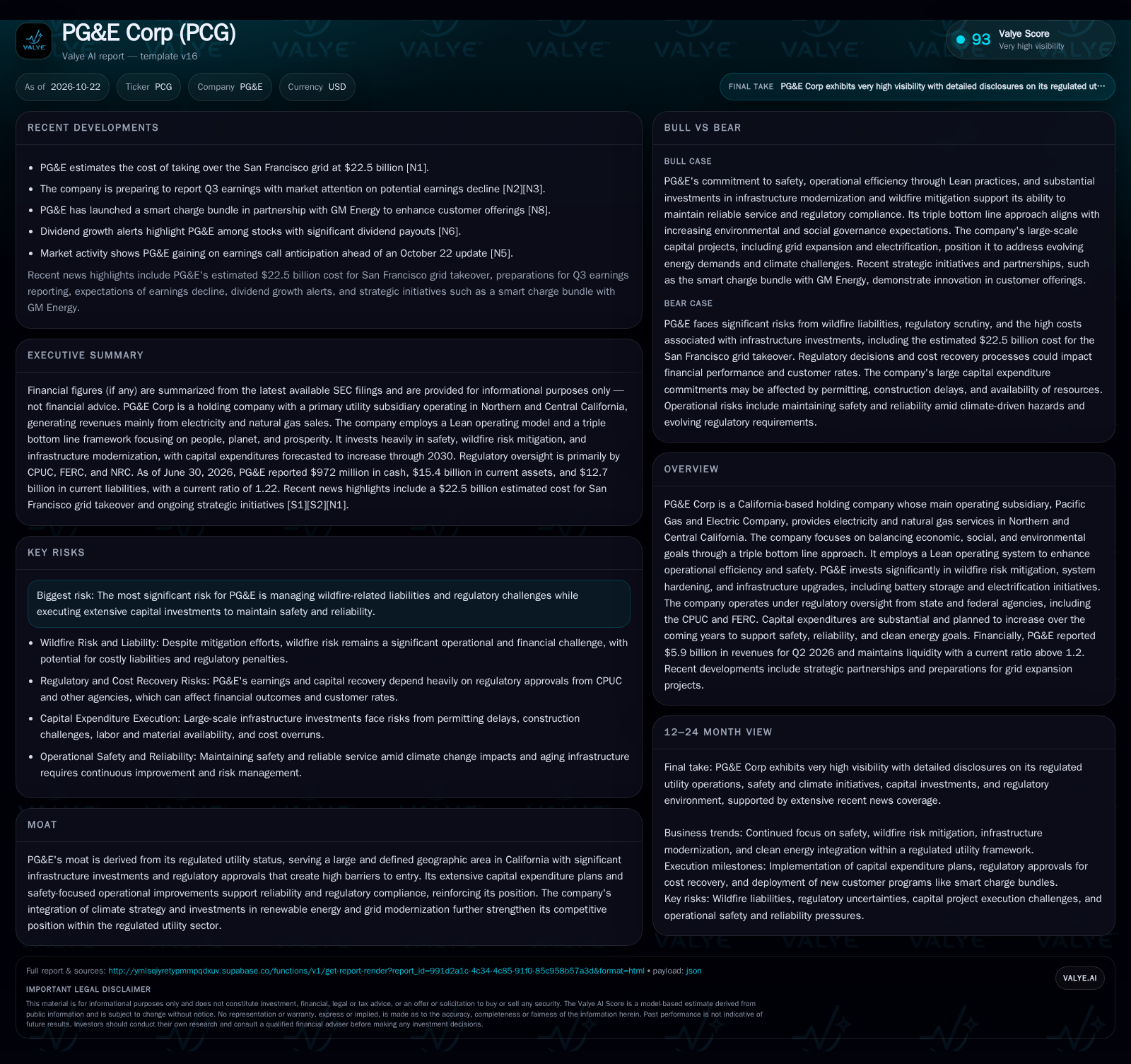
PG&E Corp is intensifying capital investments in grid modernization, wildfire mitigation, and clean energy integration while aiming to limit average annual customer rate increases to 3%. The company’s ability to recover costs through regulatory mechanisms and to control wildfire-related liabilities remains pivotal. [S1] [S2]
PG&E Corp stands at a pivotal juncture, channeling unprecedented capital into grid modernization, wildfire risk mitigation, and the integration of distributed energy resources. The company’s regulated utility model creates a foundation of revenue stability, but success now depends on its ability to convert investment into operational safety, regulatory approval, and customer affordability. With current financials stable and wildfire metrics improving, the real test will be sustaining returns as capital commitments and regulatory scrutiny intensify [S1] [S2].
Recent Disclosures Highlight Investment Surge and Risk Management
PG&E Corp is entering a period of accelerated capital investment, with $12.4 billion in capex planned for 2026 and further increases anticipated in subsequent years. These investments target transmission upgrades, energy storage, electrification, and grid hardening, all within a regulatory framework that requires cost recovery approval [S1].
The company’s wildfire mitigation efforts appear to be yielding results: PG&E reported no major wildfire ignitions involving its equipment in 2025, and overall reportable ignitions declined compared to 2024 [S1]. This improvement is critical for both operational safety and regulatory credibility.
Financially, as of June 30, 2026, PG&E reported $972 million in cash, $15.4 billion in current assets, $12.7 billion in current liabilities, and a current ratio of 1.22 [S2]. While these figures suggest short-term financial stability, they must be viewed in the context of accelerating capital needs and future regulatory determinations.
An estimated $22.5 billion cost to acquire the San Francisco grid signals both the scale of potential expansion and the magnitude of new financial and operational risks should that project proceed.
How PG&E’s Regulated Utility Model Shapes Its Economic Engine
PG&E generates revenue primarily through regulated rates for electricity and natural gas distribution in Northern and Central California. Under the cost-of-service model, the company’s allowed revenues are set by the California Public Utilities Commission (CPUC) and other regulators, based on prudent operating and capital costs plus a regulated return on equity.
The core economic equation is driven by the company’s rate base: as PG&E invests in infrastructure, the rate base expands, allowing for higher absolute earnings (subject to regulatory approval). However, this model creates a lag between capital outlay and revenue realization, and actual returns depend on the regulator’s willingness to allow cost recovery and set favorable rates.
PG&E’s plan to limit average annual customer rate increases to 3% while expanding capex implies a need for operating cost efficiencies and productivity gains [S1]. The company’s Lean operating system is intended to deliver such savings, but the degree of achievable efficiency is not fully knowable ex ante.
Variable costs—fuel, purchased power, and O&M—are largely passed through to customers under regulatory mechanisms, reducing margin volatility but also limiting profit upside. Fixed costs are significant, especially as capex accelerates, creating both operating leverage and risk if cost recovery or demand projections falter.
Barriers, Substitution Risks, and the Role of Regulatory Approval
PG&E’s competitive position is anchored in its regulated monopoly status, serving a defined and densely populated region with high infrastructure requirements. Entry barriers are formidable: new competitors face the hurdles of regulatory approval, capital intensity, and the need for integrated infrastructure.
However, the company faces indirect competition and substitution risk from distributed energy resources (DERs), private solar, battery storage, and electrification initiatives. Over 950,000 private solar customers and 820,000 electric vehicles are already interconnected with PG&E’s grid, signaling both the opportunity for new services and the risk of load defection or margin dilution if rate structures are not adapted [S1].
Regulatory relationships are a double-edged sword: while they protect PG&E from direct competition, regulatory disallowances, penalties, or delayed cost recovery could erode returns or force operational changes.
Peer utilities in other high-risk geographies, as well as municipal and community-choice aggregators, also provide a reference point for customer migration risk and regulatory precedent. The scope for technological substitution—such as microgrids or third-party grid solutions—remains constrained by capital and policy, but could accelerate if PG&E’s service or pricing falls out of step with customer or political expectations.
When Investment and Efficiency Drive Value Creation
In a favorable scenario, PG&E successfully executes its capital plan, with timely regulatory approvals allowing for full cost recovery and the expansion of its rate base. Lean operating practices drive genuine O&M savings, offsetting rising capex and enabling customer rate increases to remain at or below the 3% target [S1].
Wildfire mitigation measures continue to reduce incident frequency and severity, lowering the risk of major liability events and restoring regulatory and public trust. Grid modernization and electrification investments attract incremental load from electric vehicles and distributed generation, supporting long-term demand growth.
Confirmation of this scenario would include CPUC approval of rate increases and cost recovery for new investments, sustained improvement in wildfire safety metrics, evidence of O&M cost reductions, and constructive regulatory outcomes for large projects such as the San Francisco grid acquisition.
Sustained Capex and Regulatory Scrutiny Define the Status Quo
The most plausible outcome is one where PG&E continues to make large capital investments under close regulatory oversight. Operating efficiency gains partially offset cost pressures, but average annual rate increases approach the 3% ceiling. Regulatory approvals for cost recovery are generally granted, but some costs are deferred or subject to contention, introducing periodic earnings volatility.
Wildfire risk remains a persistent challenge, but ongoing mitigation efforts keep major incidents below historical averages. The company’s financial position remains stable, with reported liquidity position and access to capital markets, but leverage increases as capex outpaces organic cash flow generation.
Falsification of this scenario would involve either a major wildfire event tied to PG&E assets, a regulatory decision that materially disallows cost recovery, or evidence that O&M savings are not materializing as planned.
When Wildfire or Regulatory Shocks Erode Value
In an adverse scenario, PG&E experiences a significant wildfire event attributed to its infrastructure, resulting in substantial financial liability and renewed regulatory scrutiny. Cost recovery for new capital investments is delayed or partially disallowed by the CPUC, forcing the company to absorb losses or defer projects.
Customer backlash to rising rates accelerates adoption of distributed generation and energy storage, eroding load and undermining the economics of large-scale grid investments. Financing costs rise as credit risk perceptions increase, and the company’s leverage becomes a constraint on future investment.
Evidence for this scenario would include a spike in wildfire-related claims, adverse regulatory rulings, a sharp increase in customer complaints or defections, and deteriorating credit metrics.
Milestones That Will Shape PG&E’s Value Creation and Risk Profile
Regulatory outcomes for 2026–2027 general rate cases, especially decisions on cost recovery for major capital projects.
Wildfire incident frequency and severity attributed to PG&E equipment, with a focus on year-over-year trends.
Actual O&M cost savings achieved through Lean operating initiatives—if disclosed, a useful metric would be annualized run-rate reductions relative to plan.
Customer rate increase approvals and realized average annual rate growth versus the 3% management target.
Execution progress and cost tracking for the San Francisco grid acquisition, including regulatory and stakeholder milestones.
Adoption rates for distributed energy resources and private solar interconnections, as a gauge of potential load defection risk.
Debt and leverage metrics, especially as capex accelerates and large acquisitions are contemplated.
Customer satisfaction and complaint rates, particularly if regulatory or operational disruptions occur.
Disclaimer: This is research-only, informational analysis and not investment advice. It may include AI-generated interpretation and general industry context. Always verify important details using primary sources.

Comments