
Moody’s: Embedded in Global Risk Workflows, Navigating Cost Pressures and Ratings Headwinds
Moody’s stands at the center of global credit and risk assessment, leveraging proprietary data, regulatory status, and AI integration. Yet, recent cost pressures and a decline in its ratings segment challenge margin resilience and highlight the importance of continued innovation and diversification.
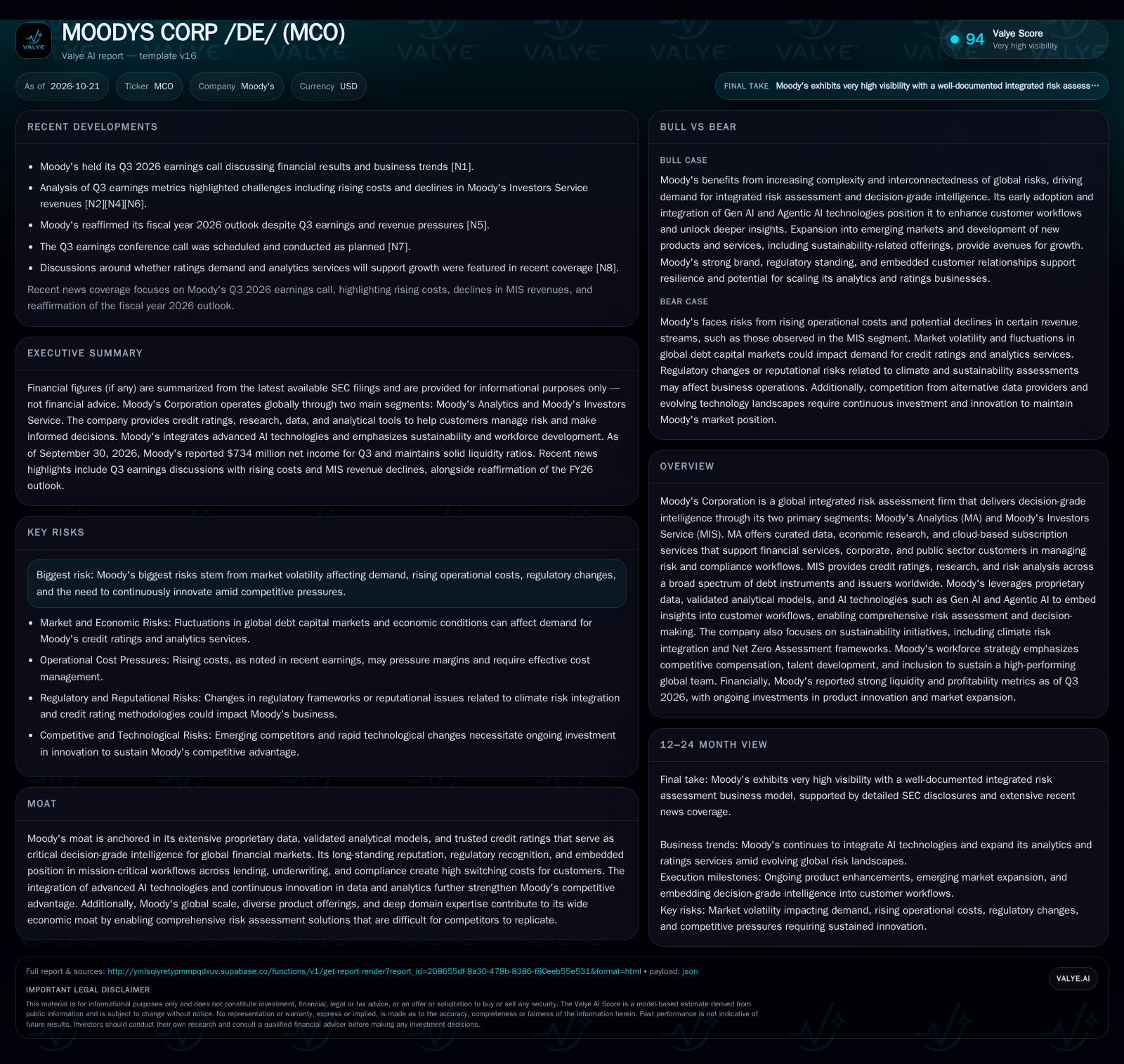
Moody’s reported $734 million net income for Q3 2026 amid rising costs and a decline in MIS revenues, even as it pushes further into AI-enabled analytics and sustainability solutions. The company’s moat remains intact due to regulatory entrenchment and workflow integration, but cost management and ratings demand volatility are emerging as critical variables. Expansion in analytics and emerging markets, if successful, could offset MIS cyclicality; execution and innovation will determine whether Moody’s can convert its data and brand into durable growth [S2] [N1] [N4] [N6].
Moody’s Corporation, a global leader in credit ratings and risk analytics, faces a transitional moment. While it reported a strong Q3 2026 net income, the firm’s flagship ratings segment (MIS) saw revenue declines and rising costs that pressured profitability. At the same time, Moody’s is doubling down on AI-powered analytics, cloud-based subscription services, and climate risk solutions, aiming to entrench itself even deeper in customer workflows and diversify its growth engines. The company’s global regulatory status and embedded relationships create a formidable moat, but execution on cost control and new product scaling will be pivotal as traditional ratings demand softens and competition intensifies.
Recent Cost Headwinds and Ratings Revenue Weakness Shape the Outlook
As of Q3 2026, Moody’s reported net income of $734 million and basic earnings per share of $4.25, with a current ratio of 1.29 and cash and equivalents of $1.513 billion [S2]. However, recent news and quarterly filings highlight two significant headwinds: rising operational costs and a decline in revenues from the Moody’s Investors Service (MIS) segment, which is the core credit ratings business [N1] [N4] [N6]. These trends have pressured profitability and signal challenges in the traditional ratings market, even as the firm reaffirms its commitment to long-term growth through technology investments and product expansion.
How Moody’s Makes Money: Ratings, Data, and Workflow Integration
Moody’s business model is fundamentally about monetizing decision-grade intelligence for financial markets. The MIS segment generates fees for credit ratings, research, and risk analysis on debt securities and issuers—pricing often scales with issuance volume and complexity, making this business cyclical and highly sensitive to global capital markets activity. The Moody’s Analytics (MA) segment, by contrast, is more recurring: it provides curated data, economic research, and cloud-based subscription services for risk and compliance workflows in banking, insurance, and corporate verticals [S1].
The economics of the ratings business feature high fixed costs—skilled labor, regulatory compliance, and technology—leading to operating leverage when issuance volumes are high but margin compression when volumes and pricing soften, as seen in the latest quarter. Analytics and subscription offerings, while requiring ongoing R&D and data infrastructure investment, can scale more efficiently and provide steadier revenue streams. Moody’s is investing in AI and cloud delivery to further reduce marginal costs and increase customer stickiness, but these investments, along with expansion into emerging markets and sustainability, are currently elevating the cost base [S1] [N4] [N6].
The interplay between Moody’s ratings and analytics segments also reflects broader shifts in the financial ecosystem. As regulatory frameworks evolve and market participants demand more granular, real-time risk insights, the traditional ratings model—based on periodic assessments—faces inherent limitations. In contrast, analytics platforms can leverage continuous data feeds, machine learning models, and scenario analysis to provide dynamic risk evaluations. This structural divergence implies that Moody’s long-term value creation may increasingly depend on its ability to pivot from a primarily issuance-driven revenue model toward a subscription and usage-based model, which offers more predictable cash flows and better alignment with client needs. However, this transition requires balancing legacy business support with innovation investments, a challenge that can strain resources and complicate capital allocation decisions.
Moreover, the cost structure differences between the segments highlight important operational considerations. The ratings business, while cyclical, benefits from high barriers to entry due to regulatory recognition and brand trust, but also incurs significant compliance and legal risk costs. Conversely, the analytics segment’s scalability depends heavily on technology infrastructure and data acquisition costs, which can be front-loaded and subject to rapid obsolescence. Consequently, Moody’s must continuously evaluate the marginal returns on technology investments, particularly in AI and cloud capabilities, to ensure that they do not merely add to fixed costs but actually enhance customer value and reduce per-unit delivery expenses over time. Effective cost management in this context is critical to preserving margin resilience amid market volatility.
Regulatory Entrenchment and Workflow Stickiness: Defensive Advantages and Emerging Threats
Moody’s moat is anchored in regulatory recognition (as a Nationally Recognized Statistical Rating Organization in the US and similar status globally), proprietary data, and deep integration into mission-critical financial workflows. Credit ratings from Moody’s are often required by regulation, embedded in covenants, or used as benchmarks across global capital markets, creating high switching costs for issuers and investors [S1].
However, the competitive landscape is evolving. Traditional peers in ratings remain (such as S&P and Fitch), but the analytics segment faces encroachment from technology-driven data providers, alternative credit risk platforms, and fintechs offering modular risk and compliance tools. Integration of AI and sustainability analytics may be differentiators, but require continuous innovation and customer adoption. Regulatory changes—especially around ratings methodologies or climate risk—could also alter the competitive balance, making ongoing investment and adaptability essential.
AI-Driven Analytics and Emerging Markets Expansion Could Offset Ratings Cyclicality
The bull case for Moody’s is that its investments in AI, cloud-based analytics, and sustainability solutions allow the company to become even more deeply embedded in customer workflows, converting data and regulatory trust into durable recurring revenue. If MA’s subscription services grow rapidly—particularly in emerging markets and for climate or KYC analytics—Moody’s could reduce its reliance on the more volatile MIS segment. Successful cross-selling and upselling within its global customer base would amplify operating leverage and margin resilience, especially if technology investments yield product differentiation that competitors cannot easily replicate.
Confirmation would come from accelerating MA revenue growth, expanding subscription ARR, new product adoption metrics (if disclosed), and evidence of operating margin stabilization or improvement even if ratings issuance remains sluggish. Material expansion in emerging markets or new strategic partnerships in AI-enabled risk solutions would further validate this scenario.
Integrated Risk Platform Maintains Core Strengths, but Ratings Headwinds and Cost Pressures Persist
The most plausible outcome is that Moody’s remains a central player in global risk assessment, with its ratings business recovering as debt capital markets stabilize, but not returning to prior peaks. Analytics and sustainability offerings continue to grow, but require sustained investment and do not fully offset MIS cyclicality in the near term. Cost pressures—both from technology investment and rising compensation—limit margin expansion, even as the company preserves overall profitability and cash generation.
Evidence for this scenario includes modest sequential improvement in MIS revenues as markets recover, steady but not breakaway growth in the analytics segment, and continued investment spend visible in operating expenses. Margin trends would likely be stable to slightly down, with cash flows supporting ongoing R&D and product rollouts rather than outsized capital returns.
Ratings Market Weakness and Inflationary Costs Erode Profitability and Strategic Flexibility
A negative scenario would see a prolonged slump in global debt issuance, regulatory or reputational setbacks in ratings, and slower-than-expected adoption of analytics innovations. Rising operational costs—particularly wages and technology infrastructure—could further compress margins, especially if MA’s new offerings fail to scale or face pricing pressure from aggressive new entrants.
Evidence would include sustained or worsening declines in MIS segment revenues, persistent cost growth outpacing revenue, and any signs of customer attrition or delayed product adoption in analytics. Regulatory challenges or a high-profile ratings controversy could exacerbate the impact, limiting Moody’s ability to invest for growth or defend its competitive position.
What Will Determine Moody’s Trajectory in a Shifting Risk Landscape?
Quarterly trends in MIS (ratings) segment revenues and issuance volumes, as these remain the largest single driver of earnings volatility and operating leverage.
Growth rate and mix of Moody’s Analytics subscription revenues—particularly recurring ARR and new product adoption, if disclosed.
Trajectory of operating expenses and margin trends, with a focus on whether cost increases are temporary (investment-led) or structural.
Evidence of successful cross-sell/upsell initiatives, including customer retention, expansion rates, and workflow integration metrics.
Regulatory developments affecting credit ratings, climate risk disclosures, or data use, and any resulting impact on Moody’s product eligibility or workflow role.
Customer adoption and revenue traction for sustainability, climate risk, and Gen AI-powered analytics solutions.
Emerging market penetration rates and new partnership or joint venture announcements in high-growth geographies.
Employee engagement and talent retention, particularly for analytics and AI talent, as this underpins R&D and product innovation.
Disclaimer: This is research-only, informational analysis and not investment advice. It may include AI-generated interpretation and general industry context. Always verify important details using primary sources.

Comments