
Graco’s Diversified Segments and Margin Discipline Confront a Mixed Macro Backdrop
Graco Inc enters late 2026 with resilient segment margins, a strategic acquisition, and a strong capital base—but faces profit headwinds and cyclical demand risks across construction and industrial markets.
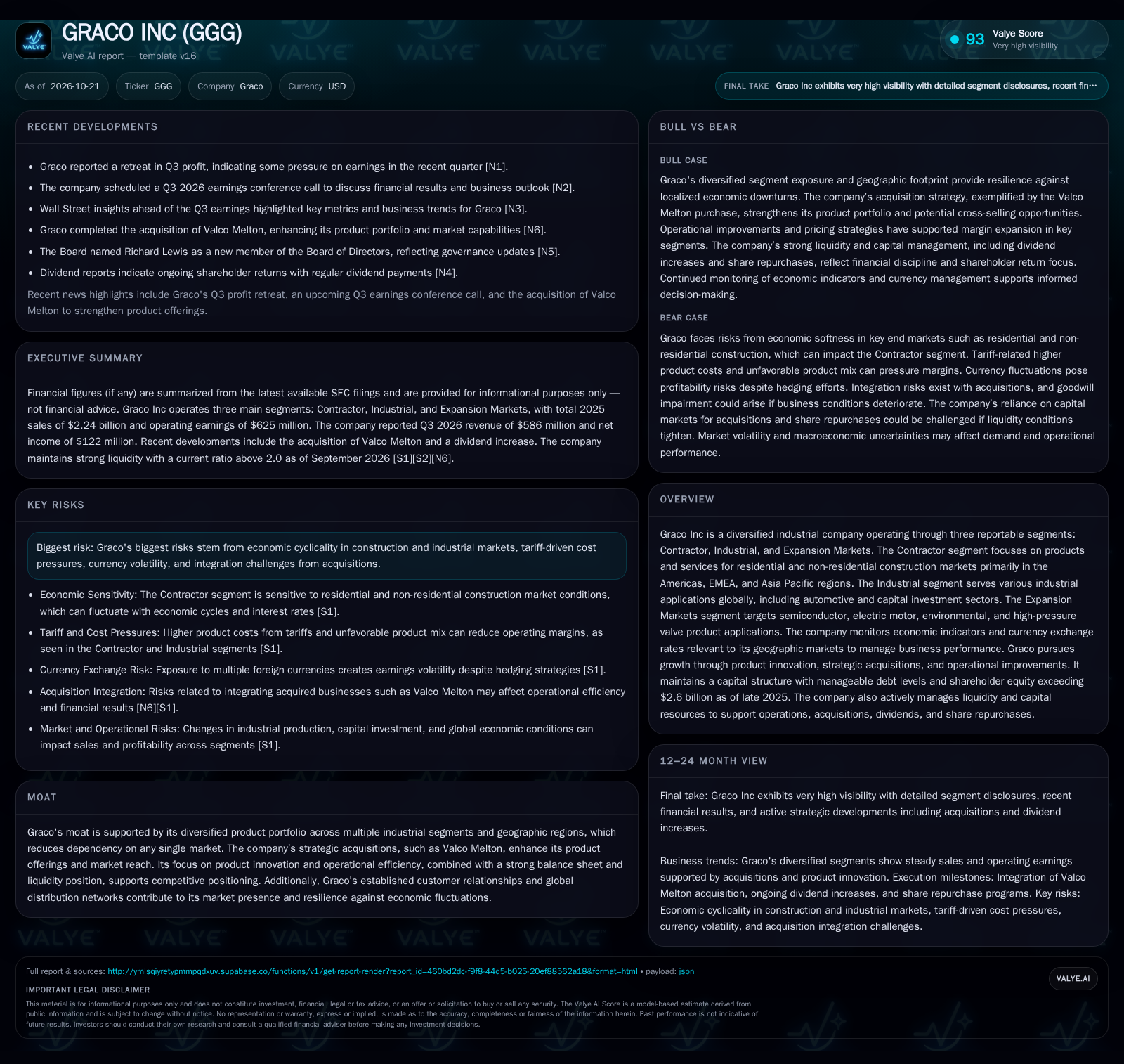
Graco’s Q3 2026 profit softened amid segment margin discipline and mixed end-market conditions. The key challenge is sustaining growth and margins against economic and cost pressures, especially in construction and industrial demand cycles. Watch for integration progress, pricing power, and evidence of segment resilience as the next tests for the thesis. [S1] [S2] [N1] [N6]
Graco Inc, a diversified equipment manufacturer, continues to balance margin discipline and capital returns with the realities of cyclical demand in construction and industrial sectors. As of Q3 2026, the company’s profitability has softened, yet its segment operating margins remain healthy, supported by a reported balance sheet position and active capital allocation. The recent acquisition of Valco Melton is a strategic move to expand Graco’s industrial footprint, but successful integration and macroeconomic headwinds present meaningful tests. The next phase for Graco hinges on sustaining pricing power, operational leverage, and resilience across its three core segments in an uncertain economic environment. [S1] [S2] [N1] [N6]
Recent Profit Retreat and Strategic Moves Shape Graco’s Landscape
Graco’s Q3 2026 financial results show revenue of $586.4 million and net income of $121.6 million, with earnings per share of $0.75. This marks a retreat in quarterly profit, pointing to margin or volume pressures in at least some business lines. The company recently closed the acquisition of Valco Melton, adding new capabilities and product breadth, particularly in industrial and packaging applications. Graco’s balance sheet remains robust, with $139.8 million in cash and a current ratio of 2.12 as of September 2026. The cited source reports dividend-related activity; that disclosure alone does not establish dividend-policy continuity, management confidence, or a material constraint on capital flexibility. [S1] [S2] [N1] [N6]
Segment Margins, Operating Leverage, and Capital Allocation Dynamics
Graco’s business model is built on durable cash generation from three main segments: Contractor, Industrial, and Expansion Markets. In 2025, the Industrial segment contributed nearly $1 billion in sales and led the company with a 34% operating margin, reflecting favorable product mix, scale, and pricing power in specialized industrial applications. Contractor and Expansion Markets segments each posted 25% operating margins, but are more exposed to cyclical swings in construction and emerging technology end-markets. The company’s fixed-cost leverage is evident in segment-level margin stability, but variable costs—such as raw materials, tariffs, and logistics—can impact profitability during periods of volume contraction or inflation.
Capital allocation remains disciplined: Graco has a history of dividend growth (7% increase in December 2025), opportunistic share buybacks (5.2 million shares repurchased in 2025), and targeted M&A exemplified by the Valco Melton acquisition. With capex guidance of roughly $80 million for 2026 and manageable debt, Graco’s capital structure supports both organic and inorganic growth initiatives. However, the ability to maintain high margins may depend on successfully passing through cost increases and maintaining operational efficiency as economic cycles shift. [S1] [S2] [N6]
The interplay between fixed and variable costs within Graco’s segments is a critical factor in understanding margin dynamics amid economic fluctuations. Fixed costs, such as manufacturing overhead and salaried personnel, provide operating leverage that can amplify profitability when volumes rise, but conversely, can pressure margins when volumes decline. Variable costs, including raw materials and logistics, are more directly tied to production levels but are susceptible to inflationary trends and supply chain disruptions. Therefore, Graco’s ability to maintain or improve margins depends not only on volume recovery but also on effective cost management strategies, such as hedging commodity price risks, optimizing supply chains, and leveraging scale economies. Additionally, the company’s pricing power is contingent on customer willingness to absorb cost pass-throughs without significant volume loss, which varies by segment and end-market sensitivity.
Diversification, Innovation, and the Challenge of Margin Defense
Graco’s competitive position is anchored by its diversified product portfolio and end-market exposure. Its footprint in Contractor (construction equipment), Industrial (automotive, manufacturing, packaging), and Expansion Markets (semiconductors, electric motors, environmental) reduces reliance on any one sector or geography. Strategic acquisitions like Valco Melton expand Graco’s reach and bolster offerings in higher-value industrial applications, potentially enhancing cross-selling and customer retention.
Despite these advantages, Graco faces formidable competition from global industrial equipment manufacturers, local market specialists, and technology-driven entrants—especially in automation and process control. Switching costs in industrial applications can be high, favoring established players, but price sensitivity and capital spending cycles in construction and manufacturing can erode pricing power. The company’s product innovation and global distribution network are strengths, but sustained margin defense will require continuous differentiation and operational agility, especially as macro conditions and input costs fluctuate.
Graco’s diversification across segments and geographies offers a natural hedge against localized economic downturns, but it also introduces complexity in managing product development and customer relationships. The company must continuously invest in innovation to stay ahead of competitors who may specialize in narrower niches or leverage emerging technologies faster. In industrial applications, where switching costs are high, Graco can capitalize on long-term customer relationships and integrated solutions, yet this advantage requires ongoing product differentiation and service excellence to prevent erosion by disruptive entrants. Conversely, in more price-sensitive construction markets, maintaining margins may require balancing aggressive cost controls with selective pricing strategies to retain market share during cyclical downturns. The company’s global distribution network further necessitates agility in responding to regional regulatory changes, trade policies, and localized competitive pressures.
Margin Expansion and Successful Integration Drive Outperformance
The most favorable outcome for Graco features above-trend growth in industrial and construction markets, combined with successful integration of Valco Melton. If global industrial production and construction activity rebound, Graco’s Contractor and Industrial segments could see both volume and pricing tailwinds. The Valco Melton acquisition could accelerate cross-selling and provide access to new verticals, lifting the company’s blended operating margin and enhancing revenue mix toward higher-margin products.
Disclosures of higher pricing realization, improved inventory turnover, and successful customer retention in new segments would further support the bull case.
Mixed End-Market Recovery and Margin Stability Remain the Most Likely Outcome
The most plausible pathway for Graco is characterized by flat-to-modest sales growth, resilient but stable operating margins, and incremental benefits from portfolio expansion. End-market demand in construction and industrial sectors is likely to remain mixed, with pockets of strength offset by cyclical slowdowns—particularly in North American and EMEA construction. Management’s ongoing focus on cost controls, operational efficiency, and selective price increases supports margin stability, but not significant expansion.
The base scenario would be confirmed by consistent segment margins, steady dividend growth, and moderate revenue increases from both legacy and acquired businesses. If quarterly profit volatility persists, but underlying cash flow and capital allocation remain disciplined, this would reinforce a steady-state outlook. Falsification would occur if segment operating margins erode meaningfully or if acquisition integration drags on overall profitability.
Economic Downturn and Integration Hurdles Pressure Performance
A less favorable scenario involves a sustained downturn in construction and industrial demand, exacerbating volume declines in the Contractor and Industrial segments. If inflationary pressures or tariffs further increase input costs, and Graco is unable to pass through price increases, operating margins could compress sharply. Integration challenges with Valco Melton—such as higher-than-expected costs, cultural friction, or slower revenue synergies—could dilute earnings and trigger goodwill impairment.
Downside evidence would include consecutive declines in segment sales and margins, negative operating leverage, and reduced or stagnant returns to shareholders. Any need to curtail capex, suspend buybacks, or slow dividend growth in response to deteriorating cash flow would further confirm a negative turn. Disclosure of acquisition-related write-downs or missed synergy targets would also be warning signs.
If macroeconomic conditions deteriorate more sharply than anticipated, Graco’s exposure to cyclical end-markets could exacerbate volume declines, leading to underutilized capacity and margin compression. The company’s fixed-cost base may limit its ability to quickly adjust cost structures, potentially resulting in disproportionate profit erosion. Moreover, integration risks with Valco Melton could be magnified under stress, as resource allocation to synergy realization competes with operational challenges. In such a scenario, capital allocation decisions may become constrained, forcing prioritization between sustaining dividends, share repurchases, and reinvestment in innovation or maintenance capex. A protracted downturn could also pressure management to reconsider pricing strategies, possibly sacrificing margin to preserve market share, which would have longer-term implications for profitability and competitive positioning.
Milestones That Will Test Graco’s Margin Resilience and Strategic Execution
Quarterly operating margin trends by segment, especially in Industrial and Expansion Markets, to gauge pricing power and cost management effectiveness (if disclosed).
Revenue contribution and margin profile of the Valco Melton acquisition, including any disclosed cross-selling or integration milestones.
Inventory turnover and working capital efficiency, especially if end-market demand becomes more volatile.
Management commentary or disclosed metrics on price realization versus input cost inflation.
Dividend growth rate and share repurchase activity as signals of underlying cash flow strength and capital discipline.
Geographic revenue mix shifts, especially exposure to North American vs. international construction and industrial markets.
Any disclosures regarding goodwill impairment, integration costs, or acquisition-related write-downs.
Disclaimer: This is research-only, informational analysis and not investment advice. It may include AI-generated interpretation and general industry context. Always verify important details using primary sources.

Comments