
Manhattan Bridge Capital: Focused Growth in Niche Real Estate Lending with Risk Discipline and Dividend Strength
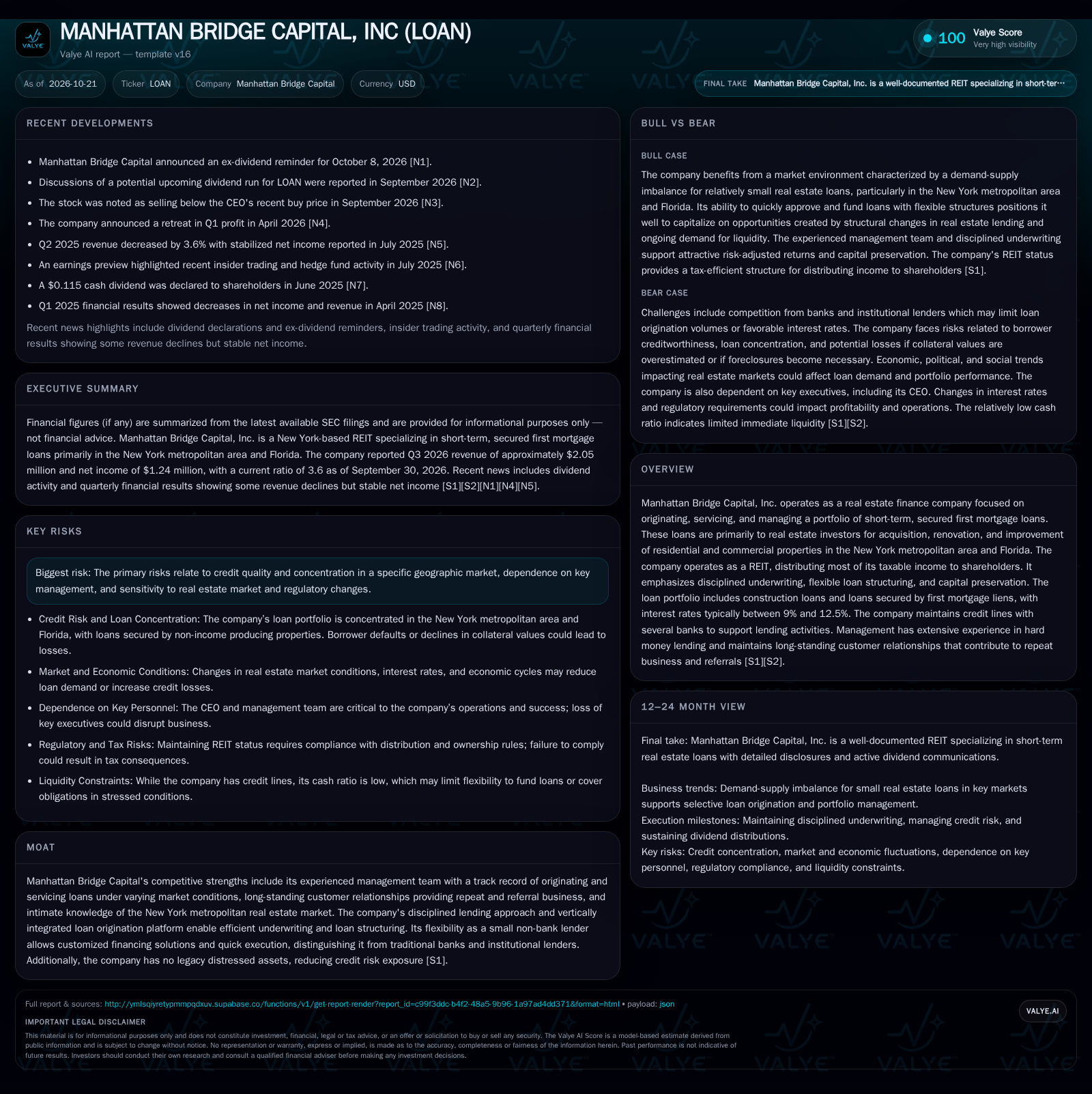
Manhattan Bridge Capital’s model is built on originating short-term, high-yield mortgage loans to real estate investors, supported by disciplined credit standards and a REIT structure mandating high payout.
Manhattan Bridge Capital’s model is built on originating short-term, high-yield mortgage loans to real estate investors, supported by disciplined credit standards and a REIT structure mandating high payout. [S1] [S2]
Manhattan Bridge Capital, Inc. occupies a specialized corner of the real estate finance market, providing short-term, high-yield loans to investors seeking rapid funding for acquisition and renovation projects in the New York metropolitan area and Florida. Recent financials reveal a stable net income profile despite revenue headwinds, underscoring both the resilience and the limitations of its tightly focused approach. The coming quarters will test the company’s ability to preserve credit quality, maintain capital access, and sustain investor distributions as competitive and macroeconomic forces intensify. [S1] [S2]
Recent Financial Results and Liquidity Overview
As of the third quarter of 2026, Manhattan Bridge Capital reported revenue of $2,053,558 and net income of $1,238,462, translating to basic and diluted EPS of $0.11. The company’s total assets stood at approximately $61.48 million, with liabilities of $18.69 million and equity of $42.79 million. The current ratio was a healthy 3.6, but the cash ratio was notably low at 0.02, with just $129,490 in cash and equivalents. [S2]
The cited source reports dividend-related activity; that disclosure alone does not establish dividend-policy continuity, management confidence, or a material constraint on capital flexibility. Notably, the company has experienced only one foreclosure in recent years, which was resolved with full payoff—demonstrating disciplined credit management but also suggesting limited stress-testing of the loan book under adverse conditions. [N1] [N4] [N5] [S1]
Manhattan Bridge Capital’s Revenue Model: Yield, Leverage, and Risk Controls
The core economic engine is the origination of short-term, high-interest loans (typically 9%–12.5%) to real estate investors who require quick, flexible funding that traditional banks are often unwilling or unable to provide. These loans, usually with one-year terms, are secured by first mortgage liens and further protected by personal guarantees from borrower principals, helping to mitigate credit risk. Interest rates may be fixed or pegged to the prime rate plus a markup, allowing some protection against rate volatility. [S1]
As a REIT, Manhattan Bridge Capital must distribute at least 90% of its taxable income, which limits its ability to retain earnings for organic growth or capital buffer build-up. To fund new loans, the company relies on revolving credit lines (totaling $42.5 million across three banks as of the latest filings), using leverage to amplify returns on equity. The business is highly sensitive to net interest margin, origination volume, and credit performance—since losses on even a small portion of the portfolio can quickly erode profitability. Fixed costs are relatively low, but the company’s model requires careful management of loan turnover, funding costs, and risk-adjusted returns to avoid liquidity or solvency stress. [S1] [S2]
Market Position and Competitive Dynamics in Specialized Hard Money Lending
Manhattan Bridge Capital operates in a niche segment of real estate finance: small, short-term loans for value-add projects often bypassed by larger banks. Its advantages include deep local market knowledge, long-standing borrower relationships, and a reputation for rapid, flexible execution. This enables the company to attract repeat business and referrals, supporting a stable origination pipeline even amid market turbulence. [S1]
However, barriers to entry are moderate. While regulatory requirements and underwriting discipline provide some insulation, other non-bank lenders and increasingly aggressive banks can enter the space during periods of reported liquidity position or when seeking yield. Larger institutional players may also compete on price or structure, compressing spreads. The company’s flexibility and speed are strengths, but as interest rates and credit conditions evolve, borrowers may have more options, and pricing power could weaken. Switching costs are relatively low for sophisticated real estate investors, unless personal relationships or speed of execution become decisive. The company’s focus on non-income producing properties adds risk but also distinguishes it from lenders targeting stabilized, cash-flowing assets.
Opportunity Phase: Demand Growth from Market Disruptions in Private Credit
The most attractive scenario for Manhattan Bridge Capital arises when traditional lenders retrench—tightening standards or reducing exposure to small, short-term loans. In such an environment, real estate investors seeking acquisition or renovation capital turn to hard money lenders willing to move quickly and structure flexible deals. If the company can maintain disciplined underwriting, avoid credit losses, and fully utilize its existing credit lines, it could see higher origination volumes at robust yields, translating to revenue and net income growth.
Confirmation of this thesis would include sustained or rising origination volumes, stable or improving net interest margins, and continued low levels of delinquencies or foreclosures. Evidence of repeat borrowers and minimal write-offs, along with the ability to increase or renew credit facilities at attractive rates, would reinforce the upside case. Expansion of the addressable market—such as regulatory changes that further constrain banks—could magnify these effects.
Base Outlook: Managing Risk, Yield, and Dividend Commitments
The most plausible outcome is continued disciplined origination in the company’s core territories, with modest fluctuations in revenue and earnings depending on local real estate cycles and funding costs. Loan demand remains healthy but competitive intensity from banks and peer lenders puts pressure on pricing and spreads.
In this scenario, credit quality stays strong—reflected in low default and foreclosure rates—and management’s underwriting discipline avoids major losses. Modest revenue declines may persist if competition intensifies or if property turnover slows, but net income remains stable due to cost control and prudent leverage. Confirmation would come from a continued pattern of stable net income, low credit losses, and renewal of credit facilities on similar terms. Falsification would occur if loan losses rise, credit line access is restricted, or dividend cuts become necessary.
Downside Risks: Credit Challenges and Funding Constraints
If real estate market conditions in the New York metropolitan area and Florida deteriorate—due to falling property values, reduced investor activity, or economic shocks—borrower defaults could rise, collateral values could decline, and the company might face losses on its loan book.
In this scenario, Manhattan Bridge Capital could be forced to slow loan origination, liquidate assets at unfavorable prices, or even face liquidity shortfalls that threaten REIT compliance and dividend distributions. Confirmation would include a spike in delinquencies, rising foreclosures, inability to renew or expand credit lines, and dividend suspension or reduction. Early warning signs could be found in declining origination volumes, increasing loan loss provisions, or management commentary on funding challenges.
Factors Influencing Manhattan Bridge Capital’s Business Durability
Quarterly origination volume and average loan size—if disclosed—will indicate whether the company is maintaining or growing its lending pipeline, especially as market conditions fluctuate.
Net interest margin trends: Compression may signal rising competition or higher funding costs, while expansion would support the thesis of disciplined pricing power.
Delinquency and foreclosure rates: An uptick would challenge the credit management narrative and could foreshadow future losses.
Renewal and availability of credit facilities, particularly any changes in rates, covenants, or lender appetite, will be crucial to sustaining loan growth and liquidity.
Management turnover or changes in key personnel, especially the CEO, would be material given the company’s reliance on experience and relationships.
Geographic or portfolio concentration shifts: Expansion beyond the core New York and Florida markets, or greater diversification in property types, would alter risk and opportunity profiles.
Disclaimer: This is research-only, informational analysis and not investment advice. It may include AI-generated interpretation and general industry context. Always verify important details using primary sources.

Comments