
NVE Corporation: Spintronics at the Intersection of Industrial IoT, Medical Devices, and Emerging Memory
NVE’s proprietary spintronic technologies anchor a high-margin niche across industrial, medical, and memory markets, but growth remains tied to concentrated customers, adoption curves for MRAM, and the pace of AIoT/IIoT integration.
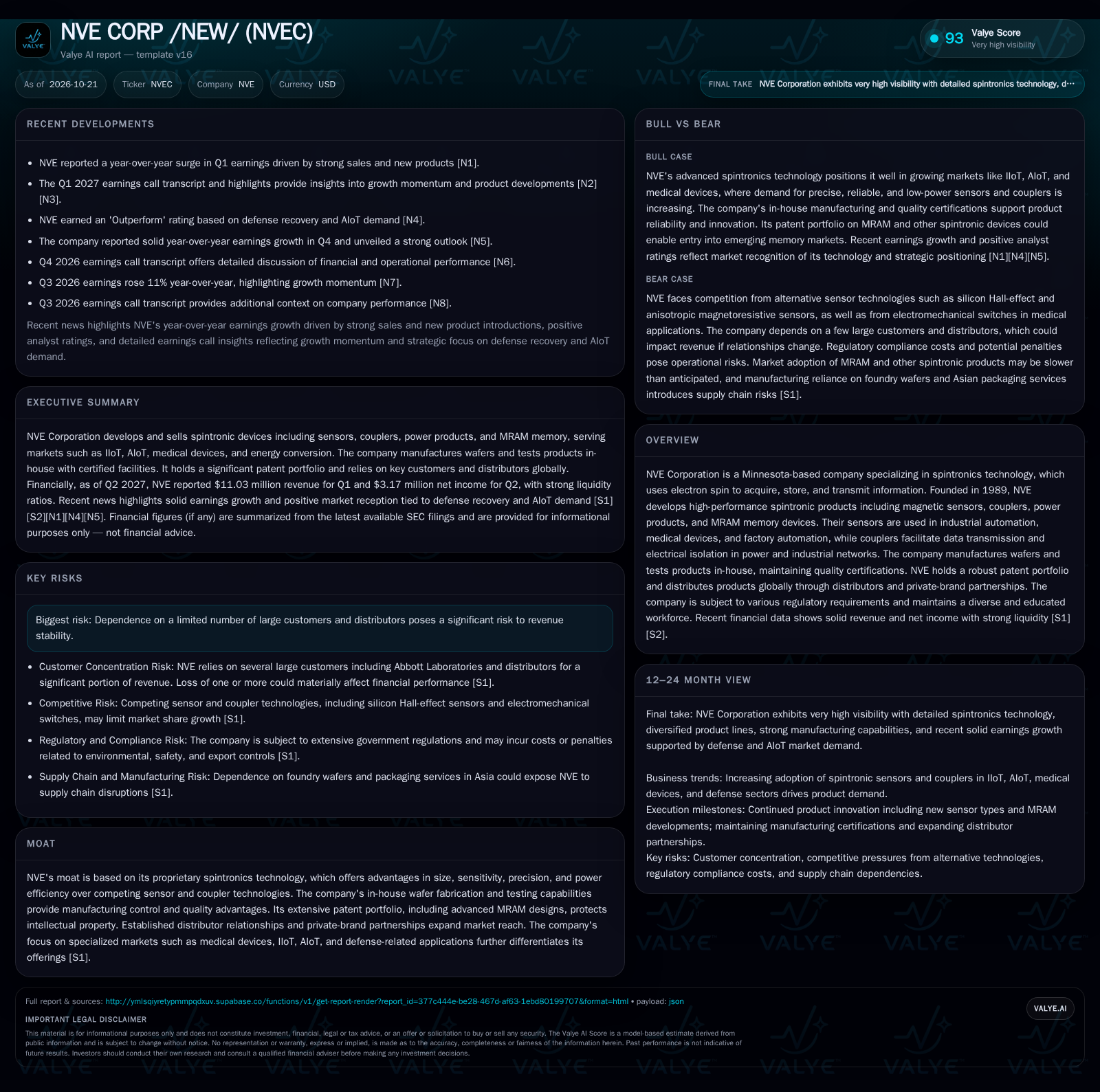
NVE Corporation develops spintronic sensors, couplers, and MRAM memory, with recent earnings growth driven by industrial automation and AIoT demand. The company’s in-house manufacturing, strong patent portfolio, and global distribution underpin its niche, but reliance on a few major customers and exposure to alternative sensor technologies remain structural risks [S1] [S2] [N4] [N5].
NVE Corporation stands at a strategic crossroads as its spintronic technologies anchor specialized applications across industrial automation, medical devices, and emerging memory markets. The company’s latest results reflect both strong demand for high-performance sensors and couplers—especially as the Industrial Internet of Things (IIoT) and AIoT sectors mature—and the complexity of operating in a market defined by rapid technology shifts and customer concentration. As NVE leverages its in-house manufacturing and patent portfolio to differentiate in a competitive landscape, its future trajectory hinges on sustaining innovation, expanding its customer base, and capitalizing on the accelerating adoption of spintronics in next-generation systems.
Earnings Growth and Product Breadth Shape NVE’s Current Position
NVE reported Q1 2027 revenue of $11.03 million and Q2 2027 net income of $3.17 million, continuing a run of solid earnings growth attributed to strong sales and new product momentum [S2] [N5]. Analyst commentary and recent upgrades cite defense sector recovery and AIoT demand as key contributors to the positive outlook [N4] [N5]. The company’s spintronic product suite—spanning sensors, couplers, power products, and MRAM—serves diverse applications within industrial automation, medical devices, and energy systems [S1]. Notably, NVE’s in-house manufacturing and more than 50 U.S. patents reinforce its ability to innovate and maintain quality control [S1]. Yet, the company’s reliance on several large customers and distributors, including Abbott Laboratories, remains a material risk to revenue stability [S1].
Spintronics Economics: Margin Structure, Scale Constraints, and Leverage Points
NVE’s business model centers on high-value, low-volume spintronic devices that command premium pricing due to performance advantages in sensitivity, power efficiency, and reliability—particularly in mission-critical IIoT, medical, and industrial applications. With in-house wafer fabrication and testing, the company controls key production variables, likely enabling higher gross margins than commodity sensor producers. However, the economics are sensitive to volume swings from major customers, given the company’s customer concentration.
The product mix spans standard and custom sensors, couplers for electrical isolation, power ICs, and MRAM for tamper prevention. Custom medical sensors and MRAM are likely higher-margin due to specialized design and lower competitive intensity. Variable costs are tied to materials and packaging, some of which depend on Asian suppliers, introducing potential cost volatility. Fixed costs are kept in check by a lean workforce and the absence of large-scale foundry overhead, but meaningful operating leverage is only unlocked if adoption rates for spintronic solutions accelerate in target verticals.
Capital intensity is moderate: NVE’s manufacturing is in-house up to wafer level but relies on external packaging. The company reported cash and liquidity metrics for the period; these figures do not by themselves establish operating runway, investment capacity, financial flexibility, or financing capacity. [S2]
How NVE’s Technology and Market Focus Define Its Competitive Edge—and Its Limits
NVE’s proprietary spintronic devices offer technical advantages over traditional silicon-based Hall-effect and anisotropic magnetoresistive (AMR) sensors, including smaller size, higher sensitivity, and lower power consumption. These features are especially valued in medical devices and factory automation, where reliability and precision are paramount. The company’s patent portfolio and in-house process control provide defensibility against direct imitation and enable custom development for demanding applications.
However, the company faces counterforces: established sensor suppliers with broader portfolios, lower-cost alternatives for less demanding use cases, and the inertia of incumbent technologies in conservative industries. In MRAM, NVE competes against much larger players with more resources and the ability to bundle memory solutions into broader system offerings. The company’s distribution through global channels and private-label partnerships extends reach but may dilute pricing power compared to direct sales.
Switching costs for industrial and medical customers are nontrivial—especially where design-in cycles are long—but not insurmountable if a competitor delivers a compelling value proposition. The real test is whether NVE can secure design wins in high-growth AIoT and IIoT deployments before alternative sensor and memory technologies close the performance gap.
Catalysts for Growth: When Defense, AIoT, and MRAM Converge
A favorable scenario for NVE would see rapid adoption of spintronic sensors and couplers in next-generation AIoT and IIoT deployments, driven by the need for ultra-reliable and precise sensing in automated factories, smart infrastructure, and advanced medical devices. If defense spending continues to recover and incorporates more spintronic-based systems, NVE’s addressable market could expand meaningfully. MRAM, if it achieves broader adoption in embedded and security applications, would provide a tailwind given NVE’s patent position.
Confirmation of this scenario would include sustained double-digit revenue growth, expanded design wins in major industrial or medical OEMs, and visible ramp-up of MRAM shipments. Additional evidence would be strategic partnerships or licensing deals with large device integrators, and a broadening customer base that reduces revenue concentration risk. Conversely, the scenario would be undermined if MRAM adoption stalls, AIoT/IIoT demand softens, or NVE fails to convert new product innovations into commercial wins.
Core Trajectory: Profitable Niche Supplier with Episodic Growth Spurts
The most plausible path for NVE is continued role as a profitable, niche provider of high-performance spintronic components to a select group of industrial, medical, and energy customers. Revenue and margins remain healthy, anchored by product differentiation and in-house manufacturing, but growth is episodic—tied to cycles in capital spending, defense budgets, and the pace of AIoT/IIoT rollouts.
Evidence for this outcome would include ongoing revenue growth in the mid-single digits, stable or improving gross margins, and periodic product launches that refresh the portfolio. Customer concentration and competition from alternative technologies would persist as structural challenges, occasionally resulting in revenue volatility if a major account is lost or delayed. Failure to materially expand MRAM adoption or to diversify the customer base would confirm that NVE remains a specialized but not scale-driven business.
Risks Materialize: Customer Losses and Technology Substitution Pressure Margins
The adverse scenario unfolds if one or more of NVE’s major customers or distributors reduce orders, whether due to internal changes, competitive switching, or changes in technology preference. Given the company’s revenue concentration, even a single large customer loss could materially impact top-line and profitability. At the same time, advances in silicon-based sensors or alternative memory technologies could erode the performance gap that currently justifies NVE’s pricing premium.
Confirmation of this scenario would be a sharp decline in quarterly revenue, margin compression, or negative operating leverage as fixed costs are spread over a smaller sales base. Early warning signs could include loss of a key medical or industrial design win, or an extended period without new product adoption by major OEMs. If MRAM fails to gain traction and the company is unable to offset declines in legacy products, NVE could see a contraction in both market relevance and financial performance.
What Will Distinguish NVE’s Next Chapter in Spintronics?
Growth in design wins for spintronic sensors and couplers in AIoT and IIoT projects—if disclosed—would signal momentum beyond legacy industrial customers.
Quarterly and annual revenue concentration among top customers: a reduction would demonstrate improved diversification and resilience.
MRAM shipment volumes and customer adoption rates: accelerating uptake would validate the growth narrative in emerging memory.
Gross margin trends: stability or expansion would support sustained differentiation, while compression could indicate rising competition or cost pressures.
New patent issuances or licensing agreements, especially with major device manufacturers, would suggest successful monetization of IP.
Any changes in distributor relationships or the addition of new global partnerships would help test the company’s reach and channel effectiveness.
Disclosure of meaningful supply chain disruptions or cost inflation tied to wafer or packaging sourcing would flag operational risks.
R&D intensity and product launch cadence: increased investment and new product introductions would indicate a proactive innovation posture.
Disclaimer: This is research-only, informational analysis and not investment advice. It may include AI-generated interpretation and general industry context. Always verify important details using primary sources.

Comments