
AT&T in 2026: Network Scale, Liquidity Pressure, and the Challenge of Capital-Intensive Growth
AT&T’s Q3 2026 results highlight the tension between large-scale telecom infrastructure, persistent liquidity pressure, and the need for continued investment in wireless and fiber. The company’s ability to translate its asset base and network reach into sustainable, profitable growth will depend on operational execution, cost discipline, and adaptation to a fiercely competitive market.
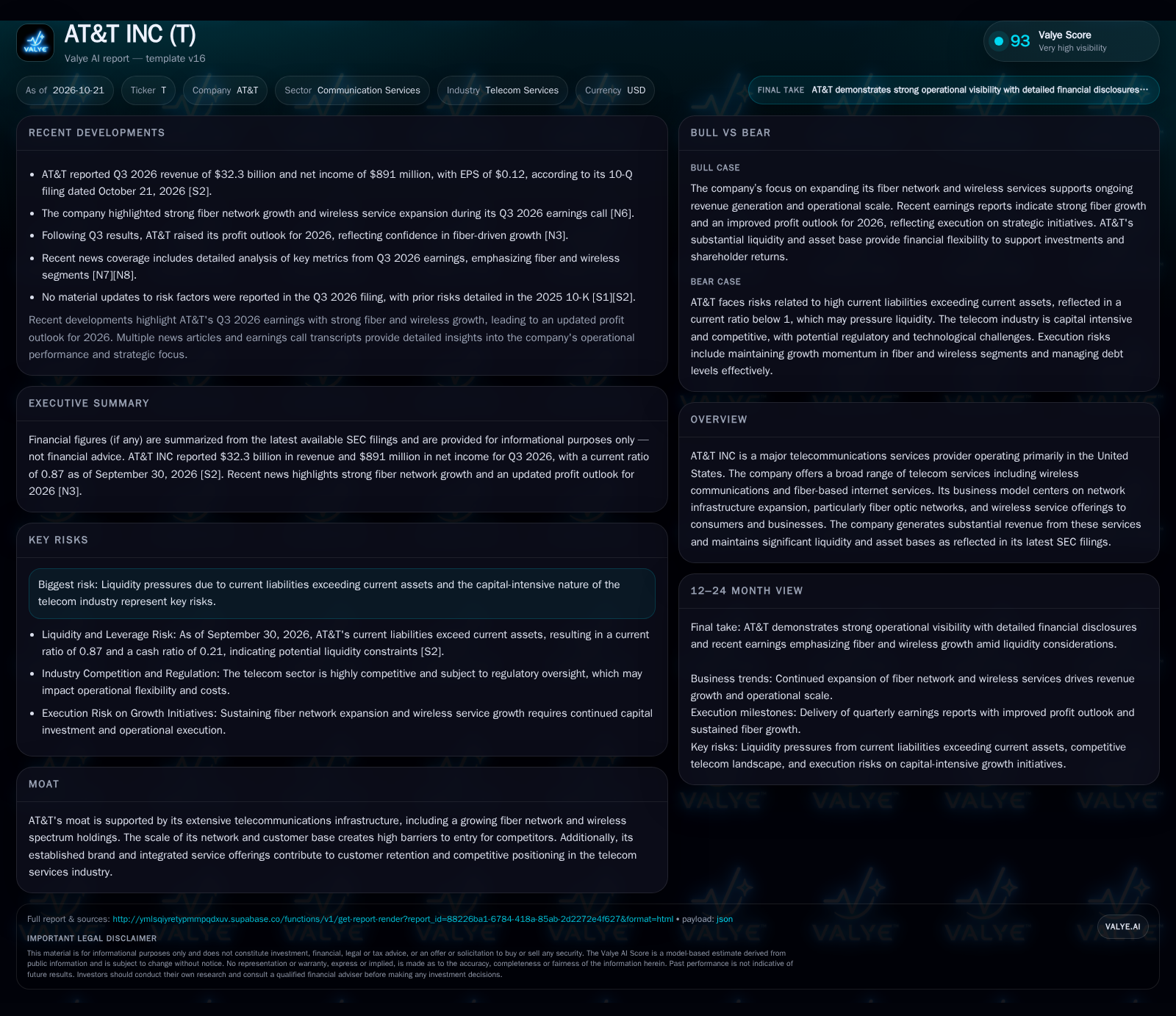
AT&T reported $32.3 billion in Q3 2026 revenue and $891 million in net income, but its current liabilities exceed current assets, resulting in a current ratio of 0.87. The company’s capital-intensive model, competitive pressures, and ongoing need for network investment create both opportunity and risk. Future performance hinges on balancing liquidity management, customer retention, and growth in fiber and wireless segments. [S2]
AT&T’s third-quarter 2026 financials spotlight the classic telecom dilemma: immense network assets and revenue scale, yet persistent pressure from short-term liabilities and the relentless capital demands of infrastructure upgrades. With $32.3 billion in revenue and $891 million in net income for Q3, AT&T remains a dominant player, but its current ratio of 0.87 signals that liquidity management is a top priority. The company’s challenge is to leverage its fiber and wireless expansion for profitable growth while navigating a highly competitive and regulated sector.
AT&T’s 2026 Financial Position: Scale Meets Liquidity Strain
AT&T reported $32.322 billion in revenue and $891 million in net income for the quarter ended September 30, 2026. Earnings per share were $0.12, suggesting continued profitability at scale. This mismatch between near-term obligations and liquid assets highlights ongoing liquidity pressure—a notable risk factor for a capital-intensive business. No new material risk factor developments were disclosed in the Q3 2026 filing, but the absence of improvement in liquidity metrics keeps potential financial flexibility in focus. [S2]
Telecom Economics: Fixed Cost Leverage and the Investment Imperative
AT&T’s business model is defined by high fixed costs—network infrastructure, spectrum, and regulatory compliance—offset by the potential for operating leverage as subscriber and usage volumes rise. Revenue is primarily generated from wireless services, broadband (notably fiber), and related value-added offerings. Pricing power is constrained by competitive intensity and regulatory oversight, but the company’s scale supports modest cost advantages in network deployment and customer acquisition.
The economics of fiber deployment are particularly sensitive: upfront capital expenditure is high, but incremental costs per customer decline as penetration within a service area increases. Wireless services, meanwhile, benefit from recurring revenue streams but face margin pressure from device subsidies, spectrum investment, and customer churn. Sustained free cash flow requires disciplined capital allocation and cost control, as missteps in network investment or pricing strategy can quickly erode margins given the industry’s thin buffer between fixed obligations and variable profitability.
The company’s current liability profile suggests that short-term funding needs—such as debt maturities, interest payments, and vendor obligations—must be carefully managed to avoid liquidity-driven operational constraints.
In addition to fixed cost leverage, the timing and scale of capital expenditures critically influence AT&T’s financial health. Large upfront investments in fiber and spectrum acquisition must be carefully phased to align with anticipated revenue growth and cash flow generation. If capital deployment outpaces subscriber uptake or ARPU improvements, the company risks underutilized assets and margin compression. Conversely, delayed investment can erode competitive positioning and future growth potential. Therefore, a dynamic capital allocation framework that integrates market demand signals, competitive moves, and technological evolution is essential to optimize returns on invested capital.
Barriers and Battle Lines: AT&T’s Moat in a Crowded Market
AT&T’s durable advantage stems from its vast network infrastructure, including nationwide wireless coverage and an expanding fiber footprint. These assets create meaningful barriers to entry: building a rival network requires billions in capital, regulatory approvals, and years of deployment. The company’s large customer base further supports retention and cross-selling, while established brand equity remains a soft but valuable asset.
However, structural advantages are counterbalanced by fierce competition from other national carriers, cable operators moving aggressively into wireless (via MVNOs and bundled offerings), and disruptive potential from emerging technologies such as fixed wireless access and satellite broadband. Price wars, promotional churn, and regulatory interventions can quickly erode the practical value of scale. AT&T’s ability to maintain its moat depends on continued investment in network quality, customer experience, and the ability to offer integrated solutions that deter switching.
Unlocking Value Through Fiber Penetration and Churn Reduction
A favorable scenario for AT&T would see accelerated adoption of its fiber broadband and premium wireless offerings, driving higher average revenue per user (ARPU) and improved retention. If capital investment is efficiently targeted—prioritizing high-density, high-income markets—incremental margins on new fiber customers could rise, leveraging existing network assets. Reduced customer churn, possibly from superior service quality or bundled discounts, would lower acquisition costs and stabilize cash flow.
Confirmation of this scenario would include sequential growth in fiber subscriber additions, rising ARPU, and a sustained decline in churn rates (if disclosed). Margin expansion and evidence of free cash flow after capital expenditures would further validate the thesis. Conversely, stagnant subscriber growth or persistent margin compression would challenge the upside case.
Steady-State: Cash Generation Balanced by Capital Demands
The most plausible trajectory is one of modest revenue growth, ongoing investment in network upgrades, and continued pressure on short-term liquidity. AT&T is likely to maintain its market share in wireless and fiber without dramatic shifts in either direction, as competitive dynamics keep pricing rational but limit outsized gains.
Confirmation would come from stable or slightly rising revenue, flat to modestly improving margins, and no significant deterioration in coverage of near-term liabilities. Any sharp increase in short-term borrowing or a material decline in cash reserves would signal a deviation from this base case.
Liquidity Stress and Erosion of Competitive Position
The adverse scenario involves a combination of liquidity tightening and intensifying competition. If AT&T is unable to refinance maturing obligations on favorable terms, or if operating cash flow weakens due to pricing pressure or rising churn, the company could be forced to curtail capital expenditures or raise expensive external financing. This, in turn, would risk falling behind competitors on network quality, accelerating customer losses and compressing margins.
Evidence of this scenario would include rising short-term debt, asset sales to meet obligations, or a spike in customer churn and ARPU declines. Regulatory or technological disruptions—such as aggressive pricing by new entrants or rapid adoption of alternative broadband technologies—would further amplify downside risk.
Testing AT&T’s Thesis: Concrete Metrics and External Triggers
Sequential growth or contraction in fiber broadband subscriber additions would help gauge the success of network expansion and customer acquisition strategy.
Trends in wireless ARPU and churn rates (if disclosed) will reveal the effectiveness of retention efforts and pricing discipline.
Changes in the current ratio or cash ratio over subsequent quarters will signal progress—or lack thereof—on liquidity management.
Announcements of large-scale asset sales, debt refinancing, or strategic divestitures could point to acute funding needs or strategic pivots.
The pace of capital expenditures, particularly in fiber and 5G deployment, should be monitored for signs of overextension or underinvestment.
Regulatory developments, such as spectrum auctions or changes in broadband policy, could materially affect cost structure and competitive dynamics.
Market share shifts among major wireless and broadband providers, if available, would help test the durability of AT&T’s moat.
Disclaimer: This is research-only, informational analysis and not investment advice. It may include AI-generated interpretation and general industry context. Always verify important details using primary sources.

Comments