
Mueller Industries: Margin Resilience and Strategic Leverage in a Volatile Materials Landscape
Mueller Industries posted double-digit sales and profit growth in 2025, aided by higher copper prices, acquisitions, and improved gross margins.
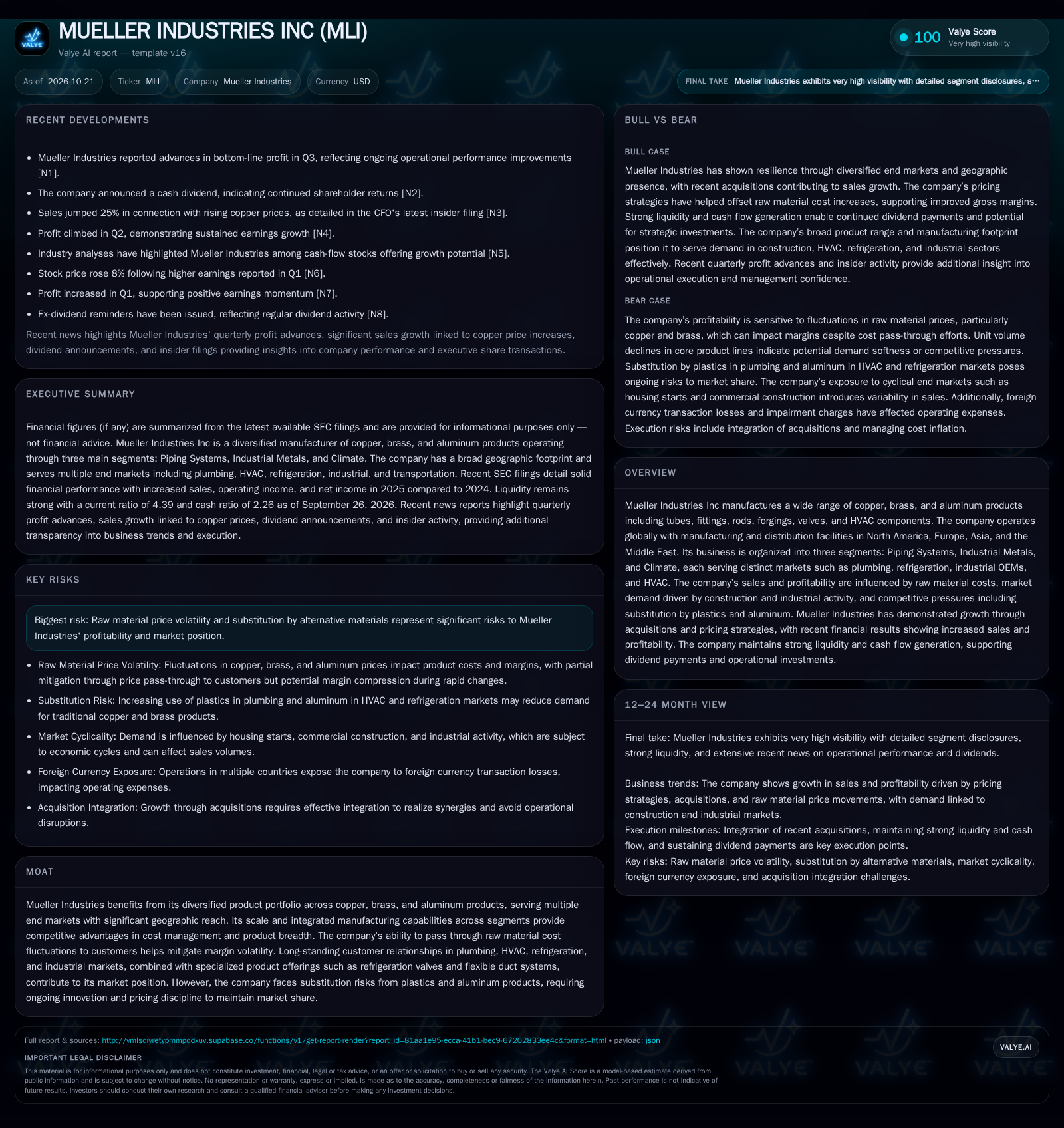
Mueller Industries posted double-digit sales and profit growth in 2025, aided by higher copper prices, acquisitions, and improved gross margins. The next phase depends on integrating recent acquisitions, defending market share against substitutes, and maintaining margin discipline as end-market demand fluctuates. [S2] [N3]
Mueller Industries’ 2025 and year-to-date 2026 results highlight the company’s ability to drive earnings growth and margin expansion even as raw material prices and end-market demand fluctuate. With a diversified product portfolio across copper, brass, and aluminum, and a global manufacturing footprint, Mueller has leveraged acquisitions and pricing strategies to offset headwinds in core volumes. The question is whether Mueller can sustain above-market profitability as competitive and structural forces reshape its addressable markets. [S2] [N3]
Recent Performance: Margin Expansion, Acquisitions, and Commodity-Driven Growth
Mueller Industries delivered a 10.9% increase in net sales for 2025, reaching $4.18 billion, while operating income and net income rose by 24.4% and 26.5% respectively over the prior year [S2]. This outperformance was achieved despite lower unit volumes in core product lines, as higher selling prices, acquisitions of Nehring and Elkhart, and growth in non-core product categories drove topline gains. Notably, gross margins expanded across all segments, with the Piping Systems segment posting a standout 31.9% gross margin [S2].
The company’s ability to pass through raw material cost increases, especially during a period of rising copper prices, allowed it to capture additional revenue and protect margins [N3]. Recent news also highlights regular dividend announcements and insider share transactions, reinforcing management’s focus on shareholder returns [N2] [N3]. As of September 2026, liquidity remains substantial, with $1.45 billion in cash and a current ratio of 4.39 [S2].
How Mueller Turns Materials Volatility into Profits—And Where Leverage Cuts Both Ways
Mueller’s core economics are shaped by its ability to source, process, and distribute copper, brass, and aluminum products at scale, serving diverse end markets from plumbing and HVAC to industrial OEMs. The company’s top line is highly sensitive to underlying commodity costs—particularly copper—which directly affects product pricing and revenue variability. The company typically passes through raw material cost changes to customers, though margin realization depends on timing and inventory accounting methods: rapid commodity price swings can either compress or temporarily boost margins, depending on how quickly costs are reflected in pricing.
Fixed costs are significant in manufacturing, supporting strong operating leverage in periods of rising demand or pricing. Gross margin improvements in 2025 suggest effective cost containment and favorable pricing dynamics, but also highlight the risk that margin gains can reverse if commodity prices fall or if substitution erodes volume. The company reported cash and liquidity metrics for the period; these figures do not by themselves establish operating runway, investment capacity, financial flexibility, or financing capacity.
A critical aspect of Mueller's economics lies in its inventory management strategy amid commodity price volatility. The timing of raw material purchases and inventory turnover rates can materially influence margin outcomes, especially when copper prices fluctuate rapidly. If Mueller employs a just-in-time inventory approach, it may reduce exposure to inventory write-downs but face supply chain risks that could disrupt production. Conversely, maintaining larger raw material inventories during price troughs could provide cost advantages but increase carrying costs and risk obsolescence if demand shifts. Understanding the company's hedging policies or derivative usage, if disclosed, would further clarify how it mitigates commodity price risks and stabilizes earnings.
Defending Share: Scale, Breadth, and the Substitution Threat
Mueller’s competitive position is anchored in its broad product offering, integrated manufacturing footprint, and long-standing customer relationships in plumbing, HVAC, and industrial markets. The company’s scale enables cost efficiencies and bargaining power in procurement, while its product breadth allows it to serve a wide range of customer needs and adapt to shifting demand across regions and applications.
However, the structural threat of substitution—plastics in plumbing and aluminum in HVAC/refrigeration—remains acute. While Mueller’s metal-based solutions are valued for durability and performance in many applications, price-sensitive customers and regulatory shifts toward lighter, lower-cost, or more environmentally friendly materials could erode demand. Competitors in the plumbing and HVAC supply chain, especially those focused on plastic or composite alternatives, are positioned to capture incremental share if these trends accelerate. Mueller’s ability to innovate, maintain cost discipline, and differentiate on service or quality will determine whether it can offset these headwinds.
Mueller's ability to innovate in product design and manufacturing processes may serve as a vital buffer against substitution trends. By developing proprietary alloys or enhanced fabrication techniques that improve durability, corrosion resistance, or ease of installation, Mueller can differentiate its metal products from plastics and aluminum alternatives. Additionally, leveraging digital tools for supply chain optimization or customer engagement could enhance service quality and responsiveness, reinforcing customer loyalty. However, these initiatives require sustained R&D investment and organizational agility; failure to adapt quickly could accelerate share erosion. Monitoring R&D intensity relative to competitors and the pipeline of patent filings would help assess Mueller’s innovation trajectory.
Catalysts for Outperformance: Integration, Pricing Power, and Construction Tailwinds
The most favorable scenario for Mueller hinges on the successful integration of recent acquisitions, continued gross margin discipline, and robust demand from construction and industrial end markets. If housing starts and commercial construction accelerate—driven by supportive monetary policy or infrastructure spending—Mueller could see both volume and pricing momentum. Effective management of raw material pass-throughs, coupled with operational efficiencies and new product development, would allow the company to sustain or expand current margin levels.
Evidence for this scenario would include continued gross margin gains, rising unit volumes in core product lines (not just price-driven revenue), and prompt, accretive integration of Nehring and Elkhart. Market share stability or growth in the face of substitution pressure, expanding dividend payments, and increased investment in innovation or capacity would further confirm this trajectory.
Operational leverage could amplify Mueller’s earnings in a constructive demand environment, but this depends on maintaining capacity utilization above certain thresholds. If end-market demand growth enables higher throughput without proportional increases in fixed costs, incremental volumes translate into outsized profit gains. Moreover, successful integration of acquisitions could unlock cross-selling opportunities and cost synergies, further enhancing margins. However, these benefits are conditional on effective cultural alignment, systems integration, and retention of key personnel. Delays or challenges in these areas could dilute expected gains. Thus, qualitative indicators such as management turnover, employee satisfaction, and integration milestones would provide early signals of execution risk or success.
Steady-State: Navigating Commodity Cycles and Incremental Share Loss
The most plausible path for Mueller is one of continued solid financial performance, but with growth moderating as commodity prices stabilize and substitution slowly erodes volumes in certain segments. Margins remain above historical averages due to ongoing pricing discipline and operational improvements, but unit sales in core copper and brass products face incremental pressure from plastics and aluminum alternatives. Acquisitions provide a buffer to topline growth, but do not fully offset end-market headwinds.
This scenario would be confirmed by stable to slightly improving gross margins, modest revenue growth driven more by pricing than volume, and periodic announcements of new product introductions or small bolt-on acquisitions. However, persistent declines in unit volume or market share in core segments, without corresponding gains in new or non-core lines, would suggest the company is struggling to fully offset structural demand shifts.
In a scenario of moderate growth and substitution pressure, Mueller’s pricing power may become increasingly tested. Customers facing cost pressures or regulatory incentives might demand more aggressive price concessions or shift to lower-cost alternatives, compressing margins. Mueller’s response could involve targeted cost reduction programs, product portfolio rationalization, or selective geographic focus to maintain profitability. However, such measures may only partially offset volume declines. Additionally, the company’s capital allocation decisions—balancing dividends, share repurchases, and reinvestment—will influence its ability to fund innovation and defend market share over the medium term. Tracking free cash flow generation and reinvestment rates would be useful metrics to evaluate strategic flexibility in this environment.
Margin Compression and Volume Erosion from Substitution and Demand Shocks
A negative trajectory could emerge if copper and brass prices decline sharply, eliminating the price-driven revenue tailwind while exposing Mueller to margin compression from unfavorable inventory accounting. At the same time, if construction activity weakens—due to macroeconomic contraction or a housing slowdown—core volume losses could accelerate. The risk is compounded if substitution by plastics or aluminum gains momentum, leading to permanent share loss in plumbing and HVAC applications.
Evidence confirming this scenario would include a marked decline in unit volumes not offset by pricing, shrinking gross margins, and downward revisions to revenue or earnings guidance.
Milestones That Will Clarify Mueller’s Margin Durability and Market Position
Quarterly gross margin trends in the Piping Systems and Industrial Metals segments, particularly in periods of raw material price volatility.
Disclosed unit volume changes in core copper, brass, and aluminum product lines—if available—to separate pricing from true demand.
Integration milestones and synergies realized from the Nehring and Elkhart acquisitions, including any management commentary on cost savings or cross-selling.
Market share developments in plumbing and HVAC, especially relative to plastic and aluminum substitutes—disclosed or inferred from industry reports.
Trends in housing starts, commercial construction, and industrial production indices, as these are leading indicators for end-market demand.
Any new product launches or R&D investments targeting substitution-resistant applications or innovative materials.
Foreign currency impacts and working capital swings, particularly in light of the company’s global operations and exposure to non-USD revenues and costs.
Disclaimer: This is research-only, informational analysis and not investment advice. It may include AI-generated interpretation and general industry context. Always verify important details using primary sources.

Comments