
OMS Energy Technologies: Customer Dependence, Certification Leverage, and the Economics of Oilfield Equipment in Emerging Markets
OMS Energy Technologies’ robust manufacturing presence and certified product portfolio have driven strong financial results and regional expansion, but heavy reliance on Saudi ARAMCO and sector cyclicality pose strategic risks. The path forward depends on diversifying end markets, sustaining certification-driven credibility, and managing operational complexity across Asia Pacific and MENA oil and gas value chains.
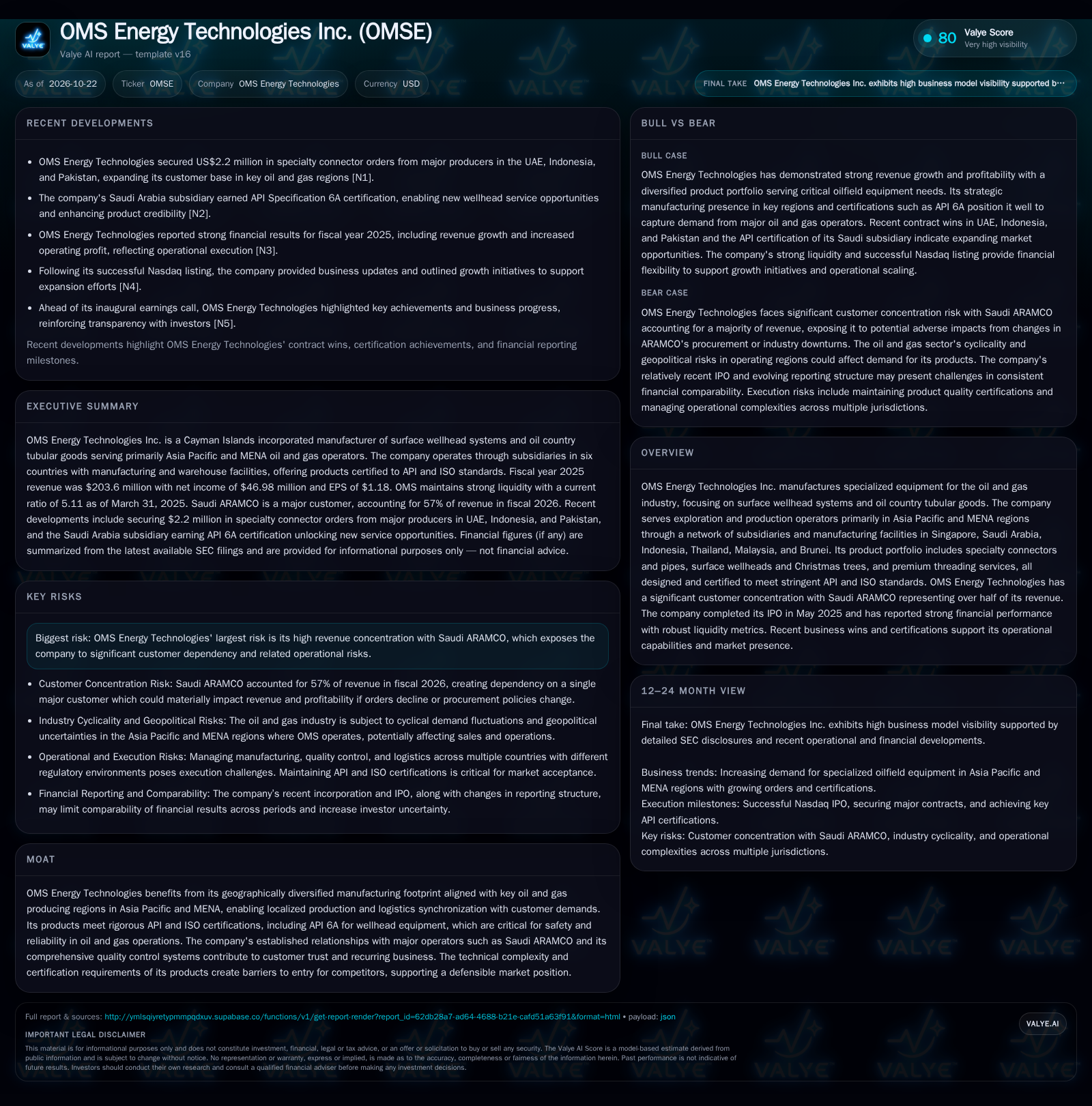
OMS Energy Technologies has demonstrated strong revenue and profitability growth, underpinned by API-certified oilfield equipment and a broad regional footprint. With 57% of revenue tied to Saudi ARAMCO, customer concentration is a key vulnerability. Recent contract wins and a successful IPO provide momentum, but the company’s future hinges on expanding its customer base, maintaining certification standards, and navigating the cyclicality and geopolitical volatility of its core markets. [S1] [N1] [N2] [N3]
OMS Energy Technologies Inc. has established itself as a regional specialist in surface wellhead systems and oil country tubular goods, serving oil and gas operators in Asia Pacific and the Middle East/North Africa. Certified to stringent API and ISO standards, OMS leverages manufacturing hubs across six countries to supply both national oil companies and independent producers. While the company’s recent financial performance and new business wins suggest momentum, its heavy dependence on Saudi ARAMCO and exposure to industry cyclicality frame the critical questions for its next phase of growth.
Recent Momentum: Financial Growth, Certifications, and Customer Concentration
OMS Energy Technologies reported revenue of $203.6 million and net income of $46.98 million for fiscal year ended March 31, 2025, alongside reported liquidity position—a current ratio of 5.11 and $72.95 million in cash. [S1] These results reflect both operational execution and the high value of its oilfield equipment portfolio.
However, Saudi ARAMCO accounted for 57% of total revenue in fiscal 2026, highlighting significant customer concentration risk. [S1] This dynamic exposes OMS to potential volatility if procurement strategies shift or if ARAMCO’s project cadence slows.
Recent $2.2 million in specialty connector orders from producers in the UAE, Indonesia, and Pakistan suggest early progress in customer diversification. [N1] Additionally, the Saudi Arabia subsidiary’s API 6A certification enhances OMS’s credibility and market access for premium wellhead services. [N2]
How OMS Makes Money: Specialized Equipment, Certification Premiums, and Regional Manufacturing
OMS Energy Technologies generates the majority of its revenue from three product segments: Specialty Connectors and Pipes, Surface Wellheads and Christmas Trees, and Premium Threading Services. These account for roughly 90% of both revenue and gross profit, suggesting a business model focused on high-value, technically demanding equipment. [S1]
The economics of oilfield equipment manufacturing are shaped by a mix of volume-driven contracts (especially with large NOCs like Saudi ARAMCO) and premium pricing for certified, customized products. API and ISO certifications—such as API 6A—are not just regulatory requirements but commercial differentiators, enabling OMS to command higher prices and access contracts with stringent technical standards.
Fixed costs are likely significant, given multi-country manufacturing and warehousing, but high gross margins on certified products provide operating leverage when volume increases. Variable costs are tied to materials (steel, alloys) and labor, both of which are subject to commodity and local wage fluctuations.
Capital needs are moderate relative to upstream E&P companies, but OMS’s working capital requirements can spike with large orders or shifts in procurement cycles. Sustaining API/ISO certifications is both a recurring cost and a barrier to entry, reinforcing the importance of scale and process discipline.
Defensible Positioning or Vulnerable Niche? Barriers, Substitutes, and the Role of Certification
OMS’s competitive position rests on its ability to manufacture API/ISO-certified wellheads and tubular goods locally in Asia Pacific and MENA, serving customers who value rapid delivery and regional support. This footprint allows OMS to synchronize logistics with customer project timelines, reducing downtime and transport costs.
The main competitive threats come from global oilfield service majors, regional manufacturers with similar certifications, and the potential for new entrants if certification or technical standards are commoditized. OMS’s established relationships, particularly with Saudi ARAMCO, provide customer stickiness but also create strategic vulnerability.
Substitutes are limited in the short term, as operators require certified equipment to meet safety and regulatory mandates. However, as drilling technology evolves (e.g., digitalization, automation), OMS could face pressure to expand its product suite or integrate digital services to maintain relevance.
The high technical and certification barriers protect OMS from low-cost entrants, but these same requirements mean OMS must continually invest to stay ahead of evolving standards—a dynamic that can compress margins if cost recovery lags certification expense.
Unlocking Growth: Diversification, Certification Leverage, and Regional Expansion
A favorable scenario sees OMS successfully leveraging its API 6A certification and recent business wins to expand its customer base beyond Saudi ARAMCO. If the company continues to secure contracts with other national oil companies and independents in UAE, Indonesia, and Pakistan, customer concentration risk would diminish, supporting more stable revenue streams.
Additional upside could come from OMS’s ability to upsell premium services or customized equipment to these new clients, taking advantage of its regional manufacturing presence and technical credibility. Sustained high gross margins and operating leverage would follow if OMS can maintain pricing power while scaling volumes.
Evidence supporting this scenario would include a declining percentage of revenue from Saudi ARAMCO, new contract announcements with other large operators, and margin maintenance despite higher sales diversity. Further API/ISO certifications or successful entry into adjacent product categories would also confirm OMS’s ability to capture incremental share.
Sustaining the Core: Managing Concentration While Executing on Incremental Growth
The most plausible trajectory is that OMS remains heavily reliant on Saudi ARAMCO for the majority of its revenue, while making gradual inroads with other regional operators. The company continues to win smaller contracts in Asia Pacific and MENA, but these do not fully offset the concentration risk in the near term.
Margins and profitability remain solid, supported by continued demand for certified equipment and OMS’s ability to manage production costs. The company invests in maintaining certifications and operational efficiency, using its liquidity to buffer against order timing volatility.
Confirmation of this scenario would be a stable or slightly decreasing ARAMCO revenue share, steady gross margins, and a consistent cadence of smaller contract wins. Falsification would come from either a sharp drop in ARAMCO orders without compensating growth elsewhere or from margin compression driven by competitive pricing or certification cost inflation.
Shock to the System: ARAMCO Volatility, Certification Lapses, or Regional Disruptions
A negative scenario would be triggered if Saudi ARAMCO materially reduces orders due to internal policy shifts, project delays, or broader oil market downturns. Given that ARAMCO accounts for 57% of revenue, any significant decline would have an outsized impact on OMS’s top and bottom lines.
Additional downside risks include failure to maintain critical API/ISO certifications, which could lead to lost contracts and reputational damage, or geopolitical disruptions in key operating regions that impede manufacturing and delivery. Intensifying price competition from regional peers or global majors could further erode margins, especially if OMS is forced to discount to maintain volumes.
Confirmation of this scenario would be a sharp revenue and profit decline, rising inventories, or disclosure of lost certifications or major contract terminations. Early warning signs could include order deferrals from ARAMCO or publicized certification or compliance failures.
Milestones That Will Test OMS Energy Technologies’ Strategic Thesis
The proportion of revenue attributable to Saudi ARAMCO in future periods—a declining share would demonstrate successful diversification.
The pace and size of new contract wins in UAE, Indonesia, Pakistan, and other Asia Pacific/MENA countries—if disclosed, this would signal traction beyond the core customer.
Gross margin trends—stability or improvement would confirm pricing power and cost control amid regional expansion.
Status and renewal of key API/ISO certifications—any lapse or delay would threaten revenue streams and customer trust.
Operating cash flow generation relative to working capital swings—a useful metric to test OMS’s ability to self-fund growth and weather procurement volatility.
Disclosure of new product introductions or adjacencies, such as digital wellhead monitoring or integration services, which could signal adaptation to evolving customer needs.
Evidence of manufacturing or logistics disruptions in any of OMS’s six operating countries, especially those tied to geopolitical or regulatory changes.
Management guidance or commentary on competitive dynamics and pricing environment in core and adjacent markets.
Disclaimer: This is research-only, informational analysis and not investment advice. It may include AI-generated interpretation and general industry context. Always verify important details using primary sources.

Comments