
Waste Connections: Vertical Integration, Industry Consolidation, and the Challenge of Capital Intensity
Waste Connections leverages vertical integration and a focus on secondary markets to drive margin expansion and steady growth, but faces persistent capital and regulatory headwinds that test its balance between shareholder returns, operational resiliency, and strategic flexibility.
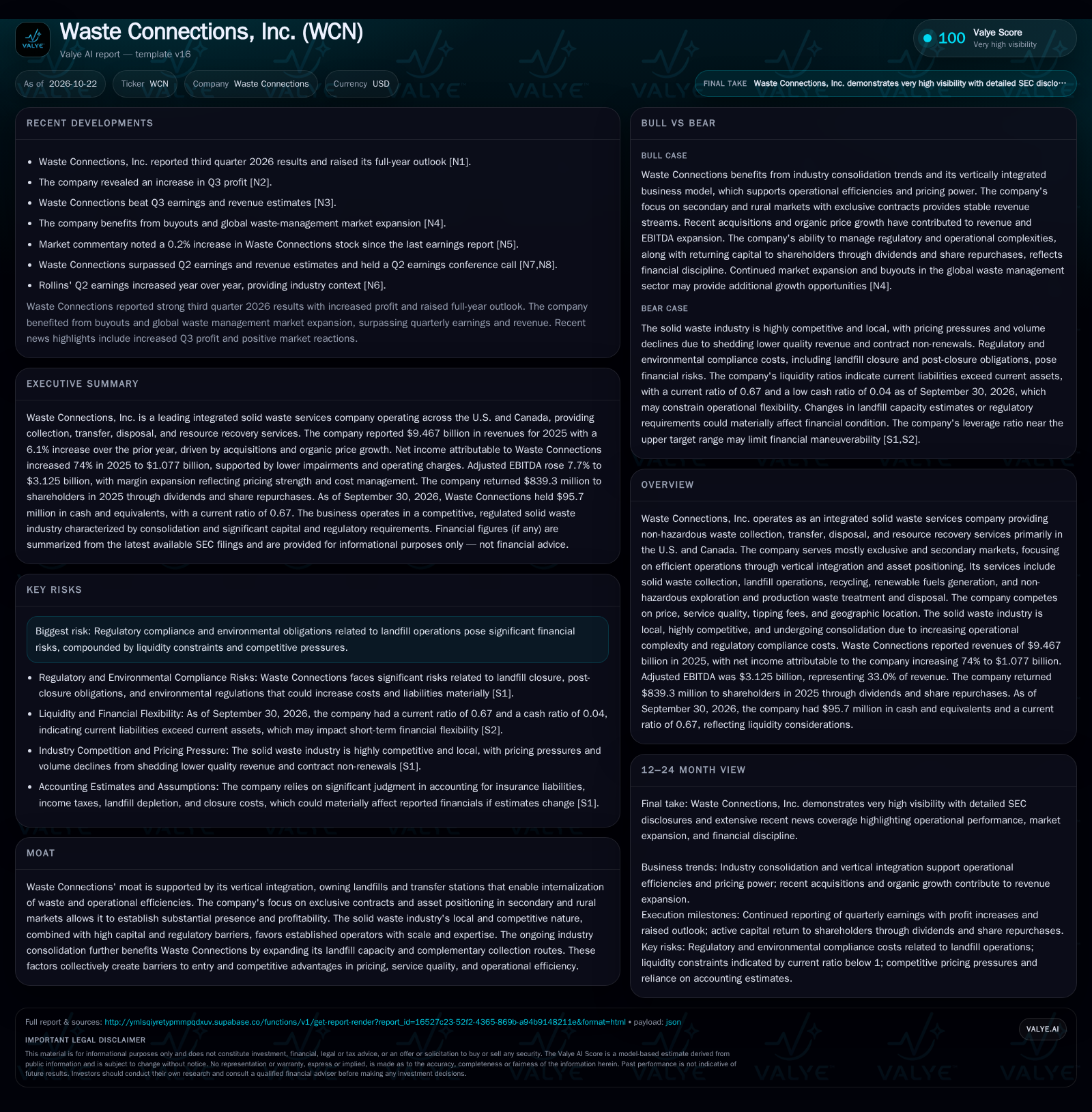
Waste Connections continues to grow through a mix of acquisitions and price-led organic expansion, with 2025 revenue up 6.1% and adjusted EBITDA margins rising to 33%. Vertical integration and exclusive contracts in rural and secondary markets underpin operational efficiency, but capital intensity, regulatory obligations, and a current ratio below 1 highlight ongoing liquidity and compliance pressures. The company's strategy depends on balancing consolidation-driven growth with the need to manage environmental liabilities and maintain potential financial flexibility. [S1] [S2]
Waste Connections, Inc. stands out in the North American waste management sector for its disciplined focus on secondary markets, vertical integration, and active participation in industry consolidation. Recent results show a business benefiting from pricing power and operational leverage, with improved profitability even as waste volumes decline. Yet, the company’s capital structure and regulatory obligations reveal the underlying complexity and risk inherent in this scale-driven industry. The next phase for Waste Connections will test its ability to sustain growth and shareholder returns while navigating the capital and compliance demands that define modern waste services.
Recent Performance and Financial Position: Growth, Margins, and Liquidity Constraints
Waste Connections reported 2025 revenue of $9.467 billion, a 6.1% increase over 2024, with $377.2 million attributed to acquisitions and the remainder to organic price increases despite volume declines. Adjusted EBITDA grew 7.7% to $3.125 billion, with margin expansion reflecting successful price-led growth and cost control. Net income attributable to the company surged 74% to $1.077 billion, largely due to lower impairments and operating charges. The company returned $839.3 million to shareholders in 2025 through dividends and repurchases, including an 11.1% dividend increase in October 2025. The company reported cash and liquidity metrics for the period; these figures do not by themselves establish operating runway, investment capacity, financial flexibility, or financing capacity. [S1] [S2]
How Vertical Integration and Asset Positioning Drive Profitability
Waste Connections’ economic model centers on capturing value across the waste management chain—collection, transfer, disposal, and recycling—primarily in secondary and rural markets. By owning landfills and transfer stations, the company internalizes a significant portion of waste volumes, reducing dependence on external tipping fees and enabling margin capture at multiple points. Exclusive contracts and asset positioning in less-contested markets allow for above-average pricing power and stable customer relationships, often with municipalities or industrial clients.
Revenue growth is increasingly price-driven as the company sheds lower-quality or less profitable volume. This has allowed Waste Connections to expand adjusted EBITDA margins to 33% even as total volumes decline—a sign that the business is prioritizing profitability over pure scale. Operating leverage is further supported by lower incremental cost per additional ton processed, especially when fixed assets like landfills are well-utilized.
However, the model is capital-intensive: landfill development, fleet maintenance, and compliance with closure/post-closure regulations require substantial ongoing investment. Debt is managed to a targeted leverage ratio (2.5x to 3.0x EBITDA), but sustained growth and capital returns depend on maintaining access to external financing and disciplined capital allocation. [S1] [S2]
Defensible Markets, Competitive Pressures, and the Dynamics of Industry Consolidation
Waste Connections’ competitive edge stems from its focus on secondary and rural markets, where exclusive contracts and local regulatory environments create natural barriers to entry. Vertical integration—owning the collection routes and the disposal endpoints—reduces third-party leakage and supports pricing discipline. The company’s strategy of acquiring smaller operators or tuck-in assets further entrenches its presence and benefits from industry consolidation, a trend driven by increasing regulatory complexity and the capital intensity of landfill ownership.
Despite these advantages, the broader waste management sector remains highly competitive and locally fragmented. Larger national peers and regionally entrenched operators compete aggressively on price and service quality for collection accounts. In landfill operations, the primary levers are location, tipping fees, and regulatory compliance. New entrants face formidable capital and permitting barriers, but established players must continually invest to maintain asset quality and navigate evolving environmental standards.
Substitution risk is low for core waste services, though recycling economics and regulatory mandates can shift waste streams away from landfill and affect overall mix. The threat of technological disruption is present but incremental—automation, route optimization, and waste-to-fuel conversion can improve efficiency, but do not fundamentally displace the need for physical collection and disposal infrastructure.
If Industry Consolidation Accelerates and Regulatory Costs Are Contained
The most favorable scenario for Waste Connections involves continued industry consolidation, allowing it to acquire or outcompete smaller operators and further entrench its position in targeted markets. If the company can continue to pass through price increases—supported by exclusive contracts and limited local competition—while maintaining or improving operational efficiency, margin expansion could persist even if volume remains flat or declines modestly.
A supportive regulatory environment, or at least predictable compliance costs, would help contain capital outlays for landfill closure and post-closure obligations. In this scenario, the company could leverage its stable cash flows to both invest in additional M&A and increase shareholder returns, with the potential for further dividend growth or accelerated buybacks.
Evidence that would confirm this scenario includes a sustained pace of accretive acquisitions, further improvement in adjusted EBITDA margins, and stable or declining per-ton regulatory compliance costs. Conversely, a slowdown in deal flow, margin compression, or unexpected spikes in closure liabilities would challenge the upside case.
Balancing Pricing Power with Capital and Compliance Demands
The most plausible mid-term outlook sees Waste Connections maintaining steady revenue growth through a mix of moderate price increases and selective acquisitions, offsetting modest volume declines as the company continues to focus on higher-quality business. Adjusted EBITDA margins remain stable or improve slightly as operational efficiencies and asset utilization gains are largely balanced by ongoing cost inflation and necessary environmental investments.
Regulatory costs tied to landfill closure and post-closure obligations continue to be a material but manageable drag on free cash flow. Liquidity remains tight but not destabilizing, provided the company avoids major regulatory shocks or acquisition missteps.
When Regulatory Shocks and Funding Strain Erode Margin and Momentum
The primary risk to Waste Connections’ thesis is a combination of adverse regulatory developments—such as stricter landfill closure requirements, increased environmental compliance costs, or unfavorable changes in local permitting—that materially increase cash outflows or erode asset values. In such a scenario, the company could face higher charges for landfill closure and post-closure liabilities, as has happened in recent years when capacity estimates changed.
Simultaneously, if capital markets tighten or the company’s leverage approaches/exceeds its stated ceiling, liquidity constraints could force a slowdown in acquisitions, capex, or even shareholder returns.
Downside evidence includes a spike in regulatory accruals or cash outflows, covenant pressure, missed or reduced dividends/buybacks, or a cutback in M&A activity. An inability to pass through price increases—due to competition or contract renegotiations—would further pressure margins and growth.
Milestones That Will Shape Waste Connections’ Strategic and Financial Trajectory
Quarterly adjusted EBITDA margin trends, especially relative to cost inflation and regulatory accruals, will gauge the persistence of operational efficiency.
The pace and terms of new acquisitions, including purchase multiples and integration outcomes, will reveal whether industry consolidation remains accretive.
Changes in landfill closure and post-closure liability estimates or related cash outflows—if disclosed—will materially affect free cash flow and risk.
Any significant changes in municipal or long-term contract renewals, pricing structures, or customer retention rates—if disclosed—could signal shifts in competitive positioning.
Regulatory developments at the federal, state, or provincial level that affect landfill operations, permitting, or environmental standards could change the company’s cost structure.
Disclaimer: This is research-only, informational analysis and not investment advice. It may include AI-generated interpretation and general industry context. Always verify important details using primary sources.

Comments