
American Airlines: Navigating Liquidity Pressure, Supply Chain Risks, and the Sustainability Transition
While its vast network and operational scale confer real advantages, the company’s ability to adapt hinges on managing cost pressures, securing sustainable fuel, and overcoming pilot shortages amid industry-wide volatility.
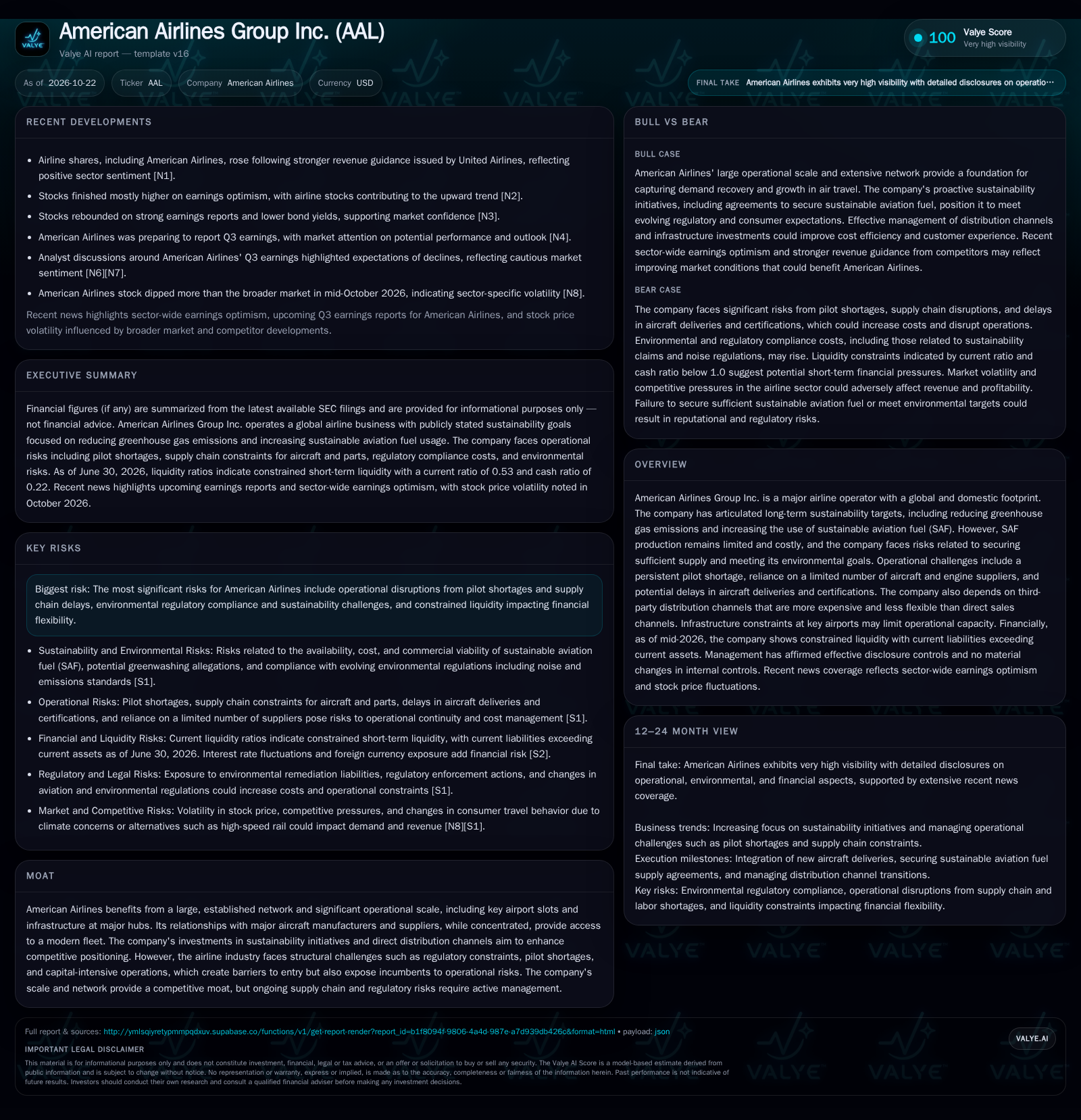
The carrier faces persistent pilot shortages, supply chain fragility (notably with major aircraft and engine suppliers), and rising operational costs linked to regulatory and environmental pressures. Its scale and hub access remain competitive strengths, but the sustainability transition and cost structure challenges demand vigilant execution. Stock price volatility reflects these uncertainties. [S2] [S1] [N8]
Despite the enduring strength of its network and scale, the airline’s near-term outlook is clouded by pilot shortages, supply chain bottlenecks, and the high cost of environmental compliance. As regulatory and consumer expectations evolve, American’s execution on cost management, fleet renewal, and fuel sourcing will shape its path forward.
Liquidity Pinch and Operational Headwinds Define Late 2026
As of June 30, 2026, American Airlines reported cash and equivalents of $1.178 billion, current assets of $14.276 billion, and current liabilities of $26.756 billion, resulting in a current ratio of 0.53 and a cash ratio of 0.22. The company reported cash and liquidity metrics for the period; these figures do not by themselves establish operating runway, investment capacity, financial flexibility, or financing capacity. [S2]
The company continues to face acute pilot shortages and relies heavily on a concentrated set of aircraft and engine suppliers, including Airbus, Boeing, Bombardier, and Embraer. Delays or disruptions from these partners could force American to extend the use of older, less efficient aircraft, impacting both cost and sustainability targets. [S1]
Sustainability is a rising operational and reputational challenge: American has committed to increasing its use of sustainable aviation fuel (SAF), but the cost and availability of SAF remain significant obstacles. Regulatory scrutiny and the risk of greenwashing allegations further complicate the landscape. [S1]
Recent news flow highlights stock price volatility and analyst expectations of earnings declines, reflecting sector-specific pressures and investor caution. [N6] [N7] [N8]
Cost Structure, Revenue Levers, and the Challenge of Fixed Obligations
American Airlines’ economics are defined by high fixed costs—aircraft ownership/leases, labor, and airport infrastructure—creating substantial operating leverage. When demand is robust, incremental revenue can drop efficiently to the bottom line, but downturns or cost shocks (fuel, labor, regulatory) can rapidly erode margins.
Pricing power is structurally limited by intense competition and the commoditized nature of most routes, aside from those protected by slot constraints or unique network advantages. Revenue is derived primarily from passenger travel, loyalty programs, and ancillary services. The loyalty segment, which includes both travel and marketing services, offers higher-margin recurring revenue but is ultimately tethered to the strength of the underlying travel business.
Variable costs—jet fuel, ground operations, maintenance—are subject to market volatility and regulatory shifts. The push toward SAF introduces a new layer of cost pressure, as SAF remains more expensive than conventional jet fuel and supply is not yet scalable. [S1]
Capital needs are persistent: fleet renewal, regulatory compliance, and technology upgrades all require ongoing investment. With current liquidity stretched, American may need to prioritize capital deployment, potentially deferring some initiatives or seeking external funding at less favorable terms.
Scale, Network, and Slot Access: Strengths Amid Industry Rivalry
American’s core advantages stem from its vast route network, access to high-traffic hubs, and entrenched slot positions at constrained airports. These confer both revenue scale and some pricing insulation on key routes, especially where regulatory or infrastructure limits restrict new entrants.
However, the airline industry remains intensely competitive, with rivals able to match fares and schedules on most domestic and international routes. Ultra-low-cost carriers and, in some markets, high-speed rail, offer credible substitutes, especially on short-haul routes.
Supplier concentration represents a double-edged sword: while relationships with Airbus, Boeing, and other manufacturers facilitate access to new aircraft and technology, they also create vulnerability to production delays and regulatory actions affecting a small set of partners. [S1]
Distribution channel dynamics are shifting. While direct sales offer cost and data advantages, American remains reliant on global distribution systems and online travel agencies—channels that are more expensive and less flexible. The ability to shift more business direct, or negotiate more favorable terms with intermediaries, could improve margins but requires sustained investment in digital and loyalty platforms.
What a Successful Cost Reset and Sustainability Transition Could Unlock
The most favorable scenario for American Airlines involves a combination of stabilized liquidity, successful renegotiation of supplier agreements, and tangible progress on SAF sourcing. If the company can secure additional financing or unlock working capital through asset sales or improved terms with vendors, it could bridge the current liquidity gap.
A rebound in business and international travel, combined with effective cost containment (notably in labor and fuel), would drive operating leverage and restore margin expansion. Demonstrated progress in integrating SAF—either through favorable contracts or government incentives—would not only mitigate regulatory risk but also position American as a preferred carrier for environmentally conscious travelers and corporate clients.
Confirmation of this scenario would include: sequential improvement in current and cash ratios, sustained profitability at or above recent levels, and public milestones on SAF adoption and fleet renewal. Announcements of direct channel growth or renegotiated distribution agreements would further support the case.
Navigating Tight Liquidity and Incremental Progress on Sustainability
The most plausible path forward sees American Airlines managing through a period of continued liquidity tightness, with operational performance fluctuating alongside macroeconomic and industry conditions. The company is likely to prioritize essential capital expenditures—fleet maintenance, regulatory compliance—while deferring discretionary projects.
Incremental gains in SAF sourcing and environmental compliance are probable, but transformative progress is constrained by industry-wide supply limitations and cost hurdles. Pilot shortages and supplier delays persist as operational headaches, with periodic disruptions likely.
Earnings remain volatile, reflecting both the demand environment and the company’s exposure to input cost swings.
Liquidity Stress and Operational Disruptions Spiral into Strategic Risk
Extended delays in aircraft deliveries or a worsening pilot shortage could result in widespread flight cancellations, loss of market share, and reputational damage.
Regulatory penalties or litigation related to sustainability claims or environmental compliance could further erode potential financial flexibility. Inability to secure sufficient SAF or demonstrate progress on emissions reduction could lead to customer defections, especially among corporate clients with their own ESG mandates.
Regulatory actions or high-profile operational failures would further confirm the downside trajectory.
Milestones That Will Define American Airlines’ Resilience and Adaptation
Updates on aircraft delivery schedules and supplier negotiations: Timely fleet renewal is critical to both cost structure and sustainability goals. Delays or renegotiations would be highly material. [S1]
Pilot hiring, retention, and training statistics (if disclosed): These would clarify the company’s ability to stabilize operations and limit cancellations.
Volume and cost of sustainable aviation fuel procured: Tracking both absolute SAF usage and its share of total fuel would test progress toward environmental commitments. [S1]
Shifts in distribution channel mix (if disclosed): Greater direct sales penetration would support margin improvement and customer retention.
Major regulatory actions, fines, or sustainability-related litigation: These could drive unplanned costs or require strategic pivots.
Changes in slot allocation or airport infrastructure access: Gaining or losing key slots would impact network competitiveness.
Public updates on loyalty program economics and engagement: This would help assess the durability of high-margin ancillary revenue streams.
Disclaimer: This is research-only, informational analysis and not investment advice. It may include AI-generated interpretation and general industry context. Always verify important details using primary sources.

Comments