
Texas Capital Bancshares: Capital Management, Risk Sensitivities, and the Levers of Regional Banking Value
Texas Capital Bancshares has demonstrated disciplined capital deployment and robust risk management, but its exposure to credit and interest rate swings remains central to both its upside and downside scenarios. The company’s ability to balance shareholder returns with prudent provisioning and rate hedging will define its resilience and future value creation.
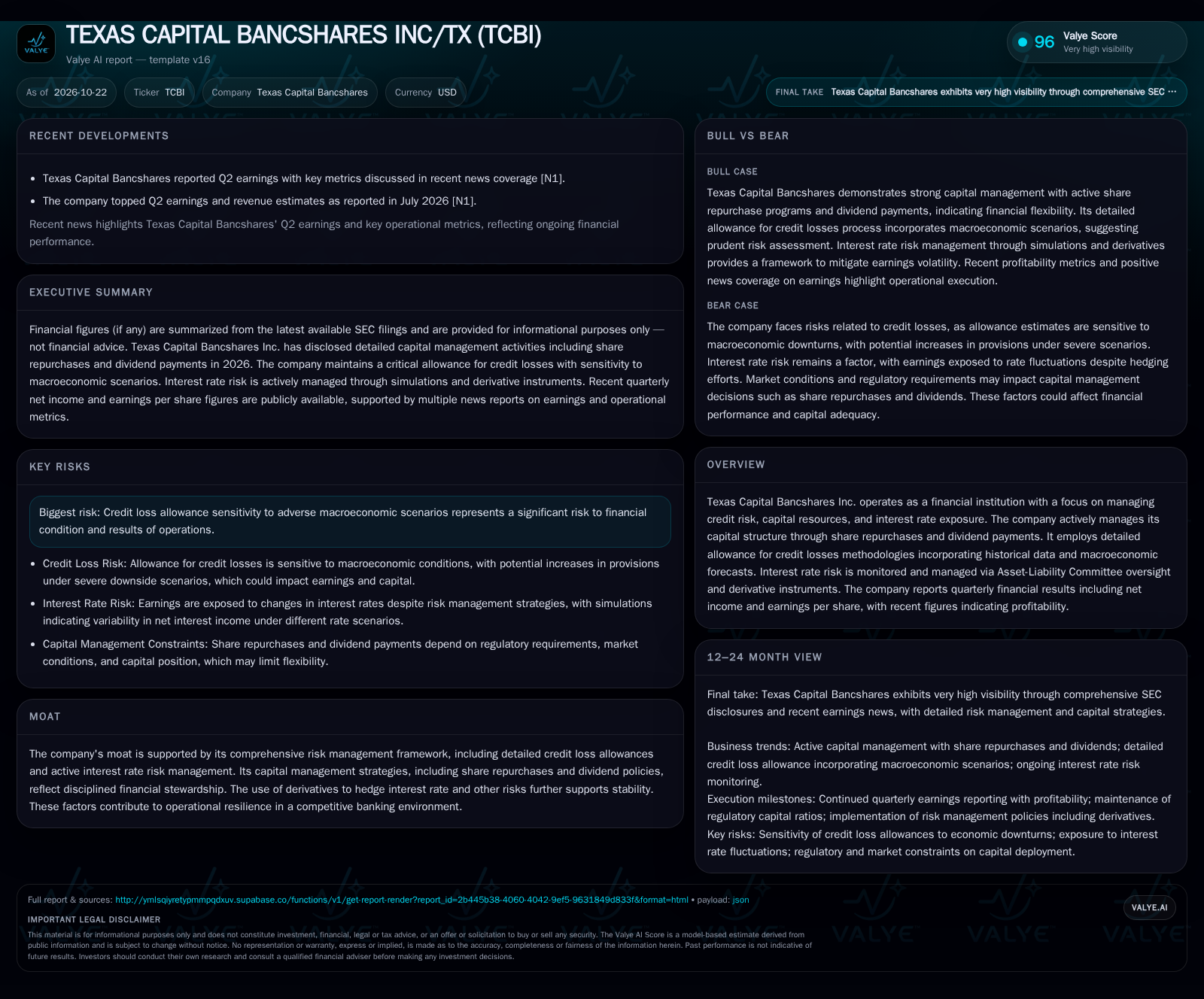
Texas Capital Bancshares has executed over $200 million in share repurchases and maintained regular dividends in 2026, underscoring its capital management priorities. However, its allowance for credit losses is highly sensitive to macroeconomic deterioration, and its asset-sensitive balance sheet leaves earnings exposed to interest rate volatility despite active hedging. The company’s future trajectory will hinge on its capacity to sustain profitability, manage credit quality, and adapt capital deployment to changing regulatory and market conditions. [S2]
Texas Capital Bancshares stands out among regional banks for its active capital management—over $200 million in share repurchases and steady dividends in 2026—and a rigorous approach to risk, particularly in credit provisioning and interest rate management. Yet, its financial profile remains tightly linked to the health of the macroeconomy and the direction of interest rates. As the company seeks to balance shareholder returns with risk containment, the critical questions are whether its provisioning and hedging frameworks are robust enough to weather potential economic shocks, and how flexibly it can deploy capital as market and regulatory landscapes evolve.
Recent Capital Actions and Risk Sensitivities Define 2026 Operating Posture
Texas Capital Bancshares' operational narrative for 2026 is anchored by three material facts. First, the company executed $201.7 million in share repurchases, buying back over 2 million shares at an average price of $97, which signals a commitment to shareholder returns and confidence in capital adequacy. Second, dividends remained a priority, with $17.3 million paid out year-to-date and an additional $0.20 per share declared for December 2026. Third, the allowance for credit losses—a critical buffer against loan defaults—would need to rise by approximately $94.6 million if the most severe macroeconomic scenario materialized, underscoring the bank's exposure to systemic downturns. These facts highlight a business balancing aggressive capital return with caution around credit risk in an uncertain environment. [S2]
How Texas Capital Earns: Net Interest Income, Credit Costs, and Operating Leverage
The core economics of Texas Capital Bancshares are shaped by the spread between interest income on loans and securities and the cost of funding those assets—primarily deposits and wholesale borrowings. As an asset-sensitive institution, its net interest income (NII) tends to benefit when rates rise, provided loan growth and credit quality are intact. However, higher rates can also pressure borrowers, raising credit risk and potentially increasing provisioning needs.
On the expense side, the company’s provisioning for credit losses—determined by historical loss experience and forward-looking macroeconomic adjustments—can swing sharply in stressed scenarios, as shown by the $94.6 million potential increase under severe conditions. This volatility can erode earnings and capital buffers quickly. Operating leverage is present, but limited: while some technology and compliance costs are fixed, branch-light regional banks often rely on relationship managers and localized underwriting, which keeps variable costs meaningful.
Capital management (repurchases and dividends) is a discretionary lever, but constrained by regulatory capital requirements and the need to reserve against future losses. The company’s ability to deploy capital flexibly—returning excess to shareholders in good times, but retaining it during stress—will be a central determinant of long-term value.
Risk Management as Differentiator, But Margin Pressures and Substitution Persist
Texas Capital’s competitive position rests on its risk management frameworks and its ability to deliver consistent shareholder returns. Its detailed credit loss modeling and active interest rate hedging may provide some insulation from shocks relative to less sophisticated peers. However, the regional banking sector is intensely competitive: national banks offer scale and technology, while fintechs and non-bank lenders encroach on select lending verticals.
Margin compression remains a structural threat, as deposit costs rise faster than loan yields in a competitive rate environment. The company reported cash and liquidity metrics for the period; these figures do not by themselves establish operating runway, investment capacity, financial flexibility, or financing capacity. Switching costs for commercial clients are moderate—relationship banking and local knowledge matter, but product commoditization and digital adoption make it easier to move funds or refinance loans. Ultimately, the company’s ability to maintain above-average returns on equity will depend on its credit discipline, funding mix, and adaptability to evolving customer preferences.
If Credit Quality Holds and Rates Stabilize, Shareholder Returns Could Accelerate
The most favorable scenario for Texas Capital arises if the macroeconomic environment remains benign: credit losses stay low, and interest rates stabilize at levels that support healthy loan yields without materially increasing funding costs. In this case, the company's asset-sensitive balance sheet would allow NII to expand, while low provisioning would enable more capital to flow toward buybacks and dividends.
Confirmation would come from a sustained low ratio of net charge-offs to average loans, stable or improving allowance coverage ratios, and continued regulatory capital headroom despite capital returns. Additional upside would be signaled by robust loan growth outpacing deposit cost increases, and news of market share gains in core Texas commercial banking verticals. Falsification would occur if unexpected spikes in non-performing assets or deposit outflows force the company to halt repurchases or cut dividends.
Profitability Sustained, But Credit and Rate Headwinds Keep Capital Deployment Prudent
The most plausible outcome is a continuation of moderate profitability, with Texas Capital maintaining its current risk management posture. Net interest income may fluctuate as rates move, but hedging and ALCO oversight help contain volatility. Credit provisioning remains in line with historical averages, with the allowance flexing in response to macroeconomic signals but not spiking sharply.
In this scenario, share repurchases and dividend payments proceed, but at a measured pace, as management monitors regulatory capital ratios and economic indicators. Evidence would include regular quarterly earnings with stable EPS, incremental but not dramatic changes in the allowance for credit losses, and a steady dividend payout. A shift toward more conservative capital deployment, or a pause in buybacks, would indicate rising caution or early stress.
A Severe Downturn Would Pressure Credit Quality and Force Retrenchment
In an adverse scenario, a macroeconomic shock—such as a recession or sharp rise in unemployment—triggers a spike in loan defaults. The company’s allowance for credit losses could rise by the modeled $94.6 million or more, slashing quarterly earnings and potentially eroding regulatory capital buffers. Asset sensitivity could become a liability if falling rates compress net interest margins faster than funding costs can be repriced.
Under these conditions, Texas Capital would likely halt or scale back share repurchases and dividends to preserve capital. Confirmation would be seen in a rising ratio of non-performing assets, sharply higher provisioning charges, and management commentary signaling defensive posture. Falsification would be indicated by continued strong profitability and stable capital ratios even as economic conditions worsen.
Benchmarks for Testing Texas Capital's Balance of Returns and Risk
Trends in the allowance for credit losses relative to loan book growth and macroeconomic forecasts—especially any outsized quarterly increases.
Quarterly net charge-off rates and non-performing asset levels, if disclosed, as an early warning for credit deterioration.
Sustainability of net interest margin (NIM) in the face of changing interest rates and deposit cost pressures.
Pace and scale of future share repurchases and dividend declarations, especially if capital deployment slows or pauses.
Regulatory capital ratios (CET1, Tier 1) and management commentary on capital adequacy in earnings releases.
Deposit growth or attrition, and funding mix shifts between core and wholesale sources, if disclosed.
Utilization and effectiveness of derivative hedges as described in risk management disclosures.
Management’s forward guidance or scenario analysis on credit quality under updated economic forecasts.
Disclaimer: This is research-only, informational analysis and not investment advice. It may include AI-generated interpretation and general industry context. Always verify important details using primary sources.

Comments