
Visteon: Navigating Cyclicality and Margin Pressures as Cockpit Electronics Advance
Visteon’s position as a major supplier of digital cockpit solutions to global automakers is challenged by recent production declines among key customers and margin compression. The company’s ability to leverage its technology portfolio and global footprint will be tested as industry trends drive both opportunity and volatility.
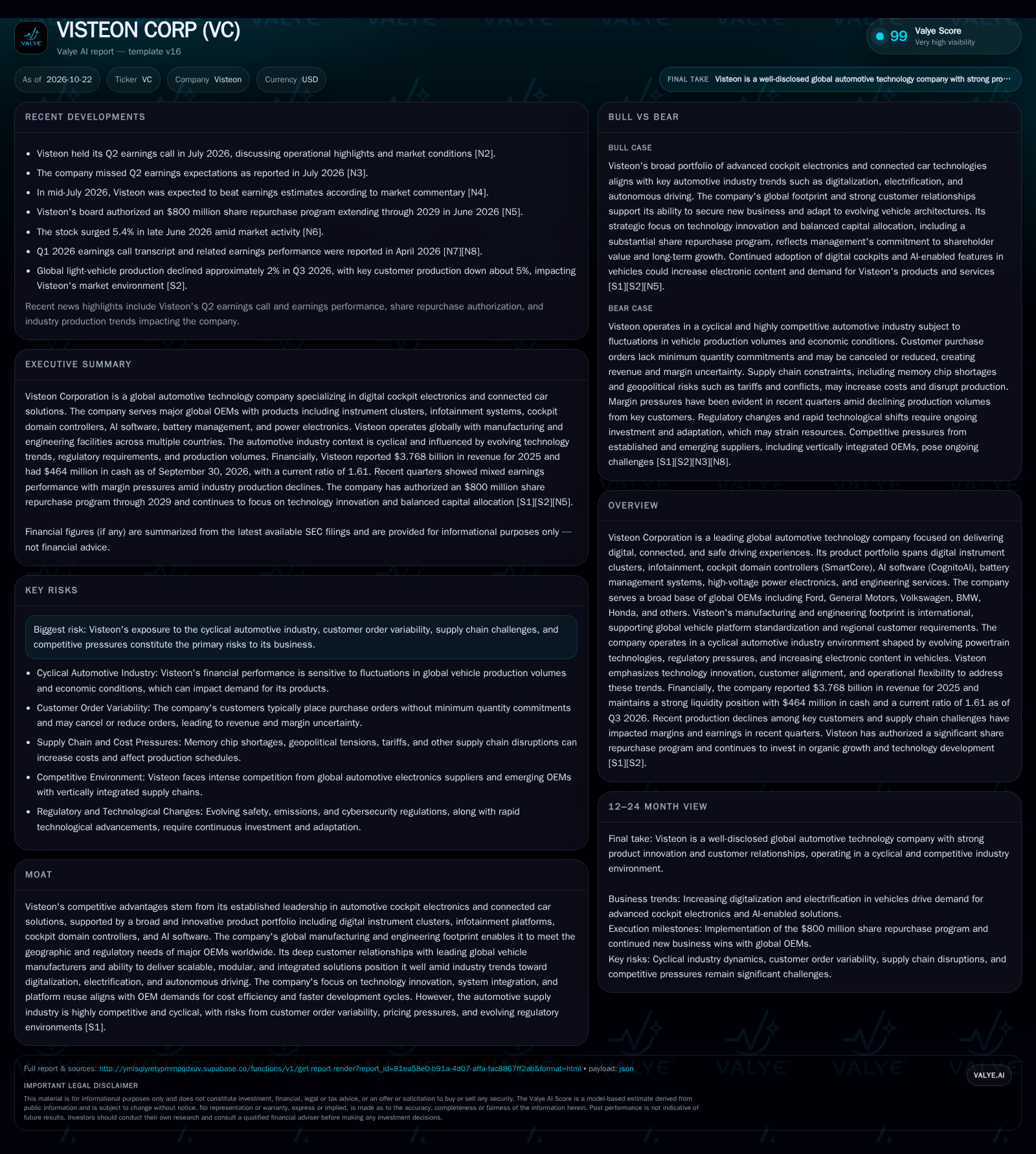
Visteon reported $3.768 billion in 2025 revenue and $970 million in Q3 2026 net sales, but faces margin compression and earnings misses as key customer production volumes decline. While its global reach and advanced product suite align with the shift to digital, connected vehicles, the company’s near-term outlook is clouded by cyclical pressures, supply chain disruptions, and competitive intensity. The critical question is whether innovation and operational leverage can offset these headwinds as the cockpit electronics market evolves. [S2] [N3] [N8]
Visteon, a global leader in automotive cockpit electronics, stands at the intersection of major industry trends: digitalization, electrification, and the rise of connected vehicles. While its portfolio and customer roster place it at the heart of OEM transformation, recent quarters have revealed the vulnerabilities of operating in a cyclical industry. Margin pressures, production declines among key customers, and persistent cost challenges have weighed on earnings. The strategic challenge is clear—Visteon must convert its technology leadership into durable financial performance amid volatile volumes and shifting competitive dynamics.
Recent Margin Compression and Production Declines: The Immediate Backdrop
Visteon’s Q3 2026 results highlight a challenging operating environment: net sales were $970 million, but gross margin compressed versus the prior year, and net income reached only $5 million for the quarter. The company’s key customers saw production volumes decline by about 5% as global light-vehicle output dropped 2% year-over-year, with particularly steep falls in China (6-17%) and the Americas (3-4%), partially offset by a 3% gain in Europe [S2]. These trends have directly pressured Visteon’s top line and profitability, compounding the impact of ongoing cost headwinds from memory chip market volatility and geopolitical disruptions. [S2] Recent earnings misses in Q1 and Q2 2026 underscore the operational headwinds [N3] [N8].
How Visteon’s Revenue Mix and Operating Model Shape Profitability
Visteon’s business is fundamentally volume-driven: it sells electronics modules and software solutions to global OEMs, with most business tied to awarded vehicle platforms. Pricing is typically negotiated per program, with little contractual revenue visibility due to the prevalence of purchase orders without minimum volume commitments [S1]. This means Visteon’s revenue is highly sensitive to customer production schedules and broad automotive cycles. Gross margins are exposed both to input cost volatility—particularly in semiconductors and specialized components—and to the company’s ability to absorb fixed engineering and plant overhead across fluctuating volumes.
As cockpit electronics content per vehicle rises, Visteon may benefit from higher average selling prices and greater software/services mix, which could support incremental margin expansion if adoption accelerates. However, the capital intensity of new product development and platform launches remains high, requiring sustained investment in R&D and engineering. The company’s share repurchase program and history of capital returns suggest a disciplined approach to capital allocation, but do not shield it from the fundamental need for scale and operating leverage to drive margin recovery in a downcycle [S2] [N5].
The sensitivity of Visteon’s revenue to automotive production cycles also underscores the importance of geographic and customer diversification in mitigating volume volatility. Given the uneven recovery trajectories and regulatory environments across regions, a well-balanced global footprint can provide some cushion against localized downturns. However, this diversification also introduces complexity in managing supply chains and adapting to region-specific technology requirements. Furthermore, the evolving regulatory landscape around vehicle safety, emissions, and cybersecurity may impose additional compliance costs or necessitate product redesigns, which could pressure margins if not efficiently managed.
Another critical factor shaping profitability is the shift toward software-defined vehicles, which changes the traditional supplier value chain. As automakers increasingly internalize software development or partner with tech firms, suppliers like Visteon must enhance their software capabilities and move toward recurring revenue models to sustain margins. This transition involves not only technical innovation but also changes in contract structures, risk-sharing arrangements, and ongoing customer support. Successfully navigating this shift could allow Visteon to capture a larger share of the vehicle’s lifetime value, but failure to adapt could result in margin erosion and reduced strategic relevance.
Assessing Competitive Dynamics in the Digital Cockpit Race
Visteon competes against a global set of automotive electronics suppliers—Aptiv, Denso, Harman, Bosch, LG, Panasonic, Valeo, and others—each seeking to capture a larger share of the digital cockpit and software-defined vehicle opportunity [S1]. The company’s core differentiators are its integrated product suite (instrument clusters, infotainment, domain controllers, CognitoAI software), deep relationships with major OEMs, and global engineering/manufacturing footprint. These enable platform wins with leading automakers and, potentially, the ability to scale innovations across multiple vehicle programs.
However, barriers to entry are not absolute. OEMs can dual- or multi-source, and the move toward standardized, modular vehicle architectures may increase the risk of commoditization. Vertically integrated OEMs and tech-entrant competitors could further erode supplier pricing power. While Visteon’s broad customer base and technology alignment are strategic assets, the competitive environment remains intense, with price competition, short product cycles, and continuous innovation pressure.
If OEM Digital Cockpit Adoption Accelerates, Margin and Revenue Expansion Could Follow
A favorable scenario for Visteon hinges on a reacceleration of global light-vehicle production, particularly among its key customers, combined with increased electronic content per vehicle. If digital cockpit and AI-enabled features become must-have differentiators for automakers, Visteon stands to benefit from higher volumes, richer product mix, and potentially improved pricing leverage—especially if its SmartCore and CognitoAI platforms become embedded standards across multiple OEMs.
Evidence that would support this scenario includes: a sustained recovery in OEM production schedules, new multi-program platform awards, disclosed increases in average content per vehicle, and sequential improvement in gross margins. Confirmation could also come from customer wins in emerging EV or autonomous platforms, or from announcements of expanded software and services contracts that increase recurring revenue visibility.
Probable Course: Gradual Recovery Amid Persistent Volatility
The most plausible trajectory for Visteon is a period of modest recovery as automotive production stabilizes, with continued margin volatility reflecting the interplay of cost pressures and competitive pricing. The company’s installed base and product roadmap should allow it to participate in the gradual electrification and digitalization of vehicle fleets, but order variability and price competition will likely cap near-term margin expansion.
Evidence for this scenario would include stabilization or slow growth in key customer production volumes, incremental gains in digital cockpit content, and ongoing but lumpy new business awards. Margins may recover gradually if supply chain and input cost headwinds abate, but significant upside would depend on a favorable shift in industry volumes or a step-change in software monetization.
When Cyclical and Structural Pressures Collide: The Risk Case
The bear case materializes if global auto production remains depressed or declines further, with Visteon’s key customers underperforming the broader market. Prolonged supply chain disruptions—especially in semiconductors—or escalating geopolitical tensions could further pressure input costs and disrupt deliveries. If price competition intensifies or OEMs accelerate in-house development of cockpit solutions, Visteon could face additional margin compression and revenue shortfalls.
Confirmation of this scenario would include: continued sequential declines in revenue and gross margin, additional earnings misses, customer program losses or delayed launches, and persistent negative operating leverage. A deterioration in balance sheet metrics or the need to curtail capital returns would also be indicative of a more adverse environment.
Milestones That Will Clarify Visteon’s Position in the Cockpit Electronics Transition
Sequential and year-over-year trends in gross margin, to gauge whether cost headwinds are being absorbed and pricing discipline is maintained.
Changes in global and regional customer production volumes, especially for key OEM customers, as a direct driver of Visteon’s top line.
Disclosed content per vehicle, by region or platform, which would demonstrate Visteon’s ability to capture more value as cockpit digitalization deepens (if disclosed).
Frequency and size of new program awards or platform wins, indicating market share gains and future revenue visibility.
Updates on semiconductor and supply chain conditions—especially memory chip pricing and availability—as input costs remain volatile.
Progress toward expanding software and recurring services revenue, including adoption of CognitoAI or other proprietary platforms.
Earnings guidance revisions or capital allocation changes (e.g.
Disclosure of customer order cancellations, program delays, or competitive losses, which would clarify downside risk exposure.
Disclaimer: This is research-only, informational analysis and not investment advice. It may include AI-generated interpretation and general industry context. Always verify important details using primary sources.

Comments