
Dover’s Next Act: Portfolio Discipline, Recurring Revenue, and the Levers of Industrial Value Creation
Dover Corporation’s strategy of focusing on core platforms, recurring revenue, and disciplined capital deployment is reshaping its industrial portfolio. The company’s recent divestitures and targeted acquisitions, alongside a rising share of aftermarket and digital solutions, set the stage for margin expansion—if integration and macro headwinds can be managed.
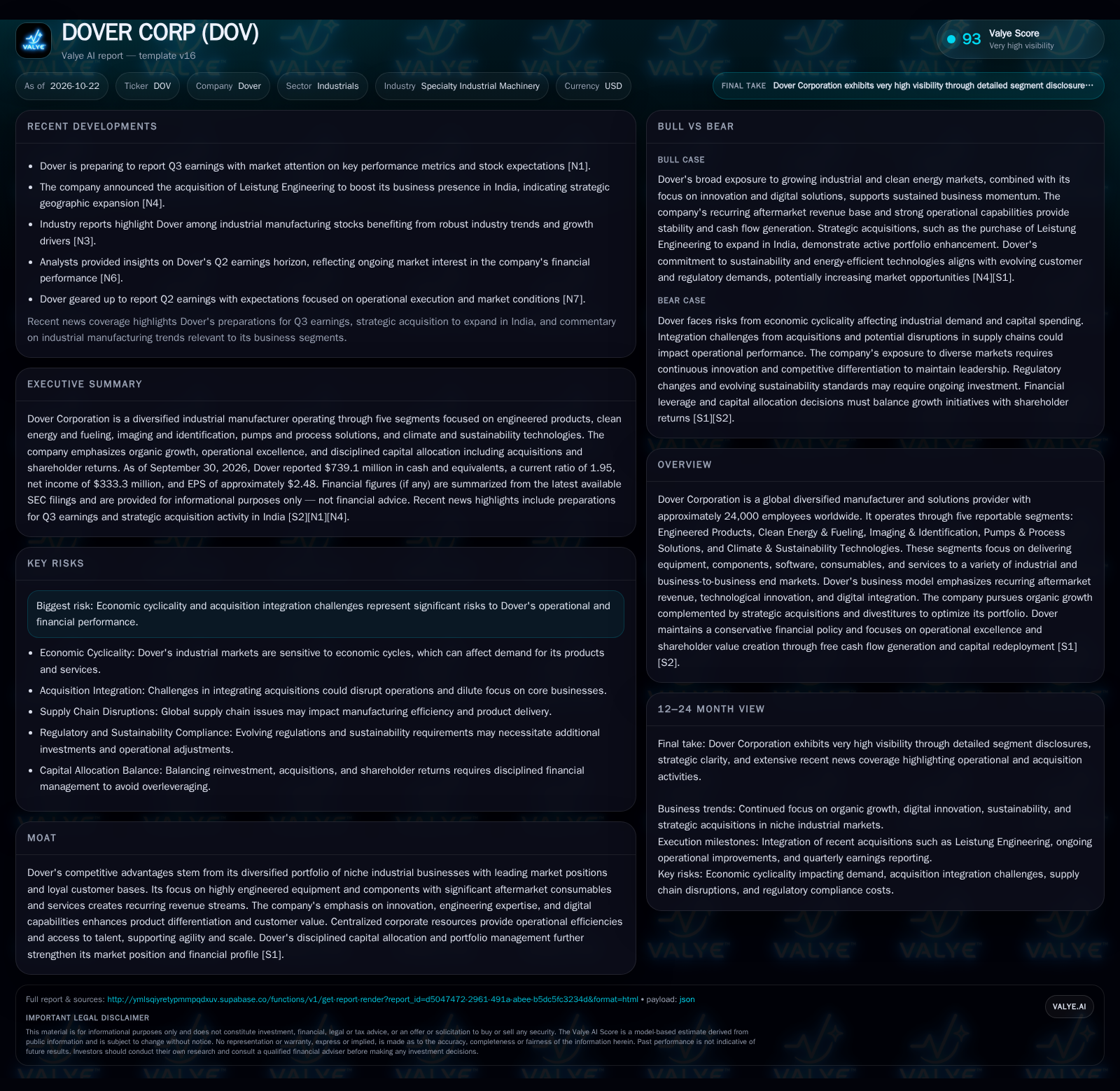
Dover has sharpened its industrial focus by divesting non-core assets and acquiring strategic businesses, notably in India, while continuing to generate roughly 40% of revenues from higher-margin aftermarket parts, consumables, and services. Its balance sheet remains conservative, with a current ratio of 1.95 and $739.1 million in cash as of September 2026. The company’s growth hinges on executing integration, digital transformation, and sustainability initiatives amid cyclical industrial demand and evolving regulatory requirements. [S1] [S2] [N4]
Dover Corporation stands at a strategic inflection point, having streamlined its portfolio through divestitures and selective acquisitions to reinforce its core industrial platforms. With nearly 40% of revenue now derived from recurring aftermarket streams, and a clear emphasis on digital and sustainability-driven innovation, Dover’s business model is designed to weather industrial cycles and capture emerging opportunities. Yet, the company’s next phase of value creation will depend on its ability to integrate new businesses, execute on operational improvement, and navigate external headwinds, from economic volatility to regulatory change. The stakes: higher margins, more resilient cash flow, and sustained relevance in a rapidly evolving industrial landscape.
Recent Portfolio Moves and Revenue Mix Shift the Strategic Landscape
Dover’s current profile reflects two material recent developments: the sale of its Environmental Solutions Group in October 2024—removing a non-core business from its portfolio—and the acquisition of Leistung Engineering to expand its footprint in India. These moves underscore management’s commitment to portfolio optimization and geographic diversification. Meanwhile, recurring revenue from aftermarket parts, consumables, services, and software now represents about 40% of total revenue, a notable shift toward more stable, higher-margin streams. As of September 2026, Dover reported cash and equivalents of $739.1 million, current assets of $4.96 billion, and a current ratio of 1.95, marking a conservative liquidity stance. Net income for Q3 2026 was $333.3 million, with diluted EPS of $2.47. These developments matter because they collectively signal Dover’s intent to drive margin quality and reduce cyclicality through a greater focus on core platforms and recurring revenue. [S1] [S2] [N4]
Understanding Dover’s Revenue Model: Aftermarket, Mix, and Margin Dynamics
Dover’s business model is built on a mix of equipment sales, aftermarket parts and consumables, services, and software. Equipment sales—often cyclical and project-driven—provide entry points into customer operations, while the installed base generates ongoing demand for replacement parts, maintenance, and upgrades. The company estimates that recurring aftermarket streams now account for roughly 40% of total revenue, which typically carries higher margins and lower volatility than original equipment sales. This recurring base is especially important in industrial markets, where customer relationships and switching frictions can be significant once Dover’s platforms are embedded in production or infrastructure environments. [S1]
Operating leverage is a key feature: incremental revenue from aftermarket and digital solutions generally flows through at higher margins due to lower variable costs. Fixed-cost absorption improves with volume, particularly in established product lines. Capital intensity varies across segments—Clean Energy & Fueling and Pumps & Process Solutions may require higher ongoing investment in manufacturing and R&D, while Imaging & Identification and software-driven offerings can scale more efficiently.
Dover’s capital allocation strategy emphasizes free cash flow generation, disciplined acquisitions, and shareholder returns through dividends and buybacks. The company reported cash and liquidity metrics for the period; these figures do not by themselves establish operating runway, investment capacity, financial flexibility, or financing capacity. The question is whether Dover can continue to shift its revenue mix toward higher-margin, less cyclical streams while maintaining investment discipline.
Dover’s Defensible Niches and Customer Retention in a Digital Era
Dover’s competitive position is rooted in its presence across niche industrial segments—vehicle aftermarket, clean fueling, marking and coding, specialty pumps, and climate technologies—where technical complexity, regulatory requirements, and customer integration needs create barriers to entry. The installed base of equipment fosters long-term customer relationships and recurring aftermarket revenue, which can be reinforced by proprietary components, consumables, and software.
However, industrial markets are not immune to substitution threats. Digitalization and the rise of smart manufacturing platforms could erode traditional hardware advantages if Dover’s digital integration lags behind competitors or new entrants. Large diversified peers, specialized engineering firms, and emerging digital-first players all pose potential challenges. The company’s emphasis on innovation and digital capabilities is designed to strengthen its moat, but its effectiveness will depend on execution and customer adoption.
Switching costs in industrial applications can be high—due to process integration, regulatory certification, and downtime risk—but customers may still seek alternatives if Dover’s offerings fail to deliver on performance, sustainability, or total cost of ownership. The company’s disciplined portfolio management, engineering expertise, and centralized resources help sustain its market position, but future differentiation will increasingly hinge on digital and sustainability leadership.
Growth Opportunities from Digital Innovation and Sustainability Initiatives
If Dover successfully integrates its recent acquisitions and accelerates the shift toward digital solutions and aftermarket services, several positive outcomes could materialize. Higher-margin recurring revenue streams could steadily increase as a share of the total, driving operating margin expansion and greater earnings resilience. The company’s focus on energy-efficient and sustainability-driven products aligns with regulatory trends and customer priorities, potentially unlocking new market opportunities—especially in clean fueling and climate technologies.
A favorable scenario would also see Dover leveraging its global footprint, particularly in high-growth regions like India, to capture share in emerging markets. Evidence that would confirm this scenario includes rising aftermarket revenue as a percentage of total sales, expanding digital/software sales, consistent margin improvement, and successful integration of new businesses such as Leistung Engineering. Additionally, sustained growth in segments tied to clean energy and sustainability would validate the company’s strategic bets. Conversely, if margin expansion stalls or digital adoption lags, the bull case could be undermined.
Outlook on Industrial Demand and Execution Challenges
The most plausible near-term path for Dover is one of steady—if uneven—progress. The company is likely to continue growing organically at or above GDP rates, with incremental gains from portfolio optimization and operational improvements. Recurring revenue should remain a stabilizing force, but the pace of mix shift toward higher-margin streams may be gradual, limited by the cyclicality of equipment demand and the complexity of integrating acquired businesses.
Operational excellence and cost discipline are expected to yield moderate margin gains, but external factors—such as industrial demand cycles, supply chain disruptions, and regulatory changes—will continue to shape quarterly outcomes. Evidence supporting this scenario would include stable or slowly rising operating margins, consistent free cash flow generation, and maintenance of a conservative balance sheet. If integration issues, unexpected cost overruns, or macro shocks emerge, performance could lag expectations.
Risks from Integration Issues and Economic Slowdowns
In an adverse scenario, Dover could face a combination of integration challenges from recent acquisitions and a cyclical downturn in industrial end markets. Failure to realize expected synergies or disruptions from integrating new businesses—especially in unfamiliar geographies or segments—could dilute management focus and erode profitability. If economic conditions worsen, project-driven equipment sales may decline sharply, and even aftermarket revenue could soften as customers defer maintenance or upgrades.
Additional downside risks include rising regulatory compliance costs, supply chain bottlenecks, or technological obsolescence if Dover’s digital transformation falls behind. Indicators confirming this scenario would be declining margins, missed earnings guidance, write-downs or restructuring charges related to acquisitions, and deterioration in working capital metrics. If recurring revenue proves less resilient than expected, Dover’s cash flow and valuation could come under pressure.
Evaluating Dover’s Progress on Margin, Mix, and Portfolio Execution
Track the share of total revenue derived from aftermarket parts, consumables, services, and software—rising percentages would support the margin expansion thesis.
Monitor operating margin trends by segment, especially in Clean Energy & Fueling and Pumps & Process Solutions, to assess mix shift and cost discipline.
Watch for integration milestones and post-acquisition performance from businesses such as Leistung Engineering, including revenue growth and margin contribution if disclosed.
Observe digital/software revenue growth rates and customer adoption of new digital platforms or product enhancements.
Note any commentary or disclosure on supply chain resilience and cost inflation containment, which could impact execution.
If disclosed, analyze customer retention rates and the installed base growth in key platforms, as these drive long-term recurring revenue.
Follow external regulatory and sustainability developments in Dover’s core markets, as compliance costs or new requirements could alter margin structure.
Disclaimer: This is research-only, informational analysis and not investment advice. It may include AI-generated interpretation and general industry context. Always verify important details using primary sources.

Comments