
J.W. Mays, Inc.: Real Estate Portfolio Leverage, Debt Constraints, and the Dynamics of Long-Term Asset Value
J.W. Mays, Inc. operates a portfolio of commercial properties in New York and Ohio, balancing stable long-term leases with significant debt and variable occupancy. The company’s recent lease extensions and concentrated ownership structure offer both resilience and risks as the real estate market evolves.
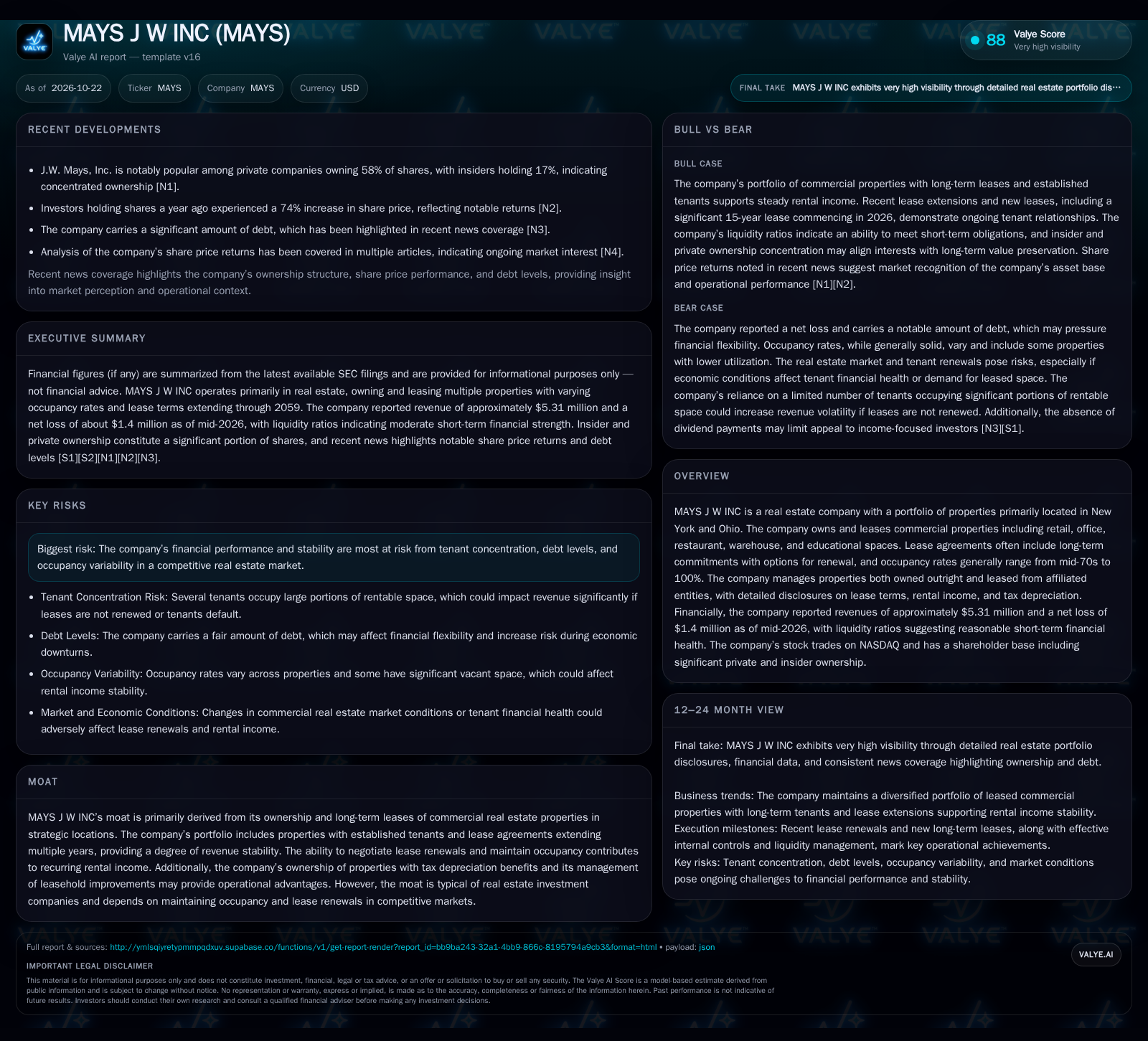
J.W. Mays, Inc. reported $5.31 million in revenue and a $1.4 million net loss as of mid-2026, with current and cash ratios of 1.65 and 0.43 respectively. The company’s portfolio is anchored by long-term leases and high occupancy in key assets, but debt levels and tenant concentration introduce material risk. Notable insider and private ownership may align incentives, while recent share price gains signal market recognition of underlying asset value. The core question is whether rental income stability and asset appreciation can offset financial and operational pressures in a changing commercial real estate landscape. [S1] [S2] [N1] [N2] [N3]
J.W. Mays, Inc. sits at the intersection of stable real estate income and the structural challenges of a concentrated, debt-leveraged portfolio. With a property base spanning New York and Ohio and occupancy rates often nearing full capacity, the company relies on long-term tenant relationships to generate steady rental revenue. However, a recent net loss and a notable debt load underscore the thin margin for error. The future trajectory of MAYS will be shaped by its ability to maintain occupancy, manage refinancing risk, and leverage its asset base as commercial real estate markets evolve.
Recent Lease Activity, Debt Load, and Ownership Concentration: What’s New and Why It Matters
MAYS J W INC reported $5.31 million in revenue for the period ended July 31, 2026, but posted a net loss of $1.4 million, highlighting ongoing profitability challenges [S1] [S2]. The company reported cash and liquidity metrics for the period; these figures do not by themselves establish operating runway, investment capacity, financial flexibility, or financing capacity. [S2] The portfolio’s occupancy rates generally remain strong—ranging from about 76% to 100%—with several long-term leases in place, including a 15-year lease at Fishkill commencing September 2026 [S1]. Meanwhile, the company’s debt burden remains a concern, as recent news coverage emphasizes its significance [N3]. Ownership is notably concentrated, with private companies and insiders holding 58% and 17% of shares, respectively [N1]. These facts matter because they frame both the stability and fragility of the current business model: stable tenants and leases provide cash flow visibility, but high debt and tenant concentration introduce potential volatility if market conditions or occupancy falter.
How MAYS Extracts Value: Lease Structures, Cost Base, and Capital Needs
MAYS monetizes its real estate holdings through a mix of retail, office, restaurant, warehouse, and educational leases. Rental income is generally locked in via long-term contracts, often with renewal options, which can provide multi-year revenue visibility if occupancy is maintained [S1]. The economics are sensitive to both occupancy rates and the mix of tenants: higher occupancy and longer lease terms typically drive operating leverage, as fixed property costs (maintenance, taxes, depreciation) are spread over more rent-paying tenants. However, the company’s exposure to a handful of large tenants means a single non-renewal or default could materially impact revenue.
On the cost side, property taxes and maintenance are significant fixed expenses, while leasing commissions and improvements can spike during tenant turnover or lease renegotiations. The company’s capital structure includes a notable debt component, which requires regular servicing and may limit reinvestment or acquisition capacity if interest rates rise or rental income dips [N3]. The absence of dividend payments in the current period suggests a focus on liquidity preservation rather than shareholder distributions [S1]. Overall, profitability hinges on keeping properties leased, managing operating costs, and refinancing debt on reasonable terms.
Where MAYS Sits in the Commercial Real Estate Ecosystem
MAYS operates in a highly competitive environment, facing both institutional real estate investment trusts (REITs) and local property operators. The company’s strategic advantage comes from its long-term property holdings in established markets and the ability to secure multi-year leases with stable tenants. However, this advantage is not unique; many peers deploy similar strategies. MAYS’s portfolio is geographically concentrated in New York and Ohio—markets with both robust demand and cyclical risks tied to local economic conditions.
Tenant switching costs can be moderate to high in commercial real estate, especially for large or customized spaces, which may support lease renewals. However, if market rents fall or regional economies weaken, tenants may seek to renegotiate or relocate, eroding pricing power. The company’s mix of property types (retail, office, warehouse) provides some diversification, but sector-specific risks—such as retail contraction or office downsizing—remain. Larger REITs may have an edge in capital costs and tenant diversification, while local operators can be more nimble. MAYS’s concentrated ownership could allow for more decisive management, but also amplifies the impact of strategic missteps.
Unlocking Asset Value: How Lease Extensions and Market Tailwinds Could Drive Equity Upside
A favorable scenario sees MAYS maintaining high occupancy and successfully extending or signing new long-term leases, particularly in its highest-revenue properties. If local economies in New York and Ohio remain resilient, tenant demand could stay robust, allowing the company to pass through rent escalations or attract new tenants at higher rates. Continued effective management of property maintenance and operating costs would support margin expansion.
Asset appreciation could become a secondary driver: if commercial property values rise, the company’s balance sheet would strengthen, potentially improving borrowing terms or enabling selective asset sales at a premium. The concentrated insider and private ownership could support a long-term orientation, resisting short-term pressures and enabling patient capital deployment. Evidence confirming this scenario would include rising occupancy rates, lease renewals with favorable terms, stable or growing rental income, improved net operating income margins, and upward property revaluations. Falsification would come from a decline in occupancy, lease defaults, or an inability to refinance debt at acceptable rates.
Maintaining Stability: Moderate Occupancy and Debt Servicing Define the Status Quo
The most plausible outcome is that MAYS continues to operate with occupancy rates in the mid-70s to near-100% range, with periodic tenant turnover but no major defaults. Rental income remains steady, supported by existing long-term leases, but limited by sector-specific headwinds such as retail consolidation or office space rationalization.
Refinancing risk is managed but not eliminated; the company may need to negotiate new debt terms in a higher interest rate environment, which could pressure margins. The portfolio’s geographic and tenant concentration introduces some volatility, but not enough to destabilize the business if a majority of leases are renewed. Evidence confirming the base scenario would include flat to modestly fluctuating revenue, stable occupancy, and continued net losses or break-even performance. Falsification would be a sharp drop in occupancy, a major tenant loss, or sudden increases in debt costs.
When Concentration Bites: Tenant Loss, Debt Stress, and Asset Impairment Risks
The principal risk is that one or more large tenants—each occupying over 10% of rentable space—fail to renew or default on their leases. This would immediately reduce rental income, potentially pushing the company into cash flow deficits given the fixed nature of property costs and debt servicing. If vacancies persist, MAYS could be forced to offer concessions or lower rents to attract new tenants, further compressing margins.
Should broader economic or sector-specific downturns hit the New York or Ohio markets, the company’s revenue could decline across multiple properties. In a scenario where debt cannot be refinanced on favorable terms, MAYS could face covenant breaches, asset sales under duress, or even insolvency risk. Evidence confirming this scenario would include a material drop in occupancy, negative operating cash flow, rising interest expense, or forced asset sales at a discount. Falsification would be the successful renewal of major leases and stable or rising rental income despite market headwinds.
What Will Test the MAYS Thesis in the Next 12–24 Months?
Occupancy rates by property, especially for those with significant tenant concentration—if disclosed, these figures would reveal whether renewal risk is materializing.
Lease renewal and extension activity, particularly for tenants occupying over 10% of total rentable space.
Changes in rental income per property or overall, indicating pricing power or concessions in new leases.
Trends in debt servicing costs and refinancing terms, especially as existing debt matures.
Operating cash flow versus net income—if disclosed, this would clarify whether reported losses are driven by non-cash items or actual cash deficits.
Movement in property values or independent appraisals, which would signal asset appreciation or impairment risk.
Management commentary or disclosures regarding asset sales, acquisitions, or major capital expenditures.
Any shifts in insider or private ownership stakes that might signal changing strategic direction or confidence.
Disclaimer: This is research-only, informational analysis and not investment advice. It may include AI-generated interpretation and general industry context. Always verify important details using primary sources.

Comments