
Honeywell After the Aerospace Spin-Off: Portfolio Focus, Technology Integration, and the Next Growth Levers
Honeywell’s 2026 portfolio transformation, highlighted by the Aerospace Spin-Off and targeted acquisitions, sets the stage for a more focused industrial technology play. With a strong installed base and new digital initiatives like Forge Cognition, the company is betting on decoupled growth in automation, data centers, and advanced process sectors.
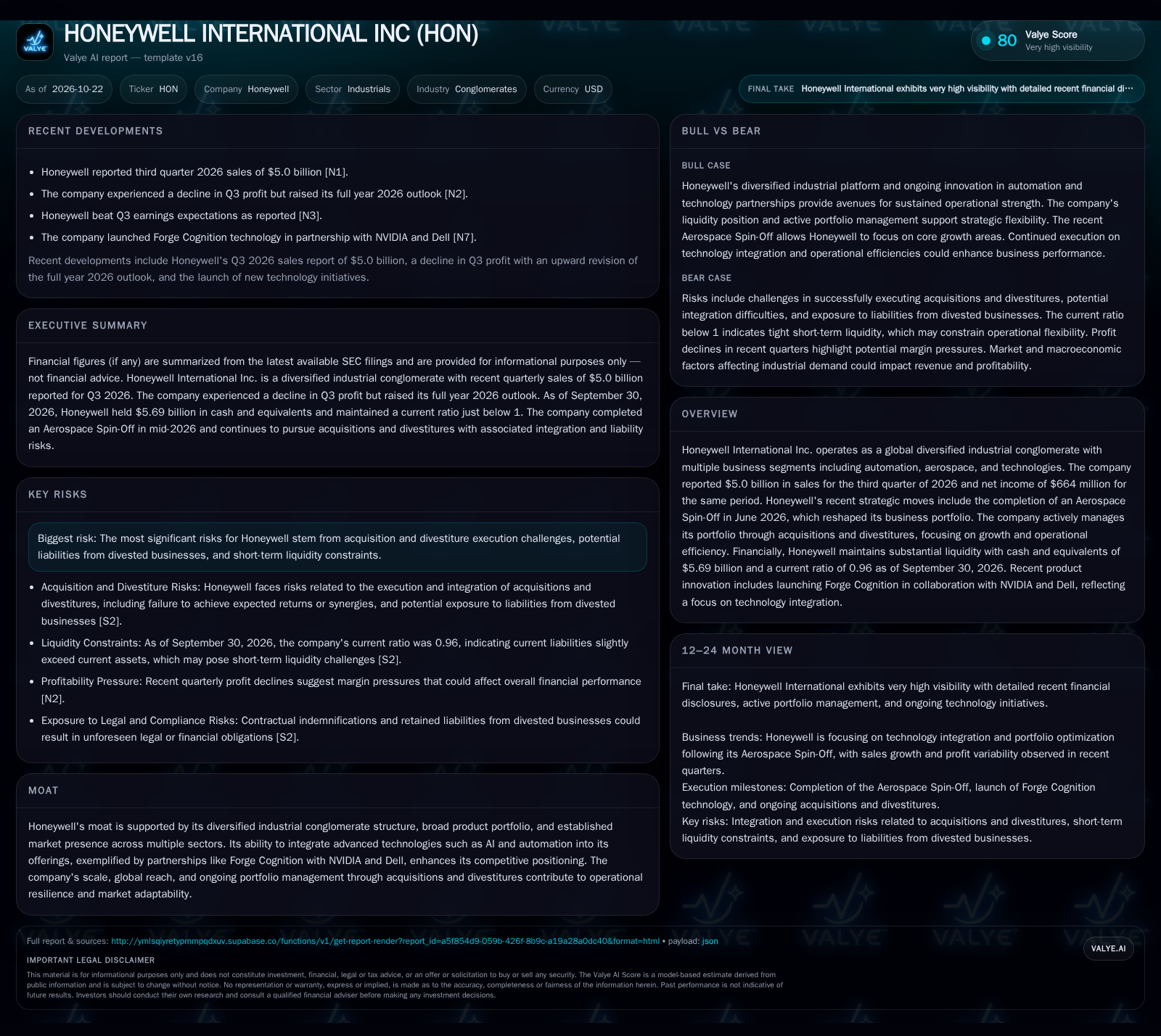
Honeywell has reshaped its business through a major Aerospace Spin-Off in 2026, focusing on automation, process technology, and digital integration. While Q3 2026 saw $5.0 billion in sales and $664 million in net income, profit declined, and the current ratio dropped below 1. [N1] [N2] [S2]
Honeywell International’s 2026 has been defined by decisive portfolio action: the completion of its Aerospace Spin-Off and a string of acquisitions targeting high-growth verticals like data centers, LNG, and building automation. The company’s Q3 2026 results—$5.0 billion in sales and $664 million in net income—reflect both the scale and the complexity of this transition. While profit declined, management’s raised full-year outlook signals confidence in new digital and automation initiatives. The big question: can Honeywell translate its diversified industrial base and innovation partnerships into sustainable, less cyclical growth, while managing integration and near-term liquidity pressures? [N1] [N2] [S2]
Honeywell’s 2026 Pivot: Portfolio Reset and Financial Snapshot
Honeywell’s most material 2026 development is the completion of its Aerospace Spin-Off on June 29, which fundamentally changes its business mix and risk exposure by focusing the company on industrial automation, building systems, and process technology rather than aviation. In the third quarter following this move, Honeywell reported $5.0 billion in sales and net income of $664 million, with basic earnings per share of $2.09 and diluted EPS of $2.08. Management responded by raising its full-year outlook, suggesting confidence in the reshaped portfolio and ongoing initiatives. [N1] [N2] [S2]
Honeywell’s liquidity, with $5.69 billion in cash and $492 million in short-term investments as of September 30, 2026, is sizable but must be weighed against the company’s $14.9 billion in current liabilities. This tightness in near-term liquidity increases the importance of operational cash flow and disciplined integration of recent acquisitions. [S2]
How Honeywell’s Business Model Generates Value Post-Spin
Honeywell’s core business economics rely on providing mission-critical products, systems, and services to industrial, commercial, and infrastructure customers. The post-spin portfolio is more focused on automation, process controls, and digital integration—areas where the company’s installed base and aftermarket opportunities can drive recurring service, software, and upgrade revenues. This shift theoretically supports higher margins and less cyclical revenue streams, especially as 'decoupled' growth in connected buildings, cybersecurity, and process optimization platforms can expand the addressable market beyond mere capital equipment replacement.
Revenue mix is influenced by both large upfront project sales and ongoing service/software contracts. Honeywell’s Honeywell Technologies Forge platform, developed in partnership with NVIDIA and Dell, signals a growing emphasis on digital, hardware-agnostic solutions that could increase customer stickiness and open cross-selling opportunities. The company’s proprietary Accelerator operating system underpins its drive for value-based pricing, operational efficiency, and rapid integration of new offerings.
Fixed costs in R&D, software development, and global sales are significant, but the company aims to leverage scale and its mature Lean/Six Sigma-driven Accelerator system for operating leverage. Capital needs remain substantial, especially for integration of acquired businesses and for investing in innovation that can be deployed across the entire portfolio. If Honeywell can successfully shift more revenue to higher-margin digital and recurring service streams, operating leverage could improve, but integration costs and potential stranded costs from divestitures remain a risk.
Competitive Moats and the Challenge from Next-Gen Automation Rivals
Honeywell’s competitive positioning post-spin is anchored by its scale, global installed base, and breadth of offerings across automation, building systems, and process technology. The company’s decades-long relationships with industrial customers, combined with a reputation for reliability and mission-critical performance, are core elements of its moat.
A key source of potential competitive advantage is the integration of advanced software, AI, and data analytics into legacy control systems—most notably through platforms like Forge Cognition. This strategic direction is designed to could increase switching costs and embed Honeywell more deeply within customer workflows. However, competitors in automation, industrial software, and controls (such as Siemens, Schneider Electric, Emerson, and ABB) are also aggressively pursuing digitalization, cloud integration, and AI partnerships, narrowing the technology gap.
Honeywell’s active acquisition strategy is a double-edged sword: while it enables expansion into adjacent verticals (e.g., data centers, LNG, life sciences), it also exposes the company to integration risks and the challenge of capturing targeted synergies in a rapidly evolving landscape. The move toward more open, vendor-agnostic architectures could erode traditional lock-in effects, making continuous innovation and customer-centricity essential for defending share.
Unlocking Decoupled Growth: What Would Prove Honeywell’s Strategy Is Working
The favorable scenario for Honeywell is that its 2026 portfolio reset enables sustained, above-GDP growth driven by high-margin, less cyclical revenue streams in automation, digital services, and targeted verticals. This outcome would require successful integration of recent acquisitions—such as in building automation and LNG—yielding both cross-selling and cost synergies.
A key trigger would be evidence of accelerating growth in recurring software and services revenues, accompanied by margin expansion and improved cash conversion. Early traction for Forge Cognition, as measured by customer adoption rates and new digital contract wins (if disclosed), would provide tangible proof that Honeywell’s technology integration and open-platform approach are resonating.
Confirmation would also come from a rising proportion of revenue from high-growth verticals like data centers, semiconductors, and life sciences, and from a clear reduction in the volatility of earnings relative to industrial peers. Falsification would be signaled by stalled digital adoption, customer churn, or persistent margin compression despite portfolio changes.
Portfolio Transformation Brings Incremental Gains, But Integration and Cyclicality Persist
The most plausible near-term scenario is that Honeywell achieves moderate growth and stable-to-improving margins as its new portfolio settles. The company benefits from its installed base, established customer relationships, and incremental cross-selling of digital and service offerings, but faces ongoing integration challenges and some exposure to cyclical industrial demand.
In this scenario, the company’s operating leverage is gradually realized as synergies from recent acquisitions are captured and the mix shifts toward higher-margin offerings. However, the process is uneven: integration costs, potential stranded overhead from the Aerospace Spin-Off, and periodic market softness in core sectors could limit near-term margin expansion.
Evidence for this path would include sequential improvements in EBITDA margins, steady growth in automation and process technology sales, and manageable working capital trends. Falsifying evidence would be persistent margin stagnation, unexpected integration write-downs, or failure to grow the digital/software revenue base.
Integration Missteps and Liquidity Tightness Could Derail Honeywell’s Reset
A negative scenario would see Honeywell struggle to integrate recent acquisitions or to offset the loss of aerospace earnings, leading to operational dis-synergies and cost overruns. If integration proves more complex or costly than planned, or if synergies fail to materialize, profit margins could compress further, undermining confidence in the portfolio transformation.
This could restrict the company’s ability to invest in growth, service debt, or pursue further acquisitions without external financing.
Downside confirmation would include rising integration costs, missed synergy targets, negative operating cash flow, or the need to curtail planned investments. Additional risk would be signaled by customer attrition or competitive share losses in automation and digital platforms.
Metrics That Will Test Honeywell’s Portfolio Strategy and Digital Ambitions
The proportion of total revenue and gross profit derived from software and recurring service contracts, if disclosed, would help gauge progress toward a higher-margin, less cyclical business model.
Quarterly and annual operating margin trends, especially in the segments most affected by the Aerospace Spin-Off and recent acquisitions, will indicate whether synergies are being realized or integration costs are mounting.
Growth rates in targeted high-growth verticals—specifically data centers, semiconductors, LNG, and life sciences—would provide evidence of success in portfolio reorientation.
Adoption rates, customer wins, or contract values tied to the Forge Cognition platform (if disclosed) will signal whether digital integration is gaining traction.
Updates on liabilities or indemnification claims arising from divested businesses would clarify the risk of unforeseen financial exposures.
Acquisition integration milestones and synergy realization progress—qualitative or quantitative—will help test management’s ability to execute on the portfolio strategy.
Any changes in credit facility utilization or new financing arrangements could signal emerging liquidity pressure or capital needs.
Disclaimer: This is research-only, informational analysis and not investment advice. It may include AI-generated interpretation and general industry context. Always verify important details using primary sources.

Comments