
Molina Healthcare: Margin Compression, Membership Growth, and the Strategic Tension Shaping Managed Care Economics
Molina Healthcare’s 2025-2026 results reveal the double-edged sword of membership expansion and medical cost inflation—forcing a strategic reappraisal of pricing, utilization management, and operational scale. The market’s core question: can Molina restore margin resilience amid intensifying regulatory and competitive headwinds?
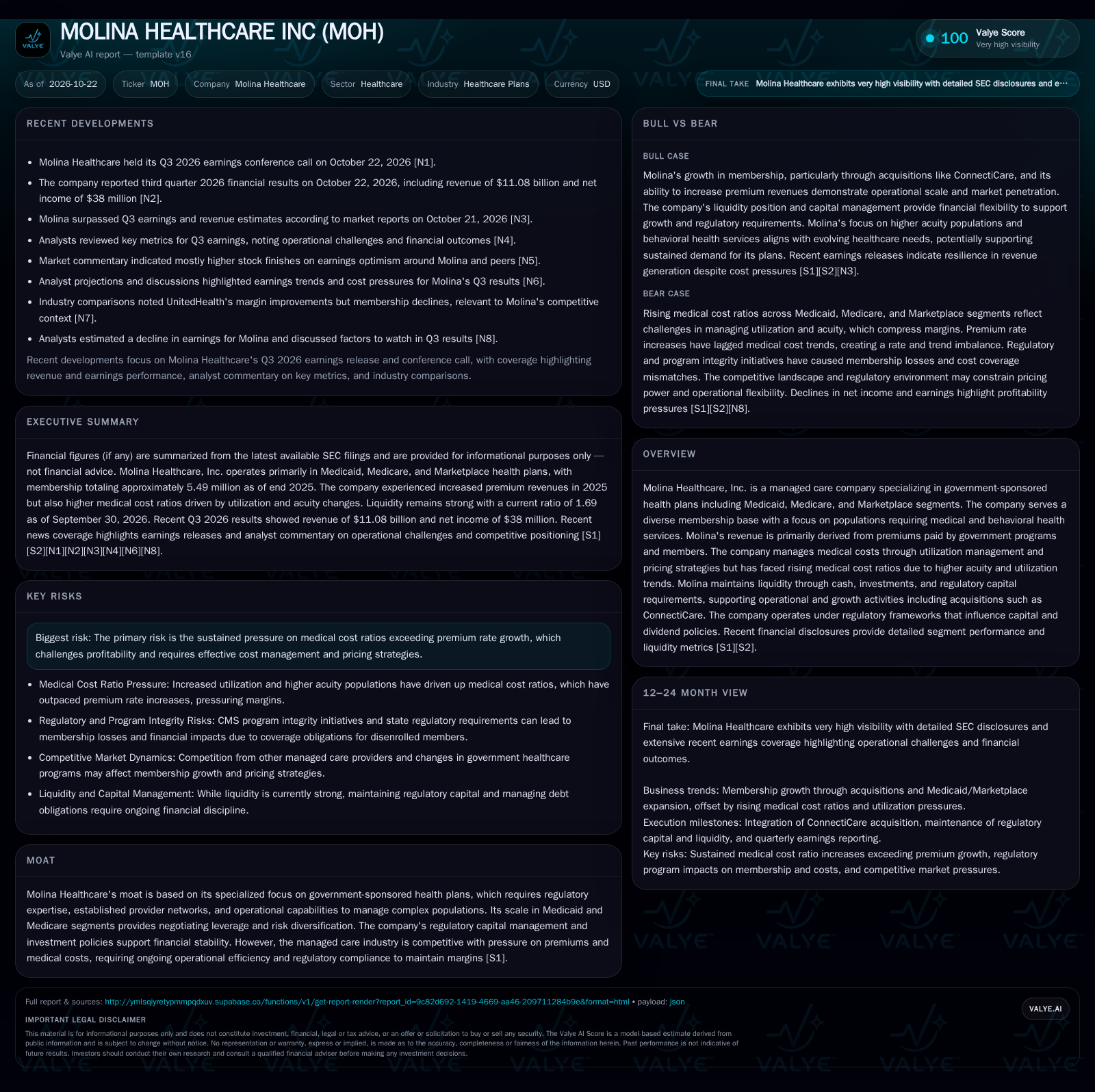
Molina Healthcare’s membership and premium revenue have grown, aided by acquisitions like ConnectiCare, but medical cost ratios have risen sharply across all segments, driven by higher utilization and acuity. The key thesis hinge: whether Molina can regain control of medical costs and premium rate adequacy while defending its position in a fiercely competitive, regulation-bound market. [S1] [S2]
Molina Healthcare stands at a crossroads. Its recent acquisition-fueled membership growth and robust premium revenue are offset by an unmistakable surge in medical cost ratios across Medicaid, Medicare, and Marketplace lines. While reported liquidity position, underlying margin compression has pushed net income and EPS to notably lower levels. The company’s near-term trajectory will be shaped by its ability to balance regulatory compliance, utilization management, and pricing power in a market where both government policy and competition are tightening the screws. The central question: can Molina restore profit resilience, or will cost inflation and regulatory constraints continue to erode its returns? [S1] [S2]
Membership Gains and Margin Squeeze: The Current Operating Reality
Molina Healthcare finished 2025 with approximately 5.49 million members, up from prior years, driven in part by the ConnectiCare acquisition that expanded its Medicaid and Marketplace footprint [S1]. Premium revenue for 2025 reached $43.05 billion, with Medicaid accounting for $32.24 billion, Medicare $6.24 billion, and Marketplace $4.49 billion [S1]. However, the company’s medical cost ratios (MCR) rose sharply: Medicaid MCR reached 91.8%, Medicare hit 92.4%, and Marketplace soared to 90.6%, each up significantly from 2024 [S1]. This cost inflation outpaced premium growth, compressing margins and leading to a Q3 2026 net income of just $38 million on $11.08 billion in revenue [S2]. [S2]
How Molina’s Revenue Model Faces the Limits of Scale
Molina’s business is fundamentally a spread business: it earns a fixed or semi-fixed premium per member (set by government contracts or risk-adjusted rates) and pays variable medical costs for members’ healthcare utilization. The company’s largest segment, Medicaid, represents over 70% of premium revenue, with Medicare and Marketplace making up most of the balance [S1]. While membership growth and acquisitions can drive top-line gains, the model’s economic leverage depends on maintaining a stable or improving medical cost ratio—any increase in utilization or acuity directly erodes margin.
The fixed-cost base is relatively low compared to variable medical expenses, so operating leverage is limited: most expense volatility flows through to gross margin. Premium rate increases are subject to state and federal approval, creating a lag (and sometimes a mismatch) between rising costs and revenue. Acquisitions like ConnectiCare can add scale and diversification, but integration costs and the need to manage higher-acuity populations can initially dilute margins until operational efficiencies are realized.
Capital needs are dominated by regulatory requirements: Molina’s subsidiaries must maintain minimum capital and surplus levels, and the parent company draws liquidity from administrative fees, subsidiary dividends, and occasional debt or equity issuance [S1]. While the balance sheet is currently strong, long-term economic value depends on restoring the premium/medical cost spread—not just growing membership.
Scale, Specialization, and the Pressures of a Crowded Managed Care Field
Molina’s specialization in government-sponsored health plans—especially Medicaid—offers a degree of regulatory expertise and population management skill, but this niche is increasingly crowded. Large national players (e.g., UnitedHealth, Centene, Elevance) bring scale advantages, diversified offerings, and negotiating leverage with states and providers. Digital-first or regionally focused entrants (e.g., Oscar Health) push innovation and challenge on cost structure.
Competition is shaped by state Medicaid contract awards, periodic rebidding, and regulatory program integrity reviews that can cause abrupt membership shifts. Molina’s moat rests on provider network depth, regulatory compliance, and its ability to manage complex, high-need populations. However, the sharp rise in medical cost ratios suggests that its utilization management and pricing strategies are under strain. Pricing power is constrained by government rate-setting, while product differentiation is minimal in the eyes of state payors. The threat of substitution comes mainly from alternative managed care organizations, not from fee-for-service or direct-to-consumer models in this segment.
In sum, Molina’s competitive position is defensible but not immune: operational discipline, cost management, and relationship management with state agencies are critical to sustaining margins and contract renewals.
Margin Restoration through Utilization Management and Rate Realignment
The most favorable scenario for Molina is one where medical cost inflation moderates (due to better utilization management, favorable population mix, or successful care interventions) and premium rates are successfully renegotiated upward to reflect higher acuity. This could occur if regulatory agencies recognize the cost pressures and allow for catch-up rate adjustments, or if Molina’s care management programs demonstrably reduce unnecessary utilization.
Confirmation of this scenario would come from a sequential decline in medical cost ratios across segments, stabilization or improvement in net income and EPS, and commentary from management or regulators about more sustainable rate trends. Additional signs would include evidence that recent acquisitions are being integrated efficiently, with cost synergies realized and no outsized reserve development. Falsification would be persistent or worsening MCRs, continued lag in premium adjustments, or evidence of further regulatory headwinds limiting pricing flexibility.
Profitability Stagnates as Cost Pressures and Rate Lag Persist
The most plausible near-term outcome is that Molina’s profitability remains under pressure: medical cost ratios stay elevated due to ongoing high utilization and acuity, while premium rates catch up only gradually due to regulatory lags and political constraints. Membership may grow modestly or hold steady, but the incremental contribution is offset by thin margins.
In this scenario, net income and EPS remain subdued relative to historical averages, and margin recovery is slow and uneven. Quarterly results show some volatility as cost trends and rate actions play out at different cadences across states and segments. Confirmation would be MCRs plateauing at current high levels, stable but unimpressive earnings, and management guidance emphasizing long-term cost control and regulatory engagement rather than immediate margin expansion. Falsification would require either a rapid margin rebound (suggesting cost or rate inflection) or a sharp margin collapse (implying loss of cost control or regulatory setbacks).
Rising Acuity and Regulatory Disruption Trigger a Margin Crisis
The adverse scenario unfolds if medical cost inflation accelerates further—perhaps driven by an unfavorable mix shift, new waves of high-cost enrollees, or care deferral effects from earlier policy changes. If premium rate increases remain capped by regulatory or political factors, margin compression could intensify, pushing operating income toward breakeven or loss.
Compounding the challenge, regulatory program integrity reviews or state budget actions could trigger abrupt membership losses or require coverage for disenrolled populations, stranding costs without corresponding revenue. This scenario might also see competitive rebidding or contract losses to larger or more nimble rivals.
Confirmation would be a further increase in MCRs, negative earnings quarters, commentary about reserve strengthening or adverse development, and/or material membership attrition. Falsification would require stabilization of cost trends or regulatory relief that protects revenue and membership.
Metrics and Developments That Will Determine Molina’s Margin Trajectory
Sequential and year-over-year changes in medical cost ratios (MCR) by segment—especially Medicaid and Marketplace—will be the clearest indicator of progress or further margin erosion.
Premium rate increases approved by state or federal regulators, and the timing of those adjustments relative to cost trends, would help test the thesis of margin restoration.
Membership trends by segment, including the impact of any new acquisitions or state contract wins/losses, will shed light on scale and revenue visibility.
Net income and EPS progression, especially in context of revenue growth, will reveal whether margin compression is being reversed or entrenched.
Integration milestones, synergy realization, and cost control outcomes from the ConnectiCare acquisition and any future deals should be tracked for evidence of operational leverage.
Regulatory developments—such as CMS program integrity initiatives, Medicaid redeterminations, or state budget changes—could materially alter both costs and membership.
If disclosed, metrics on care management effectiveness, utilization patterns (e.g., inpatient admissions, ER visits), and risk adjustment outcomes would provide deeper insight into Molina’s cost-containment capabilities.
Management guidance and commentary on rate adequacy, reserve development, and strategic priorities will help clarify the company’s capacity to navigate the current margin environment.
Disclaimer: This is research-only, informational analysis and not investment advice. It may include AI-generated interpretation and general industry context. Always verify important details using primary sources.

Comments