
MSC Industrial: Technology-Enabled Differentiation in a Fragmenting MRO Distribution Market
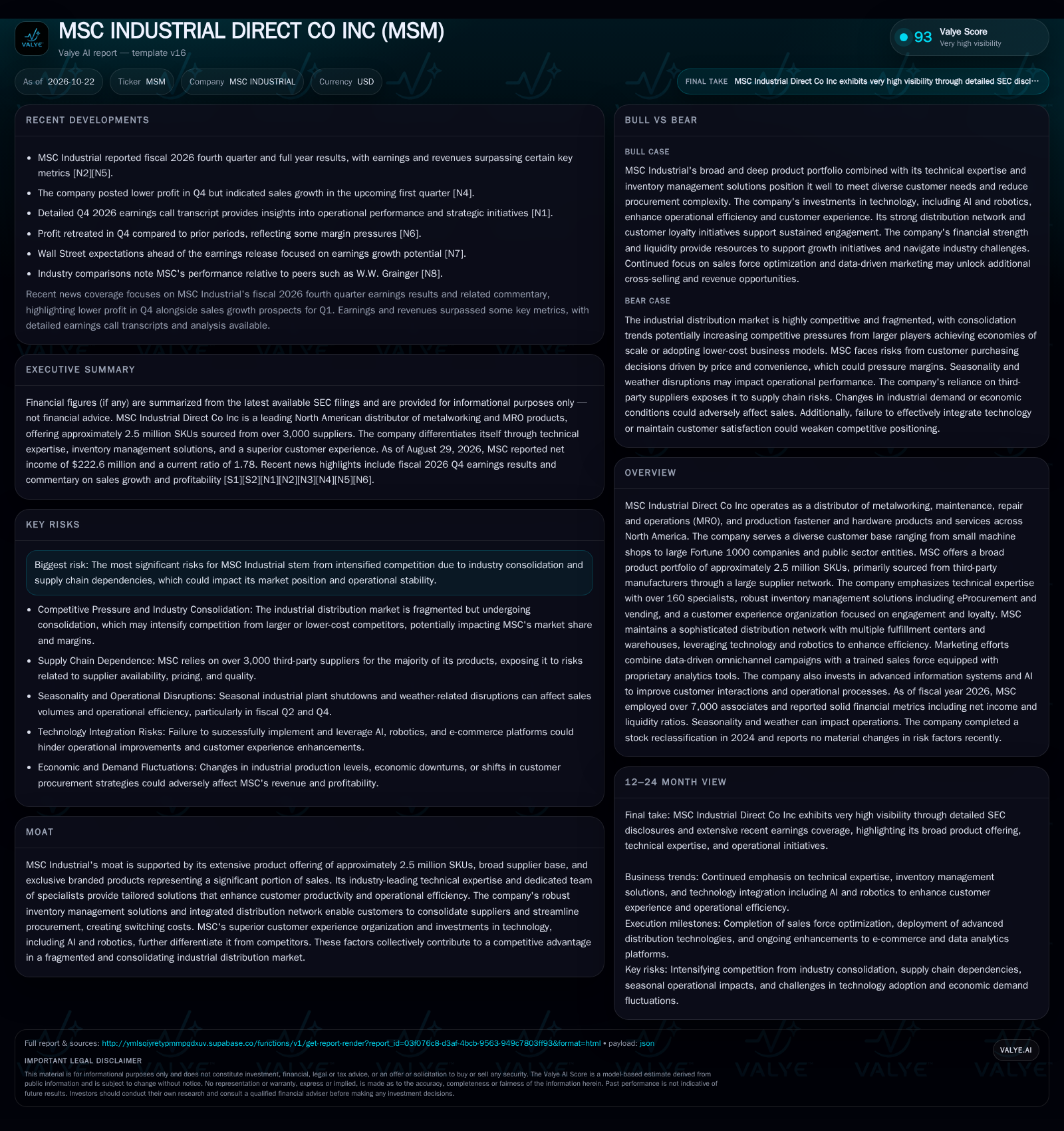
MSC Industrial Direct is advancing its role as a technical partner and supply chain optimizer for North American manufacturers. With a vast SKU catalog, specialized technical services, and investments in robotics, AI, and omnichannel marketing, the company is navigating margin pressures and intensifying competition by deepening customer integration and operational efficiency.
The company anticipates sales growth in Q1 2027, leveraging its 2.5 million SKU catalog, technical expertise, and investments in automation and AI to strengthen its competitive position as a value-added distributor in an evolving industrial MRO landscape. Risks remain around industry consolidation, supply chain volatility, and the need for continued technology integration to maintain differentiation. [S1] [N2] [N4] [N6]
MSC Industrial Direct’s latest results highlight the company’s effort to balance margin headwinds with forward-looking investments in technology and service integration. With a sprawling product portfolio and deep specialization in metalworking and MRO distribution, MSC is pursuing a strategy that goes beyond commodity distribution—leveraging technical expertise, inventory management, and advanced analytics to deepen customer relationships. The company’s ability to sustain this differentiation, however, will be tested by intensifying competition, industry consolidation, and the ongoing need to adapt digitally and operationally.
Recent Performance and Strategic Posture: A Snapshot
The company’s Q4 profit retreated year-over-year, but management and news coverage indicate anticipated sales growth for the upcoming Q1, suggesting resilience and potential for near-term recovery. The company’s SKU breadth (2.5 million active items), supplier diversity (over 3,000 suppliers, with no single supplier exceeding 5% of purchases), and a focus on exclusive brands (15% of net sales) underpin its strategy of product breadth and reduced procurement risk. Recent investments in robotics and AI are cited as key levers for operational efficiency and improved customer experience, positioning MSC to compete on more than just price or selection. [S1] [N2] [N4] [N6]
How MSC Converts Scale and Service into Revenue Streams
MSC’s revenue model is built on high-volume, low-margin distribution of MRO and metalworking products, with value-added services serving as differentiators. The core economics depend on product mix (third-party brands vs. exclusive brands), transaction volume, and the ability to embed services such as inventory management (VMI, vending, tool crib control) and technical consultation. Exclusive brands, at 15% of net sales, likely offer higher gross margins than pure distribution, but the majority of revenue still comes from third-party sourced products, keeping blended margins sensitive to competitive pricing and supplier terms.
Operating leverage arises from scale in logistics and distribution, as well as from technology investments—robotic picking and packing, AI-driven analytics, and e-commerce integration—that can reduce unit costs and improve fill rates. However, these capital and technology investments require continuous reinvestment, and their payoff depends on sustained volume growth and customer retention. The company reported a current ratio of 1.78 for the period. Cash and equivalents of $65 million, while modest, are balanced by a large base of current assets ($1.32 billion), indicating that the company’s capital structure is designed to support significant inventory and receivables. [S1]
Defending Share in a Fragmented, Consolidating Market
MSC operates in a highly fragmented and increasingly consolidating MRO distribution market, competing with broadline distributors, digital-first entrants, and niche specialists. Key competitive axes include price, product selection, availability, technical support, and procurement convenience. The company’s moat is built on its expansive SKU catalog, technical expertise (over 160 specialists), and embedded inventory management solutions, which help lock in customers through integration with their procurement and production workflows. These solutions could increase switching friction, especially for customers whose operations depend on seamless inventory replenishment and technical optimization.
However, the industry is subject to intense price competition, particularly as larger rivals consolidate and leverage greater purchasing power or digital scale. Digital disruptors may erode traditional distributor margins by offering lower-cost, self-service procurement. MSC’s investments in AI, omnichannel marketing, and proprietary analytics are an attempt to stay ahead of these trends, but the question is whether these differentiators are sufficient to maintain share and margin as the industry evolves. [S1]
When Service Integration and Automation Drive Outperformance
A favorable scenario for MSC sees its investments in automation, AI, and technical services driving sustained customer loyalty and share gains. If its inventory management solutions and technical expertise become increasingly embedded in customer operations—reducing procurement complexity, downtime, and total cost of ownership—MSC could achieve higher retention, deeper wallet share, and improved pricing power, especially for exclusive brands and value-added services.
Confirmation would come from accelerating growth in exclusive brand sales, increasing adoption of vending and integrated inventory management platforms, and evidence of higher customer retention or expansion in large enterprise accounts. Further, if the company’s AI and robotics investments measurably reduce cost per transaction or improve fill rates, this could translate into margin expansion even in a competitive pricing environment. Positive signals would include faster inventory turns, improved gross margin percentage, and public case studies of customer productivity gains attributable to MSC’s services.
Sustaining Value-Added Distribution Amid Margin Pressures
The most plausible trajectory for MSC is continued growth at or above industrial production rates, with periodic margin pressure reflecting a competitive, price-sensitive market. The company’s technical services, inventory management, and broad product selection should support customer stickiness and allow some differentiation, but these advantages will be partially offset by ongoing price competition and the need to reinvest in technology.
The middle path likely involves modest top-line growth, stable or slightly pressured gross margins, and incremental improvement in operating efficiency as automation and AI investments mature. Confirmation would include steady growth in sales to core customer segments, a stable or improving gross margin percentage, and continued investment in digital platforms. Falsification would be signaled by significant customer churn, loss of large accounts to digital competitors, or sustained margin erosion not offset by operating cost improvements.
Erosion of Differentiation and Margin Compression in a Digital-First World
The principal risk is that industry consolidation and digital disruption outpace MSC’s ability to differentiate through service and technology. If larger or more agile digital competitors offer comparable inventory breadth, faster procurement, and lower prices, MSC may see its value-added services commoditized and its customer relationships weakened. Margin compression could accelerate if exclusive brands fail to gain share or if technical services are not valued as highly as anticipated.
Confirmation of this scenario would include declining gross margins, loss of major enterprise accounts, reduced adoption of inventory management platforms, or negative trends in customer retention rates (if disclosed). Further, if technology investments fail to deliver operational savings or customer experience improvements, MSC could face rising costs without offsetting revenue gains, leading to earnings contraction and diminished capacity to reinvest.
Milestones and Metrics That Will Test MSC’s Value Proposition
Growth rate and mix of exclusive brand sales versus third-party sourced products, indicating margin potential and customer preference shifts (if disclosed).
Adoption rates and renewal/expansion of inventory management solutions such as VMI, vending, and tool crib control across core customer segments.
Gross margin trajectory and cost per transaction, as indicators of pricing power and operational efficiency.
Churn rates or retention metrics for large enterprise and public sector accounts (a useful metric would be customer retention rate, if disclosed).
Progress in automation and AI deployment: evidence of reduced fulfillment costs, improved fill rates, or faster inventory turns (if disclosed).
Comparative performance versus major peers in terms of top-line growth, margin trends, and customer wins/losses.
Impact of seasonality and industrial production cycles on quarterly sales and margins, especially during fiscal Q2 and Q4.
Evidence of supply chain stability or disruption, such as supplier concentration changes or inventory shortages impacting order fulfillment.
Disclaimer: This is research-only, informational analysis and not investment advice. It may include AI-generated interpretation and general industry context. Always verify important details using primary sources.

Comments