
Comcast in 2026: Strategic Crossroads Between Connectivity Erosion and Capital-Intensive Diversification
Comcast’s scale, asset breadth, and capital return discipline remain evident, but customer attrition in core connectivity, margin pressures in streaming, and ongoing capital intensity in content and theme parks now define the investment debate. The company’s diversified model offers resilience—but also demands execution across disparate, highly competitive markets.
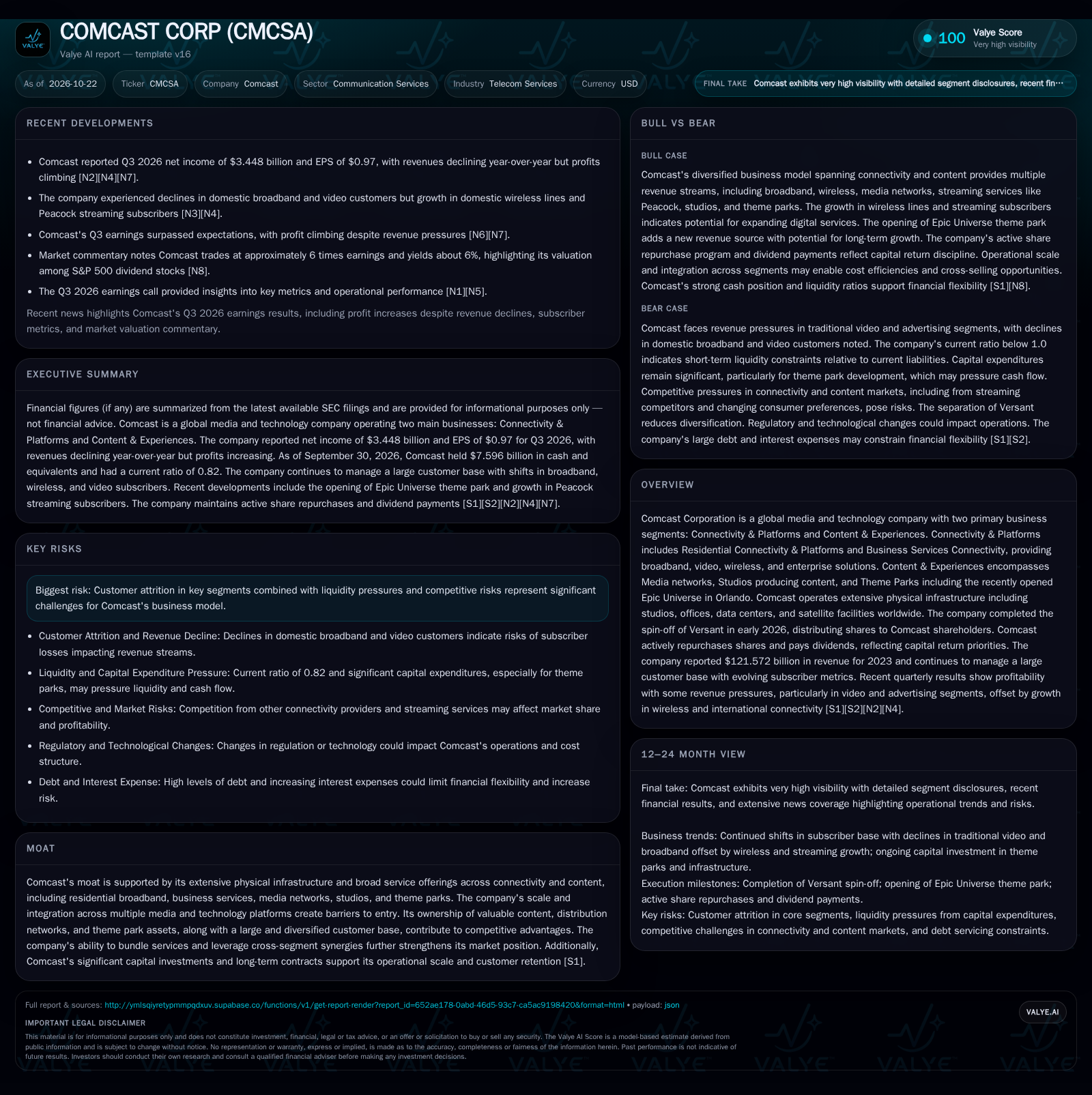
Comcast’s 2026 results reflect a business at an inflection point: broadband and video subscriber losses continue, but wireless and streaming show growth. The Epic Universe theme park adds a new revenue lever, while capital returns remain robust. However, margin compression in streaming, liquidity pressure from large capex, and intensifying competition in both connectivity and content raise questions about the sustainability of current earnings and valuation levels [S1] [S2] [N8].
Comcast enters late 2026 as a capital-returning behemoth straddling legacy connectivity, emerging digital platforms, and experiential content. While the company’s scale and diversification insulate it from abrupt shocks, persistent subscriber attrition in core broadband and video, combined with margin compression in streaming and ongoing capital demands from theme park expansion, have shifted the growth-versus-cash-flow debate. Investors must weigh the resilience of Comcast’s hybrid model against mounting competitive, technological, and capital-allocation pressures.
Subscriber Trends and Capital Allocation Set the 2026 Backdrop
Comcast’s latest results show a net decline in customer relationships, with broadband subscribers falling by 711,000 to 31.3 million and video subs down by 1.3 million to 11.3 million in 2025. In contrast, domestic wireless lines rose by 1.5 million to 9.3 million, and Peacock streaming subscribers increased by 8 million to 44 million, despite the platform’s costs exceeding its revenue. The May 2025 opening of Epic Universe in Orlando drove growth in the Theme Parks segment. Capital returns remain central: Comcast repurchased 205 million shares for $6.8 billion and paid $4.9 billion in dividends in 2025. [S1] [S2]
Divergent Unit Economics: Connectivity Headwinds, Streaming Losses, and Theme Park Leverage
Comcast’s business model blends mature, cash-generative connectivity (broadband, video, business services) with capital-intensive content and experiential assets (studios, streaming, theme parks). Broadband and legacy video are high-margin but face secular decline, as shown by subscriber losses and revenue contraction in 2025 [S1]. Wireless and business services offer growth, but margins are pressured by network costs and intense price competition. Peacock, while growing in subscribers, operated at a loss in 2025—generating $5.4 billion in revenue against $6.5 billion in costs—highlighting the challenge of scaling streaming to profitability. Theme parks, especially with the launch of Epic Universe, provide high fixed-cost leverage: incremental attendance and per-capita spending can drive outsized EBITDA gains once a park’s utilization exceeds breakeven, but require heavy upfront investment and are vulnerable to macro swings. [S1]
The interplay between Comcast’s diverse units creates complex capital allocation challenges. For instance, the mature connectivity segments generate steady cash flows that can subsidize the high upfront investments in streaming and theme parks, but this cross-subsidization is contingent on the former maintaining sufficient scale and profitability. If broadband and video declines accelerate beyond expectations, the cushion for funding growth initiatives could erode, forcing more conservative spending or external financing. Moreover, the timing of returns varies significantly: theme parks may take years to reach breakeven attendance levels, while streaming profitability depends on rapid subscriber scale and content amortization efficiency. These differing investment horizons require Comcast to balance near-term cash generation with long-term strategic bets, complicating capital discipline and potentially increasing financial risk if market conditions shift unfavorably.
Additionally, the margin profiles of Comcast’s segments respond differently to external pressures. Connectivity margins are vulnerable to rising network maintenance costs and competitive price erosion, while streaming margins hinge critically on content cost management and subscriber monetization. Theme parks, conversely, benefit from operating leverage once fixed costs are absorbed, but are sensitive to macroeconomic cycles affecting discretionary consumer spending. This divergence means that adverse developments in one segment can disproportionately impact consolidated profitability, especially if losses in streaming or lower-than-expected park attendance coincide with margin compression in connectivity. Understanding these asymmetric margin dynamics is essential for assessing Comcast’s overall earnings resilience and the sustainability of its dividend and share repurchase programs.
Comcast’s Moat: Infrastructure, Content, and Bundling—But Erosion at the Edges
Comcast’s competitive position is rooted in its dense physical infrastructure (cable, fiber, theme parks), proprietary content, and the ability to bundle connectivity, media, and experiences. In broadband, switching costs for customers are meaningful in less competitive markets but are eroding as overbuilders, fixed wireless, and fiber expand. In video, cord-cutting accelerates as streaming alternatives proliferate. The wireless segment faces entrenched national carriers and MVNOs. Streaming is hyper-competitive, with global players outspending Comcast on content and customer acquisition. Theme parks compete with Disney and regional entertainment venues, but new attractions like Epic Universe can create multi-year visitation tailwinds if executed well. Comcast’s integration across platforms and content does enable cross-selling and retention, but the effectiveness of this bundling is increasingly tested by unbundling trends and regulatory scrutiny.
Digital Platform Expansion and Experiential Growth Could Offset Legacy Decline
A bullish outcome would see Comcast stabilizing broadband attrition, growing wireless and business services at above-market rates, and achieving Peacock streaming profitability through ARPU expansion and content cost discipline. The Epic Universe park could outperform expectations, driving high-margin incremental EBITDA and reinforcing Comcast’s brand as an experiential content leader. If bundling across connectivity, streaming, and parks proves sticky—lowering churn and boosting customer lifetime value—the company could maintain or even grow cash flows despite video and advertising headwinds. Evidence for this scenario would include: a material slowing or reversal of broadband losses, positive operating margins at Peacock, and sustained double-digit growth in theme park EBITDA.
Incremental Cord-Cutting, Streaming Losses, and Capital Discipline Define the Middle Path
The most plausible forward path sees Comcast continuing to lose legacy broadband and video customers, but offsetting some of this with moderate growth in wireless, business services, and parks. Streaming remains a drag on margins, but losses narrow as subscriber growth slows and content costs stabilize. Theme parks contribute steady EBITDA but require ongoing capex for maintenance and new attractions. This scenario would be confirmed by continued, but decelerating, subscriber declines in broadband and video, gradual improvement in Peacock’s EBITDA, and stable-to-modestly growing free cash flow after capex and dividends.
Accelerated Disruption and Capital Strain Could Pressure Both Earnings and Valuation
A bearish scenario materializes if broadband subscriber losses accelerate amid aggressive fiber and fixed wireless competition, and wireless growth fails to offset connectivity margin erosion. Peacock’s streaming losses could widen if content costs rise or ARPU stagnates, while theme park visitation could disappoint due to economic downturns or competitive responses from rivals. High capital expenditures—especially for park expansion and content—combined with a current ratio below 1.0, could force Comcast to scale back capital returns or take on additional debt, pressuring both earnings and the dividend. Confirming evidence would include a reacceleration of broadband/video losses, persistent negative EBITDA in streaming, theme park underperformance, and any reduction in share repurchases or dividend payouts.
KPIs and Market Developments That Will Shape Comcast’s Strategic Trajectory
Net change in broadband, video, and wireless subscribers each quarter—especially the pace of broadband attrition and wireless additions.
Peacock’s paid subscriber count, ARPU, and EBITDA trajectory—evidence of path to streaming profitability or persistent drag.
Theme park attendance, per-capita spending, and segment EBITDA—particularly post-Epic Universe ramp-up.
Magnitude and direction of consolidated free cash flow after capital expenditures and dividends—testing sustainability of capital returns.
Quarterly capital expenditure levels and any changes to planned investments in parks, network infrastructure, or content.
Dividend payout and share repurchase trends—any signs of reduction or suspension would be material.
Competitive developments in U.S. broadband (fiber builds, fixed wireless pricing), and regulatory changes affecting bundling or market access.
Leverage and liquidity metrics—especially if current ratio or cash position deteriorates further or refinancing needs rise.
Disclaimer: This is research-only, informational analysis and not investment advice. It may include AI-generated interpretation and general industry context. Always verify important details using primary sources.

Comments