
EVI Industries: Acquisition-Driven Scale, Operational Leverage, and the Fragility of Margin Expansion
EVI Industries has built a diversified platform through targeted acquisitions and selective expansion into consumer garment care, yet recent financial results reveal the tension between operational improvements and persistent external risks. The company's ability to integrate new assets, manage cost pressures, and sustain technology-driven gains will shape its margin profile and long-term market positioning.
EVI Industries’ strategy of acquiring commercial laundry distributors and expanding into consumer garment care has delivered modest profit growth and periodic operational improvement.
EVI Industries stands at the intersection of acquisitive scale-up and operational volatility. The company’s methodical expansion—anchored by the purchase of regional commercial laundry distributors and forays into consumer garment care—has delivered incremental profit growth and occasional operational breakthroughs. Whether EVI can harness technology and integration to achieve sustained margin gains will determine if its roll-up model yields durable value or remains vulnerable to external shocks and internal complexity.
Recent Results: Acquisition Growth, Profit Uptick, and Operational Volatility
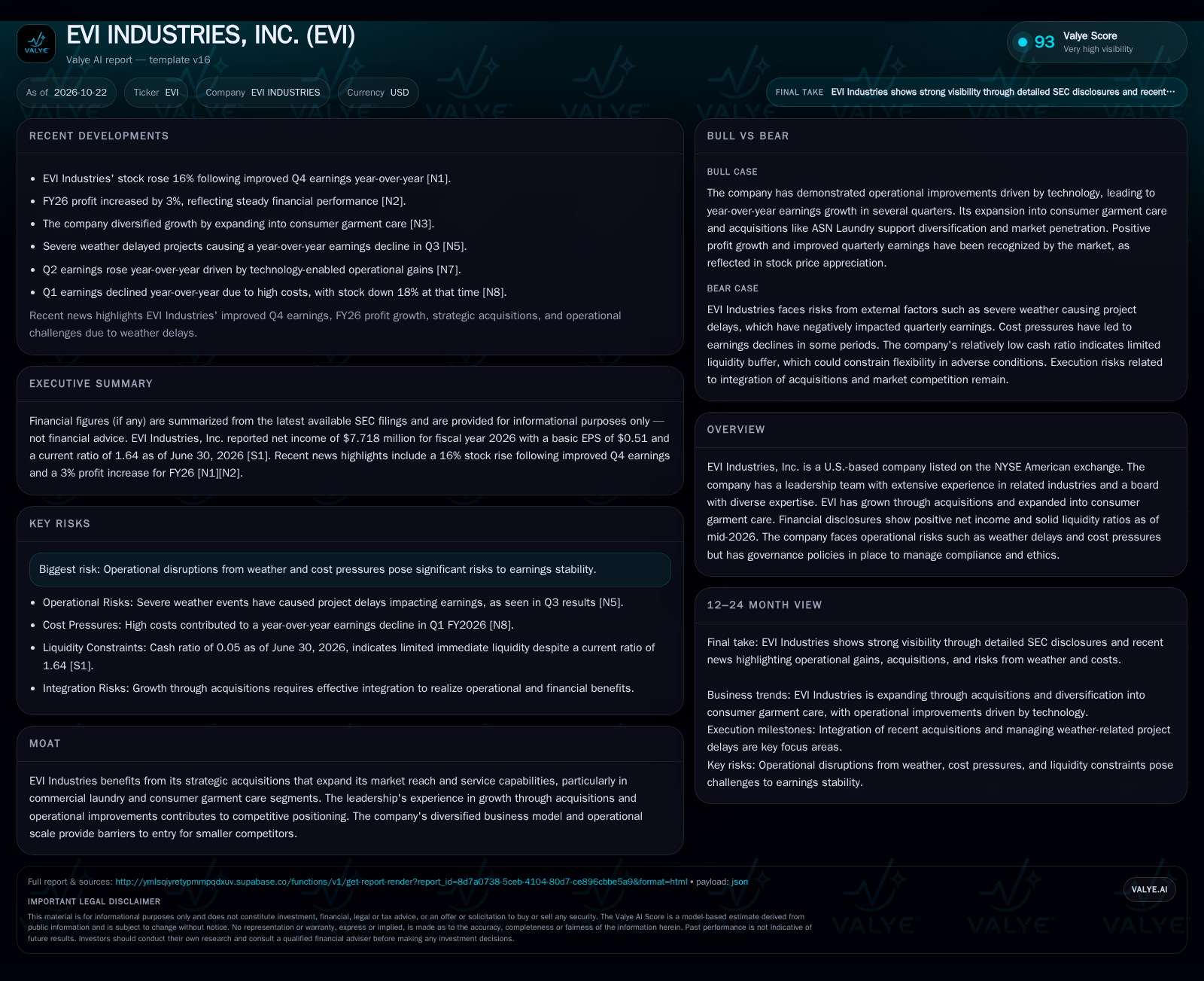
EVI Industries reported net income of $7.718 million for the fiscal year ended June 30, 2026, with a basic EPS of $0.51 and diluted EPS of $0.48 [S1]. The company’s FY26 profit rose by 3% year-over-year, and Q4 earnings improvement drove a 16% stock price increase [N1] [N2]. The company’s Q1 and Q3 earnings, however, were negatively impacted by high costs and weather-driven project delays, respectively [N5] [N8]. EVI’s liquidity position is constrained, with a cash ratio of 0.05 as of June 30, 2026, despite a current ratio of 1.64 [S1]. Recent acquisitions—ASN Laundry and BEL—demonstrate continued expansion of its distribution and service capabilities [S1] [S2]. These facts underscore EVI’s pattern of steady but modest financial improvement, punctuated by operational disruptions and a reported liquidity position buffer.
Beyond headline financials, the interplay between acquisition pace and operational execution critically influences EVI’s short-term performance volatility. Each acquisition introduces integration complexity, which may temporarily elevate costs and strain management bandwidth, especially given the geographic dispersion of assets. Moreover, the timing of acquisitions relative to seasonal demand cycles can amplify earnings variability, as newly acquired businesses may not immediately align with EVI’s centralized planning and procurement strategies. This dynamic underscores the importance of not only the number of acquisitions but also their sequencing and the company’s capacity to absorb and standardize disparate operating models efficiently.
How EVI’s Roll-Up Model Aims to Generate Profitable Scale
EVI Industries’ core business economics center on acquiring and integrating independent distributors of commercial laundry equipment and services, then leveraging scale to improve purchasing power, expand service offerings, and drive operational efficiencies. Revenues are generated from equipment sales, installation, aftermarket parts, and recurring maintenance services. Expansion into consumer garment care introduces potential for higher-margin, service-oriented revenue streams, though the scale and maturity of this segment remain in development [N3].
The company’s cost structure combines meaningful fixed overhead from acquired entities with variable costs tied to equipment procurement, labor, and logistics. Integration of acquisitions typically offers opportunities for SG&A rationalization and supply-chain optimization, but also introduces complexity and upfront costs. Operating leverage is plausible, as incremental revenue from new acquisitions or organic growth could flow disproportionately to the bottom line if integration is successful and cost discipline is maintained.
The potential for operating leverage in EVI’s roll-up model depends heavily on the balance between fixed and variable costs across the combined entity. While fixed overhead can be rationalized through consolidation, a significant portion of costs—such as labor-intensive installation and maintenance services—remain variable and tied to revenue volume and geographic service requirements. Therefore, margin expansion is conditional on achieving scale benefits without proportionally increasing variable costs, which may require process standardization and technology adoption to reduce labor intensity. Additionally, supply chain optimization hinges on negotiating favorable terms with multiple equipment manufacturers, which could be constrained if the acquired entities maintain legacy vendor relationships that resist consolidation.
Defensible Niche or Exposed Aggregator? EVI’s Position in a Fragmented Market
EVI operates in a fragmented market of commercial laundry equipment distribution and service, where local relationships, technical expertise, and after-sales support are key differentiators. The company’s acquisition-driven strategy allows it to aggregate regional players, enhance service breadth, and negotiate better terms with equipment manufacturers. Expansion into consumer garment care may offer access to a larger addressable market and incremental cross-selling opportunities [N3].
However, the roll-up approach faces counterforces: integration risks, cultural clashes, and the potential for operational inefficiency as organizational complexity grows. Larger rivals or vertically integrated manufacturers could exert pricing pressure, while smaller, nimble local competitors may compete aggressively on service and responsiveness. Technology adoption—such as remote diagnostics, workflow automation, and customer portals—could provide a competitive edge if EVI can deploy these tools consistently across its distributed network.
Switching frictions in commercial laundry distribution are moderate: while customers value established relationships and reliable service, contracts are often not long-term, and price sensitivity can be high in certain customer segments. EVI’s ability to create durable customer retention will hinge on its service execution and value-added offerings.
EVI’s competitive positioning is also shaped by the evolving technological landscape in commercial laundry services. The adoption of remote diagnostics and predictive maintenance tools can enhance service efficiency and customer retention but requires significant upfront investment and change management across acquired operations. The heterogeneity of the acquired companies’ technological capabilities and workforce skill sets may slow uniform technology deployment, thereby limiting the pace at which EVI can realize associated cost savings and service enhancements. Furthermore, the degree to which customers value these technological features varies by segment, potentially affecting the return on technology investments and necessitating tailored approaches across different regional markets.
Unlocking Margin Expansion Through Seamless Integration and Technology Adoption
The upside scenario rests on EVI’s ability to consistently integrate acquisitions, realize cost synergies, and embed technology-driven operational improvements. If the company can harmonize processes across acquired entities, reduce redundant SG&A, and centralize procurement, incremental revenue from new acquisitions and organic growth could yield outsized gains in operating margin.
Successful expansion into consumer garment care could provide a higher-growth, higher-margin revenue stream, diversifying the business and reducing cyclicality. Technology-enabled service offerings, such as predictive maintenance or digital customer engagement, could foster stickier customer relationships and incremental recurring revenue.
Evidence confirming this scenario would include sustained sequential improvement in earnings margins, clear disclosure of realized synergy targets, rising contribution from service or recurring revenues (if disclosed), and a reduction in the volatility of quarterly earnings despite external shocks. Additional signs would be improved liquidity metrics and a track record of successful acquisition integration with minimal disruption.
Incremental Growth Amid Persistent Cost and Integration Headwinds
The most plausible trajectory for EVI is continued modest profit growth driven by periodic acquisitions, with operational improvements offset by intermittent cost spikes and project delays. The company is likely to continue expanding its footprint in commercial laundry distribution and selectively in consumer garment care, but integration challenges and external disruptions may periodically compress margins.
Quarterly earnings volatility is expected to persist, reflecting the sensitivity of project-based revenue to weather and macroeconomic conditions, as well as the lag in realizing full synergies from new acquisitions.
Confirmation of this scenario would be a pattern of steady but slow net income growth, periodic one-off charges or margin compression episodes, and a stable but unimproved liquidity position. Disclosures of integration costs, acquisition cadence, and any commentary on cost discipline or working capital management would help test the thesis.
Margin Compression and Liquidity Strain from Cost Surges and Disrupted Integration
The downside risk is that EVI’s acquisitive growth model is undermined by persistent cost pressures, failed integrations, or exogenous shocks (such as severe weather) that disrupt project execution and erode margins. If acquired entities fail to deliver expected synergies, or if integration is slow or ineffective, overhead costs could rise faster than revenue, leading to margin contraction.
Extended periods of negative free cash flow or covenant breaches could further constrain flexibility.
Milestones for Testing EVI’s Integration, Margin, and Liquidity Thesis
Quarterly operating margin trends, particularly after major acquisitions, would help assess whether integration and cost synergies are being realized.
If disclosed, the proportion of revenue derived from service, recurring contracts, or consumer garment care would clarify the shift toward higher-margin, less cyclical business.
Disclosure of integration costs, timelines, and synergy targets for recent acquisitions (ASN Laundry, BEL) would help test execution risk and value capture.
Working capital turns and cash conversion cycle metrics, if disclosed, would provide insight into the company’s ability to manage liquidity and fund growth internally.
Any commentary on the impact of weather or other external disruptions on project pipelines would illuminate the company’s risk management effectiveness.
SG&A as a percentage of revenue post-acquisition would signal whether scale is translating into improved operating leverage.
Disclaimer: This is research-only, informational analysis and not investment advice. It may include AI-generated interpretation and general industry context. Always verify important details using primary sources.

Comments