
Union Pacific: Freight Diversification, Operating Discipline, and the Economics of a Modern Rail Platform
Union Pacific’s Q3 2026 results confirm the strength of its diversified freight model and operational focus, but ongoing capital intensity, labor dynamics, and economic cyclicality remain central to its long-term value equation.
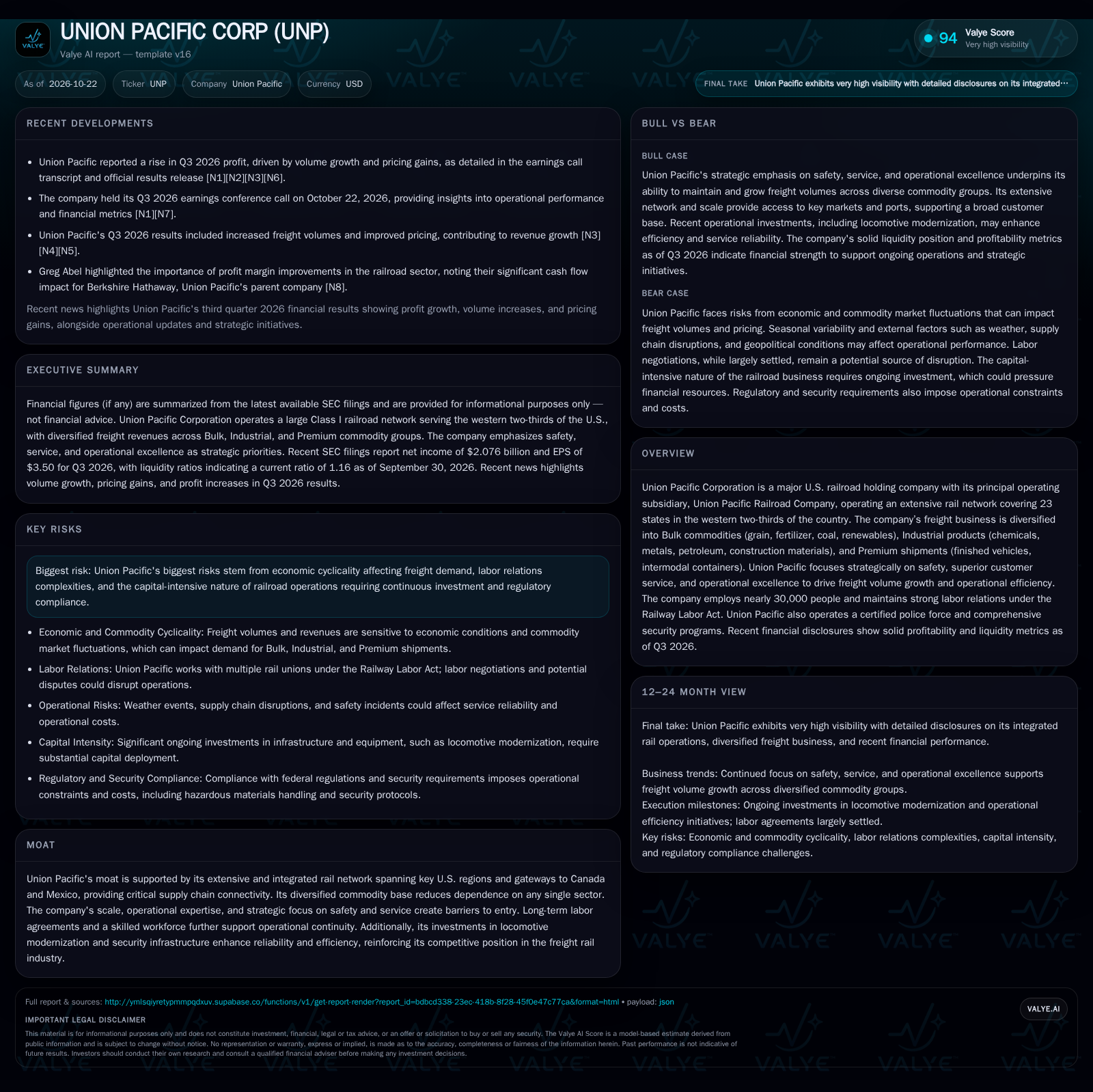
Union Pacific delivered higher profits, volume growth, and pricing gains in Q3 2026, supported by a three-pronged freight mix and ongoing modernization. Its vast, integrated rail network and disciplined operations underpin its competitive position, but the business remains exposed to economic cycles, labor negotiations, and the need for sustained capital investment. The key question is whether operational improvements and network scale can offset industry headwinds and capital demands as the freight landscape evolves. [S2] [N2] [N3]
Union Pacific’s latest results reinforce its position as a cornerstone of North American freight logistics, with Q3 2026 bringing profit, volume, and pricing gains across its diversified commodity groups. The company’s integrated rail network, disciplined operations, and focus on modernization provide clear advantages in an industry defined by high barriers to entry and substantial fixed costs. Yet, the balance between ongoing capital needs, labor dynamics, and exposure to macroeconomic cycles will determine whether Union Pacific’s operational improvements translate into durable shareholder value as the freight market continues to evolve. [S2] [N2] [N3]
Recent Results Highlight Profitability and Volume Momentum
Union Pacific reported net income of $2.076 billion and basic EPS of $3.50 for Q3 2026, reflecting a period of rising profit, freight volume growth, and improved pricing power. The company’s freight revenue mix remains balanced—Bulk (33%), Industrial (37%), and Premium (30%)—helping buffer against volatility in any single sector. Its current ratio stands at 1.16, with $2.211 billion in cash and cash equivalents at quarter-end. These figures underscore Union Pacific’s ability to generate cash and maintain liquidity while investing in operational improvements and network modernization. [S1] [S2] [N2] [N3]
How Union Pacific’s Business Model Converts Scale into Cash Flow
Union Pacific’s core economics are defined by the high fixed-cost, high-operating-leverage nature of railroads. The company’s 32,889-mile rail network enables it to spread infrastructure, equipment, and labor costs across a vast volume of freight, creating powerful scale economies. Revenue is generated through hauling Bulk, Industrial, and Premium products, with pricing often set via contract or tariff and subject to negotiation and competition from other railroads and trucking. While incremental volume tends to carry high margin once fixed costs are covered, railroads face substantial ongoing capital needs—including track maintenance, rolling stock renewal, and technology upgrades such as locomotive modernization. Variable costs include fuel, maintenance, and labor, the latter of which is unionized and subject to collective bargaining. The model’s success hinges on maintaining high asset utilization, minimizing service disruptions, and optimizing the mix of high-margin and high-volume shipments. Pricing power is robust but not absolute—railroads must balance competitive pressures with the need to recover rising costs.
The capital intensity inherent in Union Pacific's business model necessitates a careful balance between maintaining existing infrastructure and pursuing growth initiatives. Given the long asset life cycles and the critical role of safety and regulatory compliance, capital allocation decisions must weigh the timing and scale of investments against expected returns and operational impact. For example, deferring maintenance can lead to service disruptions and higher long-term costs, while aggressive expansion may strain liquidity and elevate financial risk. Furthermore, the interplay between fixed and variable costs means that volume fluctuations have asymmetric effects on profitability; a downturn can disproportionately erode margins due to underutilized assets, whereas volume growth can rapidly improve financial performance once fixed costs are absorbed.
Integrated Network and Service Reliability Anchor Competitive Advantage
Union Pacific’s competitive edge rests on its integrated, contiguous network spanning 23 states and connecting major U.S. markets with Canadian and Mexican gateways. This infrastructure forms a barrier to entry that is virtually insurmountable for new rail entrants, and the network’s density supports efficient routing and service flexibility. The company’s scale also allows it to serve large industrial customers and major ports, particularly in automotive and intermodal segments. However, competition remains intense from other Class I railroads on overlapping corridors, as well as from long-haul trucking—especially for time-sensitive or high-value freight. Technological investments in safety, service reliability, and operational efficiency (such as locomotive upgrades and digital scheduling) are necessary to maintain this advantage, but require sustained capital outlays. Diversification across commodity groups mitigates exposure to individual market swings, but does not fully insulate the business from broad economic downturns or secular shifts in freight demand.
Operational Excellence and Modernization Unlock Margin Expansion
A favorable scenario for Union Pacific would see continued volume growth—especially in Premium and Industrial segments—paired with successful execution on operational efficiency and modernization initiatives. Investments in locomotive upgrades and digital operations could yield lower fuel costs, improved reliability, and higher network throughput, allowing the company to capture additional share from trucking and competitors. If labor stability persists and wage inflation is contained, incremental revenue could flow disproportionately to the bottom line due to high operating leverage. Evidence for this scenario would include sustained growth in revenue-ton-miles, rising operating margins, and improved service metrics (such as dwell time and on-time performance), as well as positive commentary from major industrial and intermodal customers.
Stable Freight Mix and Cost Discipline Sustain Steady Cash Generation
The most likely trajectory is that Union Pacific maintains its diversified freight mix and operational discipline, generating steady cash flows and incremental margin improvement. Volume growth may moderate as macroeconomic conditions normalize, but ongoing investments in safety and reliability should limit service disruptions and support customer retention. Labor costs are likely to rise, but long-term agreements and productivity gains may offset much of the pressure. Confirmation of this scenario would include relatively stable operating ratios, modest volume growth across major commodity groups, and continued progress on modernization projects.
Economic Shock or Labor Disruption Erodes Volume and Margins
Adverse conditions could arise from a macroeconomic downturn, sharp commodity price declines, or significant labor unrest. In such a scenario, freight volumes would contract, particularly in cyclical Bulk or Industrial segments, while fixed costs would limit the company’s ability to flex expenses downward. A major labor dispute could disrupt service and drive up costs, while supply chain shocks (such as weather or regulatory changes) could further impair network efficiency. Evidence of downside risk would include declining revenue-ton-miles, rising operating ratios, missed service targets, and negative developments in labor negotiations or regulatory compliance (such as fines or mandated capital spending increases).
Milestones and Metrics That Will Shape Union Pacific’s Value Proposition
Trends in revenue-ton-miles and carload volume by commodity group, as disclosed quarterly, will indicate whether volume growth is being maintained or eroding.
Operating ratio performance and trends—especially if disclosed separately for core vs. adjusted basis—would help test the effectiveness of cost discipline and operational initiatives.
Service reliability measures such as average train speed, terminal dwell time, and on-time performance, if disclosed, would provide insight into operational excellence and customer retention.
Capital expenditure levels and allocation (maintenance vs. expansion vs. technology) will reveal whether investment is keeping pace with efficiency and compliance needs.
Labor cost growth, union negotiation outcomes, and any signs of workforce disruption or wage pressure should be monitored closely given the high degree of unionization.
Pricing trends and contract renewal rates in the Premium and Intermodal segments would help assess the company’s ability to offset cost inflation and compete with trucking.
Progress on major modernization initiatives, such as locomotive upgrades or digital scheduling platforms, if quantified, would confirm management’s ability to execute on operational excellence.
Regulatory developments affecting safety, emissions, or capital requirements could materially impact operating costs and capital needs.
Disclaimer: This is research-only, informational analysis and not investment advice. It may include AI-generated interpretation and general industry context. Always verify important details using primary sources.

Comments