
SpaceX After Its IPO: Scale Economics, Platform Ambitions, and the Next Competitive Battlegrounds
Fresh from its $85.7 billion Nasdaq IPO, SpaceX enters the public markets with robust profits, deep liquidity, and an evolving business model that spans rockets, global connectivity, and superintelligent software. The company’s challenge now is to translate its capital and technical lead into durable, multi-segment economic moats—while navigating the relentless capital requirements and execution risks that define the aerospace and AI frontier.
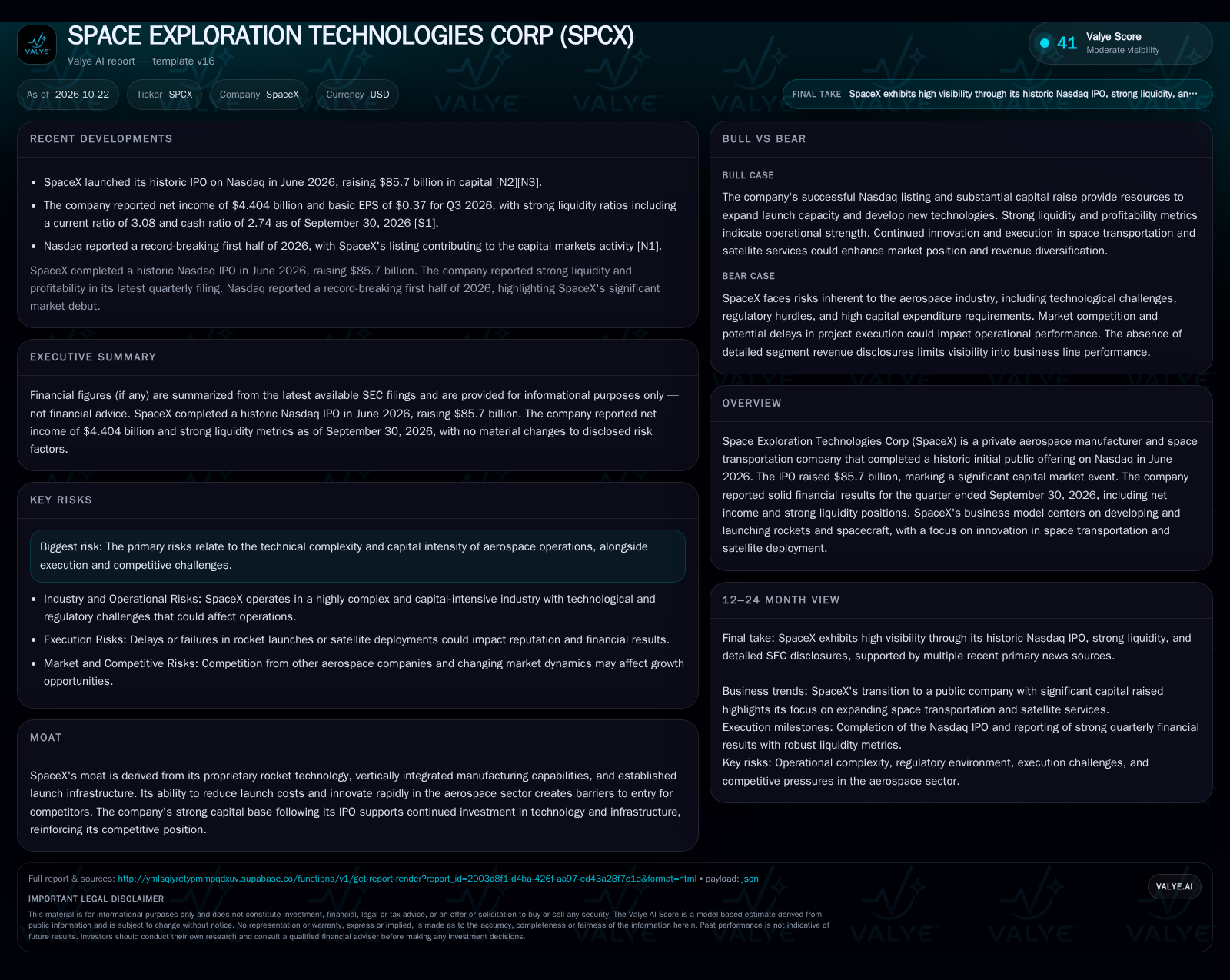
SpaceX’s 2026 IPO supplied significant capital, and the company reported $4.4 billion in quarterly net income with reported liquidity position as of September 30, 2026. The business is now structured into three segments: Space (launch services and manufacturing), Connectivity (Starlink broadband), and Super Intelligence (AI-driven software and infrastructure, bolstered by the Cursor acquisition). While its scale and integration offer potential operating leverage and cross-segment synergies, the company faces high fixed costs, execution risks, and the need to prove commercial sustainability across all segments. Key watchpoints include segment-level profitability, launch cadence, Starlink’s ARPU and churn (if disclosed), and the integration of Cursor into the broader platform.
SpaceX’s public debut in 2026 marks a pivotal moment for the commercial space and technology sectors. With $85.7 billion raised in its IPO and quarterly net income north of $4 billion, the company is now positioned as not just the dominant private launch provider, but a diversified platform spanning rockets, global broadband, and superintelligent software. The challenge for investors and management alike is to convert this scale and capital into lasting economic advantages—while navigating the high fixed costs, intense competition, and execution risks that define both aerospace and the AI frontier.
IPO Windfall, Segment Expansion, and Operational Throughput: The State of SpaceX in Late 2026
The most material recent developments for SpaceX are its historic $85.7 billion Nasdaq IPO in June 2026 and the consolidation of Cursor, an AI infrastructure and software company, into its Super Intelligence (SI) segment following a merger at a $60 billion implied equity value in August 2026 [S1] [N3]. As of September 30, 2026, SpaceX reported net income of $4.404 billion for the quarter, with basic EPS of $0.37 and a cash and short-term investment position exceeding $89 billion [S1]. Operationally, the company executed 33 Falcon launches in Q3 2026 (down from 43 a year prior), and deployed 476 metric tons to orbit, with a mix of customer and internal payloads [S1]. These facts matter because they reflect both the company’s ability to generate substantial operating profits and its ongoing investment in internal infrastructure (notably Starlink and, prospectively, the SI segment). The Cursor acquisition signals a strategic broadening from pure hardware and connectivity into the AI/software platform domain, potentially altering the company’s long-term economics and sources of differentiation.
How SpaceX Makes—and Could Lose—Money: The Interplay of Scale, Segment Mix, and Cost Structure
SpaceX’s business model is now a hybrid of capital-intensive hardware (launch vehicles, satellites), recurring service revenue (Starlink broadband), and emerging software/platform economics (Super Intelligence). The Space segment’s economics are driven by launch cadence, payload mix (customer vs. internal), and the ability to amortize fixed R&D and manufacturing costs over a high launch volume. Historically, launch margins have been thin industry-wide, with profitability hinging on reusability and vertical integration. SpaceX’s high throughput and internal consumption of launch capacity for Starlink and SI deployments may allow it to operate at higher utilization than most competitors, but this also means that a significant portion of launch activity does not convert directly into external revenue.
Starlink, the Connectivity segment, introduces a different economic profile: high up-front capex for constellation buildout, but the possibility of recurring subscription revenue from a global user base. ARPU, churn, and network operating costs will determine whether Starlink’s economics converge toward those of a telecom utility or can sustain premium margins. The SI segment, with the Cursor acquisition, brings software economics—potentially high gross margins and rapid scaling if adoption is strong, but also substantial ongoing investment in compute infrastructure and talent. The key test for SpaceX will be its ability to drive operating leverage across these segments and to balance the capital needs of ongoing constellation and infrastructure expansion with the cash flow generated by mature business lines.
Defensible Moats—or Just a Head Start? Competitive Dynamics Across Launch, Connectivity, and AI
SpaceX’s competitive position in orbital launches is anchored by scale, reusability, and vertical integration. Its ability to launch at high cadence and cost per kilogram below most rivals has historically deterred new entrants and forced incumbents to accelerate their own innovation. However, the launch market remains susceptible to price competition, government procurement shifts, and the risk of technological leapfrogging (such as rapid advances in reusable or alternative propulsion technologies).
In satellite broadband, Starlink’s early deployment advantage is significant, but the sector is attracting deep-pocketed rivals (both sovereign and corporate). Long-term differentiation will depend on service reliability, global regulatory navigation, and the ability to continuously refresh the constellation at scale. The newly constituted SI segment faces a much more crowded field: hyperscalers, specialized AI infrastructure firms, and open-source communities all vie for dominance. SpaceX’s advantage here may lie in deeply integrated hardware-software stacks and the ability to cross-leverage its in-house launch and network capabilities, but commercial traction and ecosystem adoption remain open questions.
If Platform Ambitions Succeed: Synergies, Margin Expansion, and Ecosystem Lock-In
The bullish scenario for SpaceX is one in which its cross-segment integration pays off: the company leverages its launch infrastructure and satellite network to create a self-reinforcing ecosystem, where internal demand (Starlink and SI) maximizes utilization, and external customers are attracted by superior cost and reliability. If Starlink achieves telecom-like scale with healthy ARPU and low churn, it could become a cash-generating engine to fund ongoing capex and support riskier bets in AI/software.
The Cursor acquisition and the SI segment could, in this scenario, deliver high-margin software and platform revenue, especially if SpaceX can differentiate its offerings through proprietary data, close integration with Starlink, or unique compute capabilities. Confirmation would come from disclosure of rapid SI segment revenue growth, strong cross-selling between segments, and evidence of durable customer lock-in (such as long-term contracts or consistently rising renewal rates, if disclosed). Falsification would be indicated by flat or declining segment profitability, lack of user traction in software, or evidence that internal launches are crowding out profitable external business.
Sustaining Scale, Managing Complexity: The Most Likely Trajectory
The most plausible medium-term outcome is that SpaceX continues to dominate orbital launches and maintains Starlink’s global presence, but faces intensifying competition and the challenge of managing a sprawling, capital-hungry conglomerate. The company will likely need to balance reinvestment in its core infrastructure with the demands of scaling new segments, particularly as launch throughput and internal deployments fluctuate.
In this scenario, profitability remains solid but margin expansion is gradual, with the majority of cash flow plowed back into launch vehicle upgrades, constellation refreshes, and ongoing SI platform development. Confirmation would come from stable or improving consolidated margins, sustained launch cadence, and incremental SI segment revenue. Falsification would be seen in rising capex outpacing cash generation, operational bottlenecks, or persistent underperformance in any one segment.
When Scale Isn’t Enough: Execution Risk, Capital Drain, and Market Disruption
The adverse scenario plays out if SpaceX’s capital intensity and execution challenges overwhelm its operating leverage. Potential triggers include major launch failures or Starlink outages, regulatory setbacks in key markets, or rapid competitive advances (especially from state-backed or hyperscale players in both launch and AI). If internal launch demand crowds out higher-margin customer business, or if Starlink and SI fail to scale profitably, the company could see margin compression and a deteriorating return on invested capital.
Confirmation of this scenario would be visible in declining launch or Starlink ARPU, rising operating losses within segments, or sustained negative free cash flow despite headline profitability. Early warning signs would include slower launch cadence, customer defections, or evidence of integration challenges with Cursor.
Milestones and Metrics That Will Define SpaceX’s Multi-Segment Thesis
Segment-level revenue and profitability disclosure (if provided) to assess the economic health of Space, Connectivity, and SI individually.
Quarterly launch cadence and mass-to-orbit trends, particularly the mix of internal versus customer launches.
Starlink subscriber growth, ARPU, and churn rates (if disclosed), to gauge the sustainability of the Connectivity business.
Gross margin progression and capital expenditure trends across segments, as indicators of operating leverage and capital discipline.
Integration milestones and revenue contribution from Cursor/SI segment, especially customer wins and ecosystem adoption.
Free cash flow generation versus cash burn, given ongoing constellation and infrastructure investments.
External regulatory developments—spectrum allocation, launch licensing, or geopolitical constraints—that could impact growth or cost structure.
Any evidence of cross-segment synergies, such as bundled offerings or internal cost savings, to validate the platform thesis.
Disclaimer: This is research-only, informational analysis and not investment advice. It may include AI-generated interpretation and general industry context. Always verify important details using primary sources.

Comments